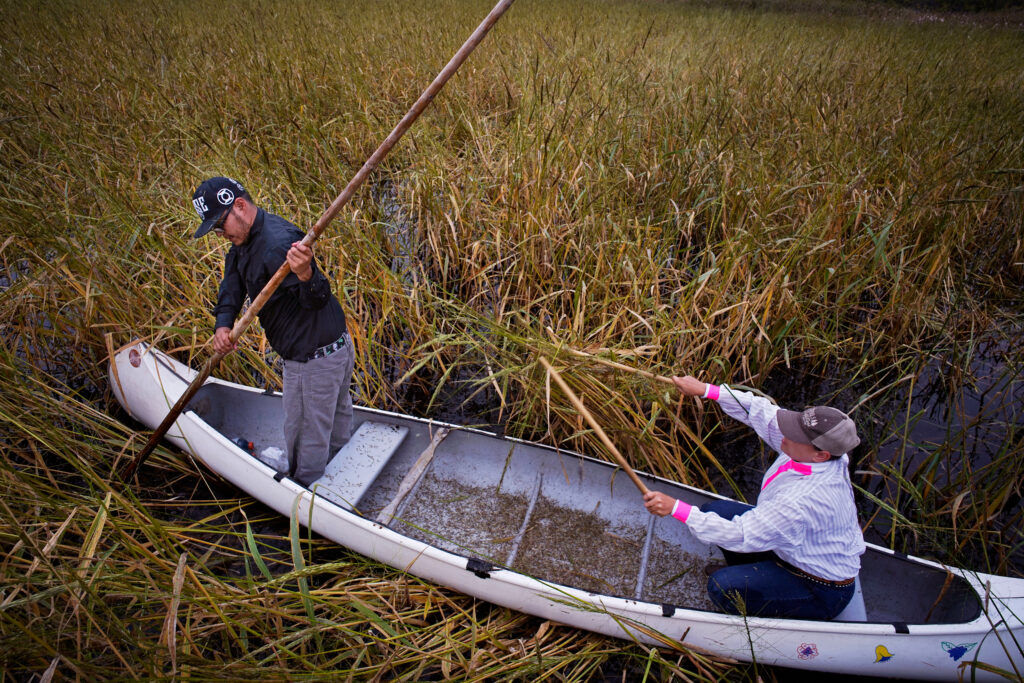
Bazile Minogiizhigaabo Panek, a member of the Red Cliff Band of Lake Superior Chippewa, was 7 years old when he attended his first rice harvest in northern Wisconsin. He and his sister rode in a canoe while his mom pushed the boat with a pole through the plants growing out of the shallow water. Together, they tapped the plants with sticks. Rice seeds rained into the canoe; others fell into the water.
Indigenous peoples have harvested wild rice, or manoomin, in the upper Midwest for millennia. They care for the plant, which they consider a relative and critical to their cultural identity. They watch it grow through the summer and spread its seeds as they reap them.
“There’s just this moment of excitement and the acknowledgement that we are doing something that my ancestors have done for thousands of years, or doing a similar process that works to honor them,” says Panek, founder of Good Sky Guidance, a company that advises public institutions and corporations on Indigenous knowledge and environmental initiatives.
But the manoomin that once abounded in the region—memorialized in names like Wild Rice Lake—has been declining due to factors like changing land use and global warming. Finding all the water bodies that support these plants and exactly where they grow can be time-consuming and expensive. Restoring them can take years, and the Trump administration pulled funding for some restoration projects.
Yet the plant and the people who nurture it are resilient, and some recent efforts to identify, protect and restore northern wild rice have shown success.
Researchers recently found that drone technology can
detect where the species grows, which could be helpful for restoration projects. Separate research published last year, co-authored by Panek, determined that cutting back vegetation that outcompetes manoomin—along with other measures such as lowering water levels during certain growing periods—could help slow the plant’s decline. And tribes, universities and nonprofits are working together to restore it in the region.
“We envision that we would continue to locate habitats that traditionally and historically sustain rice and that can again, and then take and equip community members with the skills and equipment needed to harvest and process that rice,” said Jessie Conaway, an Indigenous arts and sciences research coordinator at the University of Wisconsin-Madison who works on a wild rice restoration effort in Wisconsin’s Lake Winnebago. “This leads to food sovereignty, cultural revitalization, nutrition, the building blocks of communities.”
An Important Plant Under Stress
The Indigenous peoples who long depended on manoomin knew that if they cared for the plant, it would care for them. Yet Western practices altered the landscape and the plant itself.
Federal and local government agencies dammed rivers, using them to control water levels and float logs harvested from the northern forests. As traditional wild rice habitats flooded, they became increasingly inhospitable for the plant. Pollution from mining and farming has added to the struggle. And today, wake from motorboats can rip the plant from a lake bottom by its roots during a particularly vulnerable stage of growth.
In the early 1900s, the U.S. Department of Agriculture began to research manoomin. The University of Minnesota took the helm in the 1950s and continues to do so today, exploring ways to genetically modify the plant so it’s less fragile—“shatter-resistant” or “shatter-proof”—and people can harvest more grain with machinery.
That effort runs counter to some Indigenous ideas on interacting with manoomin, said Taylor Fairbanks, a member of the White Earth Nation located in northwestern Minnesota. A 2026 University of Minnesota graduate, she investigated the history of water, manoomin and the Ojibwe people within the Great Lakes region for her senior thesis.
“When it comes to that genetic modification, there’s not a sense of connection that is being built among people,” she said. “Manoomin has been able to steward itself, and we have been able to do that in return. When we create manoomin to become shatter-proof, then it’s not actually manoomin, it’s actually patty rice, the kind of wild rice that you see in grocery stores, because it’s being industrialized.”
In 2018, the White Earth Band of Ojibwe
enacted an ordinance recognizing manoomin’s “inherent rights to exist, flourish, regenerate, and evolve, as well as inherent rights to restoration, recovery, and preservation,” part of the growing rights of nature movement. A lawsuit later brought on behalf of manoomin against the Minnesota Department of Natural Resources aimed to prevent construction of a pipeline plaintiffs said would violate manoomin’s legal rights, but an appeals court ruled in 2022 that the tribal court did not have jurisdiction.
A warming climate brings further threats to manoomin. A study
published last year in the journal Communications Earth & Environment drew on decades of research by tribal nations on manoomin and compared them to the climate record. The researchers concluded that warmer winters, which reduce ice coverage on waterways and wetter summers, which raise water levels, could continue to stress the plant.
“It’s one of many factors put in conversation with the history of land-use change across the region,” said lead author Madeline Nyblade, now the faculty co-director of the State University of New York’s Center for Native Peoples and the Environment. “Some land-use problems are more manageable than climate change seems.”
Protecting Manoomin
The question of how to best keep manoomin thriving across the landscape now centers on how to protect wetlands and shallow lakes from mining, other forms of contamination and dams that affect water levels.
“There’s a ton of restoration going on across the region, led by tribes, nonprofits, intertribal organizations, government, state governments,” Nyblade said, “and that is what gives me hope.”
One of those projects is the Intertribal Winnebago Wild Rice Revitalization Project. In 2019, an Intertribal group partnered with the University of Wisconsin-Madison to start a manoomin restoration project in Lake Winnebago.
This story is funded by readers like you.
Our nonprofit newsroom provides award-winning climate coverage free of charge and advertising. We rely on donations from readers like you to keep going. Please donate now to support our work.
Donate Now
They mapped areas named for manoomin in multiple Indigenous languages. For the first three years of the project, they worked with the Wisconsin Department of Natural Resources to find seven areas where wild rice persisted and studied the ecology, water conditions and sediment. They worked with researchers at the university to test the water chemistry and water flow.
“We’re now using that as a baseline measurement of what manoomin habitat in this watershed might look like,” said Alex Mixtli, environmental specialist for the Brothertown Indian Nation, which co-leads the project. “We’re using that to compare to other sites.”
The Trump administration, which has cut off
grants for many environmental-justice efforts, pulled funding for the project last year. The blow will have long-term impacts, said Conaway, but project organizers continue to fundraise while shifting their efforts. They plan to reseed another area and will continue to monitor the places they previously studied.
“Rice has huge ecological benefits for the lake, the wetland and lake ecosystems,” said Conaway, who co-leads the project. “That’s been a very cool aspect: to translate that Indigenous and mainstream science knowledge into educating the public about the places that you love and that rice is supporting.”
Further north, resource managers are feeling good about the progress of restoration. Near Duluth, Minnesota, the 1854 Treaty Authority, an inter-tribal organization that protects off-reservation treaty rights, has worked alongside collaborators to restore manoomin since 2015.
“We’ve had some core restoration areas where we’re really focused on and we’re seeing a lot of success there now,” says Darren Vogt, resource management division director for the 1854 Treaty Authority. “The goal is to have them self-sustaining. We’re getting there or close, and we can start to look at some other areas.”
Manoomin is an annual plant with rich genetic diversity, and it doesn’t germinate every year. The more restoration projects there are, the greater the plant’s potential to adapt as climate change and other threats alter its growing conditions.
“There’s so many different ways that nations and their collaborators are working to protect wild rice and experimenting,” Nyblade said. “There’s a wide network of people who are learning from all of these knowledges and tools.”
The 1854 Treaty Authority is now part of a larger wild rice group that includes nonprofits, government agencies and other tribes. Representatives meet a few times a year to discuss their efforts. Three years ago, the treaty authority started wild rice camps to show people how to harvest and process manoomin, which are very popular with schools and the public. The group is trying to figure out how to meet demand.
“The knowledge you gain by harvesting each year is immense versus sitting in a lab in a university. It’s a different way of knowing, and you have that connection to the resource,” Vogt said. “There’s a lot of interest in manoomin, which is just—it’s cool to see.”
About This Story
Perhaps you noticed: This story, like all the news we publish, is free to read. That’s because Inside Climate News is a 501c3 nonprofit organization. We do not charge a subscription fee, lock our news behind a paywall, or clutter our website with ads. We make our news on climate and the environment freely available to you and anyone who wants it.
That’s not all. We also share our news for free with scores of other media organizations around the country. Many of them can’t afford to do environmental journalism of their own. We’ve built bureaus from coast to coast to report local stories, collaborate with local newsrooms and co-publish articles so that this vital work is shared as widely as possible.
Two of us launched ICN in 2007. Six years later we earned a Pulitzer Prize for National Reporting, and now we run the oldest and largest dedicated climate newsroom in the nation. We tell the story in all its complexity. We hold polluters accountable. We expose environmental injustice. We debunk misinformation. We scrutinize solutions and inspire action.
Donations from readers like you fund every aspect of what we do. If you don’t already, will you support our ongoing work, our reporting on the biggest crisis facing our planet, and help us reach even more readers in more places?
Please take a moment to make a tax-deductible donation. Every one of them makes a difference.
Thank you,
<small>Source: Inside Climate News</small>