BROOKHAVEN, N.Y.—The crowd grew restless at Brookhaven Town Hall on Long Island as residents voiced their concerns about groundwater contamination from a nearby landfill that has spread beneath parts of their community.
At the meeting in late March, speakers criticizing the landfill’s operations were met with applause and shouts of support from the audience.
Monique Fitzgerald and the organization she co-founded, the Brookhaven Landfill Action and Remediation Group, have urged the town to close the landfill. Fitzgerald, a lifelong resident of North Bellport, a hamlet within Brookhaven, and other residents have
been concerned about the contamination for decades.
“I am disappointed,” Fitzgerald told town officials. “You just wasted our time with this presentation.”
The contamination plume extends roughly 8,000 feet southeast from the landfill, according to the Town of Brookhaven, which owns the structure. Though it has not reached any drinking water sources, it has spread to the groundwater beneath homes and roadways, and a portion of it discharges into the Beaver Dam Creek,
according to a report the town submitted to state regulators.
Town officials and contracted engineers evaluated several potential responses, including immediately closing the landfill or pumping out contaminated groundwater for treatment.
Instead, officials recommended what they described as the most practical and cost-effective measures: expanded monitoring of the contamination and connecting some homes with private drinking wells to the municipal water supply.
The Town of Brookhaven did not respond to multiple requests for comment for this story.
North Bellport and Brookhaven have been designated as disadvantaged communities by the state. The classification recognizes heightened vulnerability to environmental hazards due to demographic, health and socioeconomic factors.
Lynne Maher, a Brookhaven resident who says she lives near the contaminated groundwater, felt the town was toying with people’s lives.
“The town cannot be trusted,” she said, accusing town officials of using “scare tactics.”
“Anything … Could Be in There”
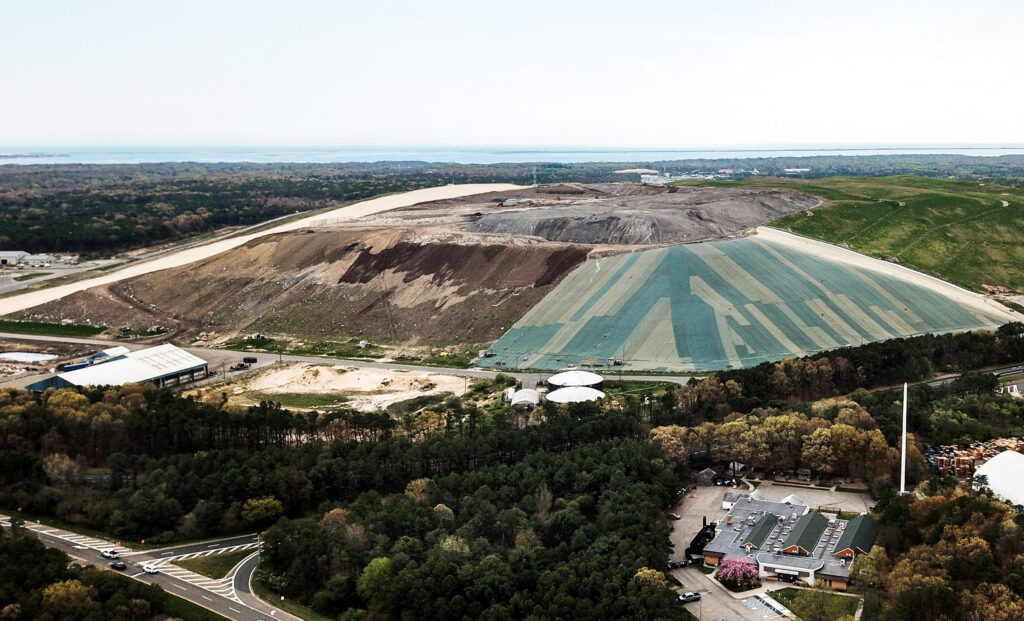
The 270-foot-tall Brookhaven landfill, which opened more than 50 years ago, towers over nearby communities. It has six so-called “cells,” which are operational units that divide large landfills. Currently, only one “cell” is still accepting waste—mostly waste incineration ash. The first three cells, which were all closed before 1995, accepted solid waste.
When a landfill is operational, moisture and rainwater can soak the waste, creating contaminated runoff. Today, the liquid is collected and pumped out of the landfill using a dedicated collection system and storage tanks. But the landfill’s earliest cell was built before the current regulations were in place.
Due to inadequate liners in earlier cells, the mixture, also called leachate, has leaked into the groundwater in the surrounding area. The spread of the contamination is commonly known as a “plume.”
As
confirmed by state regulators, the groundwater contains levels of per- and polyfluoroalkyl substances, known as PFAS or “forever chemicals,” above New York’s standards for groundwater.
PFAS chemicals are found in consumer and industrial products—and they’re very difficult to break down. Scientists have detected them in soil, water, fish and even human blood, though their effect on human and animal health are still being studied.
According to the EPA, exposure to these chemicals can adversely affect reproductive health, child development and increase the risk of certain cancers.
Though the town’s report asserts that the historical use of PFAS in consumer products makes it difficult to attribute the contamination to the landfill, state regulators have
urged the town to acknowledge that the landfill is “the only conclusively identified source of emerging contaminants” for the area beneath it, in their comments on the original report.
Regulators also confirmed elevated levels of 1,4-dioxane, an industrial solvent. According to the Environmental Protection Agency, the chemical “
poses an unreasonable risk to human health,” and has been linked to higher cancer risks when present in drinking water.
“We’re talking about landfill leachate that can contain many hundreds of different man-made chemicals,” said Jennifer Epstein, a freshwater ecologist who is now the director of science at New York River Watch, a group advocating for better water quality.
“Anything really that’s been used in commerce and has gone into some type of consumer good … could be in there,” she said.
U.S. Geological Survey scientists first detected groundwater contamination at the Brookhaven landfill
in 1983.
In 2022, sampling required by new landfill regulations again confirmed the presence of the plume. The state Department of Environmental Conservation
ordered the Town of Brookhaven to investigate the plume and develop “corrective measures” to remediate or limit the damage caused by the existing plume, which are now being reviewed.
The Leachate Problem
Though landfill leachate can enter the soil and groundwater through inadequate landfill liners, there are other ways the chemicals it contains can end up in local water bodies.
When landfill leachate is collected in the typical fashion, through pipes that transport it to holding tanks, it is often
taken to a wastewater treatment plant.
While wastewater treatment plants are designed to clean contaminants typically found in households and businesses, they often cannot break down and remove the complex chemicals present in landfill leachate.
The federal Safe Drinking Water Act usually develops regulations for one chemical at a time, making it difficult to fully protect people from leachate, which often contains a range of contaminants, said Epstein.
EPA documents acknowledge that typical drinking water treatment systems do not remove 1,4-dioxane. The Suffolk County Water Authority, which serves Brookhaven, removes the solvent to state standards using a method called the Advanced Oxidation Process, but it can be very costly.
In 2017, the water authority
filed a lawsuit against chemical companies, alleging that they manufactured and sold 1,4-dioxane knowing it would pollute groundwater when used as intended. Last year, a judge ruled that it could move forward to trial.
Scientists are still figuring out how to test and remove PFAS, which encompasses thousands of different chemicals.
When a wastewater treatment plant sufficiently cleans a liquid, the treated water is released back into local waterbodies to re-enter the water cycle. Currently, the plants
don’t have limits on how much PFAS they can discharge into those water bodies.
Drinking water sources in New York are still treated for two types of PFAS, and will have to reduce the levels of four more by 2029,
according to current EPA regulations. According to the state’s Health Department, regulators ultimately want to develop treatment standards for 23 common PFAS chemicals.
This story is funded by readers like you.
Our nonprofit newsroom provides award-winning climate coverage free of charge and advertising. We rely on donations from readers like you to keep going. Please donate now to support our work.
Donate Now
When these chemicals do end up in local water bodies, the source is not always landfill leachate because PFAS are present in many manufacturing processes. But, Epstein said, regulators know that these contaminants are present in leachate, so “to allow it to then be dispersed back into the environment is a really illogical practice.”
“If you know that you have problems with the amount of contamination in your water, it makes a lot of sense to turn off the spigots that you can—that you know are a source,” she said.
Epstein and her organization have been advocating for on-site treatment of landfill leachate. Since 2023, state regulators have been
considering regulatory changes to landfill leachate management to reduce this downstream contamination. They aim to submit a proposal to the public this summer.
Concerns in North Bellport and Brookhaven
Residents near the Brookhaven landfill are no strangers to the burden of pollution—not just in the local groundwater, but also in the air.
Landfills release methane into the surrounding atmosphere. Methane is a potent greenhouse gas that contributes strongly to short-term global warming. Elevated levels of it in the air can also lead to ground-level ozone, a harmful pollutant
associated with more local asthma hospitalizations.
Landfills may release
more methane than state data reveals. Katherine Blauvelt, executive director of Full Circle Future, a nonprofit that tracks landfill emission regulation, said that the state’s reporting methodology was “flawed.” The state, she said, doesn’t use modern technology like drones or satellite imagery to track methane.
“They’re still walking around with handheld devices only four times a year, and then again they’re reporting their estimated emissions based on a formula, not based on reality,” said Blauvelt, a former assistant commissioner for energy resources in Minnesota.
This past January, the state’s Department of Environmental Conservation
released new regulations for measuring and reporting greenhouse gas emissions from landfills. Starting in 2029, many large landfill emitters will be required to directly monitor methane using advanced detection technologies, while most landfills will need to begin reporting emissions data starting in June 2027.
Blauvelt and her organization hope the regulations will provide residents who live near landfills with the information needed to link landfills to local health disparities.
“They can tell that something is happening in their communities, but they don’t actually have the data or the monitoring or the tracking to really understand what’s happening to people they love, to themselves, to their communities,” she said.
The Town of Brookhaven has
requested an extension for its operating permit, which expires in July. The landfill is expected to reach capacity in the second half of 2028, though operators told Newsday it could remain open longer.
Fitzgerald wants to see a plan for the landfill’s eventual closure—one that includes a real effort to reduce waste.
“We stand in solidarity with communities across the country and the globe where our waste is ending up,” she said.
About This Story
Perhaps you noticed: This story, like all the news we publish, is free to read. That’s because Inside Climate News is a 501c3 nonprofit organization. We do not charge a subscription fee, lock our news behind a paywall, or clutter our website with ads. We make our news on climate and the environment freely available to you and anyone who wants it.
That’s not all. We also share our news for free with scores of other media organizations around the country. Many of them can’t afford to do environmental journalism of their own. We’ve built bureaus from coast to coast to report local stories, collaborate with local newsrooms and co-publish articles so that this vital work is shared as widely as possible.
Two of us launched ICN in 2007. Six years later we earned a Pulitzer Prize for National Reporting, and now we run the oldest and largest dedicated climate newsroom in the nation. We tell the story in all its complexity. We hold polluters accountable. We expose environmental injustice. We debunk misinformation. We scrutinize solutions and inspire action.
Donations from readers like you fund every aspect of what we do. If you don’t already, will you support our ongoing work, our reporting on the biggest crisis facing our planet, and help us reach even more readers in more places?
Please take a moment to make a tax-deductible donation. Every one of them makes a difference.
Thank you,
<small>Source: Inside Climate News</small>