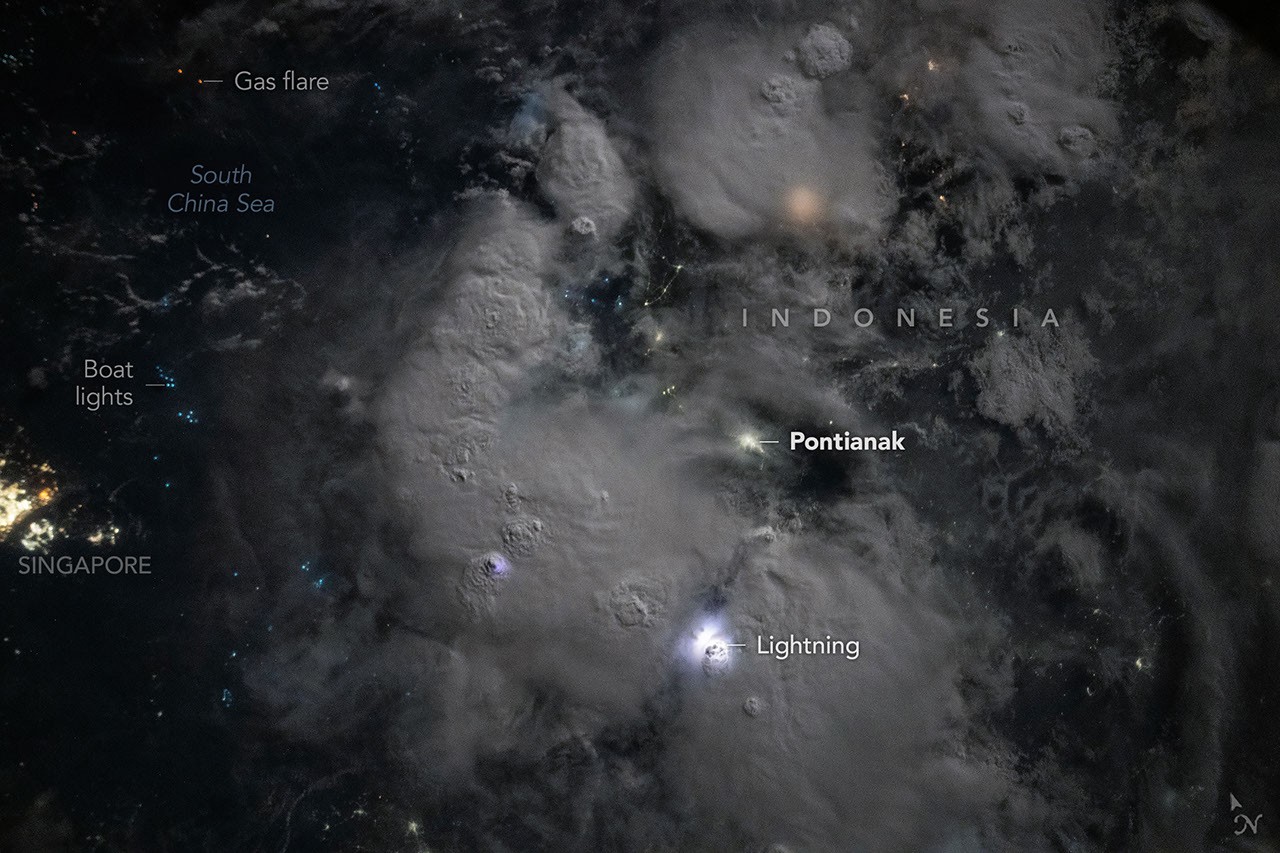
On October 28, 2026, astronauts aboard the International Space Station photographed a dazzling nighttime scene as the station passed over the South China Sea near Borneo at 14:20 UTC (9:20 p.m. Western Indonesian Time). The image, taken with a Nikon Z9 camera, captures the glow of Singapore’s city lights, clusters of fishing‑boat lanterns, offshore gas flares and vivid lightning bolts that “look like a transcontinental brigade tossing fireworks from cloud to cloud.”
The photograph (ISS075‑E‑250951) shows Singapore’s illuminated urban area on the left, with the curving Singapore Strait separating the city‑state from the Indonesian islands of Batam and Bintan. A bright blue cluster west of Singapore, likened to the Pleiades, marks a fleet of fishing vessels using lights to attract squid and schooling fish. Scattered orange points farther northwest are identified as gas flares, while several “overshooting tops” – domelike protrusions rising above thunderstorm anvils – are illuminated by lightning flashes, indicating strong updrafts that can reach the stratosphere.
“Cities and civilization look like tendrils outlined with the glimmer of a Broadway marquee,” NASA astronaut Donald Pettit wrote in Air & Space magazine, describing the view of Earth’s night lights from orbit.
“On Earth, people see lightning from below the clouds. In orbit, we see it from above… it looks like a transcontinental brigade is tossing fireworks from cloud to cloud,” former astronaut Sally Ride observed in the same publication.
“Like fireflies in the night, lightning is my favorite sight from space,” astronaut Anil Menon said in a video posted to X, noting that the rapid pinpoints of lightning flicker almost constantly along Earth’s darkened limb.
- NASA scientists estimate that roughly 2,000 thunderstorms are active on Earth at any given moment.
- These storms generate about 60 lightning flashes per second, or roughly 5 million flashes each day.
The image was captured by a member of Expedition 75 and processed by the ISS Crew Earth Observations Facility and the Earth Science and Remote Sensing Unit at NASA’s Johnson Space Center. After cropping, contrast enhancement and removal of lens artifacts, the photograph was released to the public through the ISS National Lab and is available via NASA’s Gateway to Astronaut Photography of Earth.
<small>Source: NASA — read the original story there.</small>