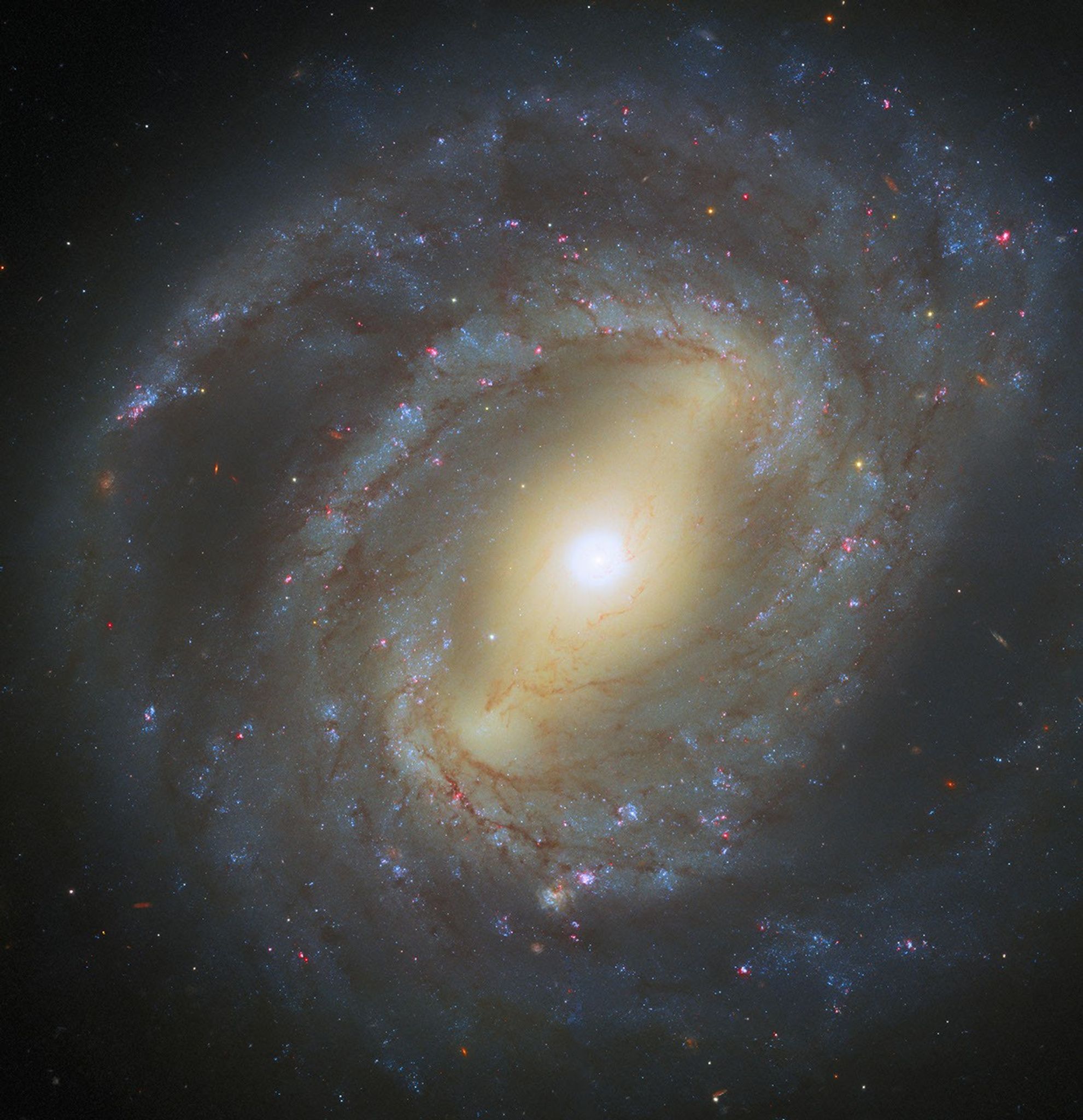
NASA’s Hubble Space Telescope has released a new, high-resolution image of the galaxy NGC 4394, offering a striking view of a celestial body that closely resembles our own Milky Way. Located in the constellation Coma Berenices and situated approximately 55 million light-years from Earth, NGC 4394 is a member of the Virgo Cluster, the nearest major galaxy cluster to the Milky Way. The image highlights the galaxy’s distinct central bar of stars and graceful spiral arms, features that astronomers believe would be visible if the Milky Way were viewed from a similar face-on perspective.
Galactic bars are a common feature in the universe, with astronomers estimating that 65 percent of nearby spiral galaxies possess one. While Hubble has previously captured images of other barred spirals such as NGC 5728, NGC 685, and NGC 613, the formation of these straight streaks of stars remains an area of active study. Current theories suggest that galactic bars form when a galaxy’s stellar disk becomes unstable due to gravitational interactions with passing galaxies or internal forces, causing the circular orbits of stars to elongate into a bar shape.
Observations indicate that while galactic bars are prevalent in the current universe, they were less common several billion years ago. Research suggests this trend may be temporary, as massive bars can eventually become unstable themselves. Beyond its structural similarities to the Milky Way, NGC 4394 may also share a specific nuclear characteristic: a Low-Ionization Nuclear Emission-Line Region, or LINER. This area near the galaxy’s center exhibits specific spectral signatures, likely driven by either a supermassive black hole or intense star formation, though the exact mechanism of LINER formation is not yet fully understood.
The new image incorporates data from a recent Hubble observing program led by Dr. David Thilker, designated as program #18103. This initiative aims to understand how star formation concludes in galaxies located within dense cluster environments, comparing these processes to those in more isolated galaxies. Using Hubble’s Wide Field Camera 3, researchers analyzed the ages of individual star clusters across 40 galaxies, including NGC 4394, to gain insights into stellar evolution in crowded cosmic settings.
Hubble has previously observed NGC 4394, with an earlier image released a decade ago as part of a different program focused on the neighboring galaxy Messier 85. During that earlier observation, Hubble’s Advanced Camera for Surveys captured NGC 4394 while another instrument studied Messier 85’s star clusters. The latest release underscores the telescope’s continued role in mapping the detailed structures of nearby galaxies and refining our understanding of galactic evolution.
<small>Source: NASA — read the original story there.</small>


