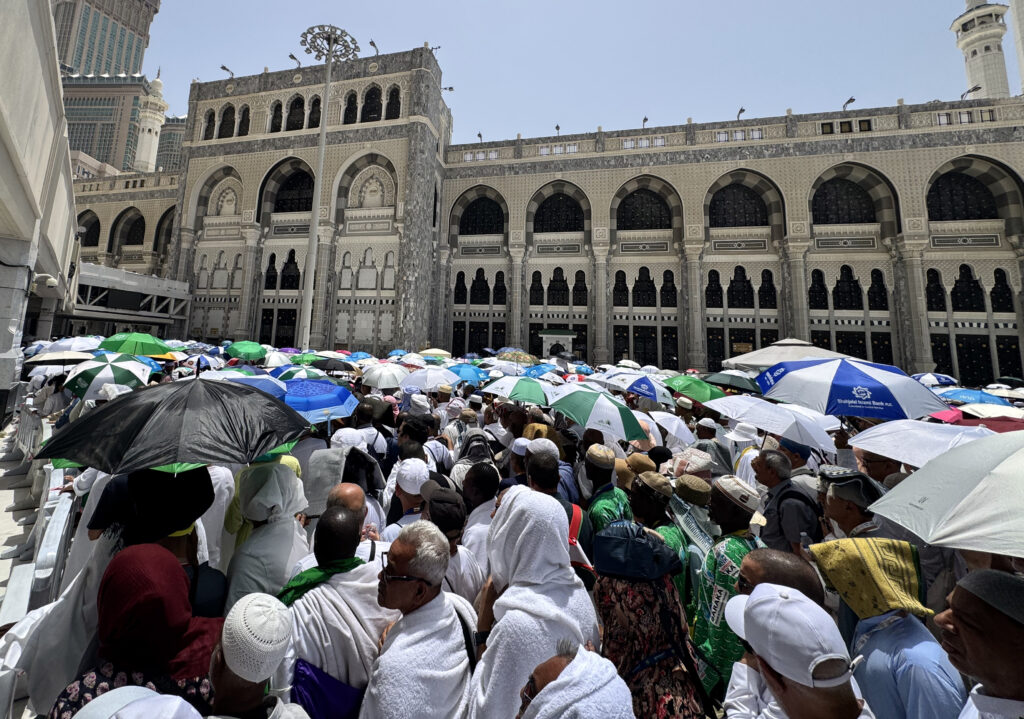
More than 1.7 million people participated last week in the annual Islamic pilgrimage to Mecca in Saudi Arabia—consistently one of the world’s largest mass gatherings.
Muslims are expected to perform Hajj at least once in their lives, but an increasingly perilous threat looms over the holy journey: heat.
When the Hajj took place in mid-June during 2024, more than 1,300 people died, many succumbing to heat-related illnesses as
temperatures topped 125 degrees Fahrenheit and humidity hit unusually high levels. The pilgrimage’s timing changes each year based on the Islamic lunar calendar, so this year—and the next roughly two decades—fall in cooler seasons, a slight relief for pilgrims and officials helping manage the pilgrimage.
However, a
new analysis suggests that the window for heat-safe Hajj pilgrimages is dwindling as climate change ratchets up the temperature during historically cooler months. Research shows that the region’s growing suite of heat-mitigation strategies for the pilgrimage significantly reduces health issues. But experts say worsening heat may outpace these efforts and the key to tackling this issue is addressing the source of the problem—carbon emissions.
A Sizzling Holy Journey
One of the five pillars of Islam, the Hajj is considered a mandatory religious duty for Muslims who are physically and financially able to complete it. The five- to six-day pilgrimage can cover dozens of miles through parts of the Saudi Arabian desert region, with visits to holy sites along the way.
The majority of participants are traveling to the country from other parts of the world, and many are older than 65—factors that can make them particularly vulnerable to heat stress.
Visitors exposed to much higher temperatures than they’re used to are not adequately acclimatized. So until their bodies adjust, heat and humidity can affect them physiologically more than residents. (I previously
reported on this phenomenon with tourism.) Elderly populations and people with illnesses face higher risks during the Hajj, particularly in conditions such as 2024’s sweltering journey.
A
study published last year found the upper limits of human heat tolerance were topped for a total of 43 hours over the six days of the 2024 Hajj, which would be difficult for people to handle even in peak physical condition.
In recent years, Saudi Arabia has introduced heat-action plans with interventions such as more shade, free water and umbrellas, air-conditioned buses and misting areas. A
2024 study analyzing heat and health during the Hajj over 40 years found that heat-mitigation strategies helped significantly reduce cases of heat stress and exhaustion.
But not everyone has access to these measures, an issue made abundantly clear in 2024, experts say. According to the Saudi government, the vast majority of pilgrims who died during that year’s Hajj were not registered for the pilgrimage. Without permits, they were not allowed to tap into certain cooling resources,
The New York Times reported. It can be difficult to secure a Hajj permit due to high demand, quotas and costs.
And even for permitted participants, heat plans may not cut it much longer. The 2024 study analyzing decades of data suggests that “the intensifying heat may be outpacing current mitigation efforts, signalling a need to recalibrate existing approaches.”
Summer in Spring
Though this year’s Hajj was held in spring, it was still a scorcher. Temperatures consistently passed 100 degrees.
“I can’t adapt,” Inas Gamal, a Hajj participant traveling from Egypt,
told France 24. “I had planned to perform all my prayers at the Grand Mosque, but I couldn’t go down for the prayers held during the day.”
This year’s temperatures may not seem staggeringly hot compared with the peak 125-degree day during the 2024 Hajj, but it’s much hotter than it used to be this time of year, according to the new analysis by a team of scientists with
World Weather Attribution. The researchers found that average daily temperatures in Mecca and the surrounding region this May were almost as high as the average summertime temperatures from 1970 to 1990. This level of heat is much more likely than it would have been in a preindustrial climate, according to the scientists.
“Climate change has once again shown us that expectations based on a climate that no longer exists can be thrown out of the window,” analysis co-author Clair Barnes, a climate scientist at Imperial College London, said in
a statement. “Our analysis shows very clearly that less of the year is now safe for the millions of Muslims who wish to undertake the Hajj.”
The Hajj is not set to take place in the summer months again until around 2050, but that doesn’t mean participants are safe from extreme heat in the fall and even in spring before then, the new study suggests. And as
the Guardian pointed out, Saudi Arabia is the world’s second- largest oil producer, supplying climate-warming fossil fuels to the rest of the world.
“If we don’t rapidly reduce our dependence on fossil fuels — an industry at the very centre of the Saudi economy — we are resigning ourselves to the fact that millions and millions of Muslims will be forced to carry out the Hajj rituals in a climate that is simply unsuitable for it,” analysis co-author Friederike Otto of Imperial College London said in a statement.
More Top Climate News
The Trump administration is getting rid of a $368 million deep-ocean observation system that has helped scientists understand how climate change is impacting marine environments for the past decade,
Eric Niiler reports for The New York Times. The National Science Foundation said it will begin pulling in more than 900 instruments in ocean areas across the U.S. and the Irminger Sea between Greenland and Iceland. This area is important for monitoring changes to the Atlantic Meridional Overturning Circulation, a system of ocean currents that helps regulate the climate but may be destabilizing, as my colleague Bob Berwyn reported. The observation system costs $48 million annually to run.
The Middle East’s Dead Sea is dying as climate change and human activities shrink its surface area,
Laura Paddison reports for CNN. The Dead Sea (which is technically a lake) is the lowest place on Earth and one of the saltiest bodies of water. It recedes roughly 4 feet each year, largely due to dams in the Jordan River, where much of the Dead Sea’s water comes from, and mineral extraction. Officials from Jordan, Israel and Palestine are scrambling to reverse this decline, but fraught politics and high costs are slowing progress.
The United States’ Bureau of Land Management is openingtens of thousands of acres in northwestern Colorado to oil and gas leasing—the biggest sale in the state in modern history,
Jennifer Oldham reports for Capital and Main. This area supports the country’s largest elk herd, as well as large populations of pronghorn and mule deer and a variety of endangered plants and other animals. The move is part of the Trump administration’s push to expand fossil fuel extraction over conservation, experts say.
About This Story
Perhaps you noticed: This story, like all the news we publish, is free to read. That’s because Inside Climate News is a 501c3 nonprofit organization. We do not charge a subscription fee, lock our news behind a paywall, or clutter our website with ads. We make our news on climate and the environment freely available to you and anyone who wants it.
That’s not all. We also share our news for free with scores of other media organizations around the country. Many of them can’t afford to do environmental journalism of their own. We’ve built bureaus from coast to coast to report local stories, collaborate with local newsrooms and co-publish articles so that this vital work is shared as widely as possible.
Two of us launched ICN in 2007. Six years later we earned a Pulitzer Prize for National Reporting, and now we run the oldest and largest dedicated climate newsroom in the nation. We tell the story in all its complexity. We hold polluters accountable. We expose environmental injustice. We debunk misinformation. We scrutinize solutions and inspire action.
Donations from readers like you fund every aspect of what we do. If you don’t already, will you support our ongoing work, our reporting on the biggest crisis facing our planet, and help us reach even more readers in more places?
Please take a moment to make a tax-deductible donation. Every one of them makes a difference.
Thank you,
<small>Source: Inside Climate News</small>