Another warm, arid winter could leave Colorado River reservoirs nearly dry.
That is one of the projections a group of Colorado River experts released Monday, building on a
previous report released last September assessing the future of the waterway’s federally managed dams under different hydrological scenarios. The new report forecasted the impacts of another dry winter and a wetter one, which it found would not provide enough water to extricate the basin from the depths of a climate change-fueled drought.
“Both scenarios demonstrate the need to adopt significant additional measures to permanently decrease consumptive uses across the entire Basin,” the authors wrote.
The
Colorado River and its tributaries serve 40 million people across seven Western states, 30 tribal nations and Mexico. In the U.S., the Colorado River Basin is split into an upper basin containing Colorado, New Mexico, Utah and Wyoming, and a lower basin comprising Arizona, California and Nevada. Water use in the basins, between 11 and 13 million acre feet recently, has consistently outstripped what nature provides, leading to some reductions in usage but an imminent need for much steeper cuts.
But the new
report finds the supply-and-demand imbalance is likely to persist under a range of weather and usage scenarios.
If water year 2027, measured from the beginning of October 2026 to the end of the following September, is similar to water year 2025, one of the five driest since 2000, and human consumption is on par with the lowest levels this century, the U.S. would overconsume the natural flow of the river by 2.59 million acre feet (one acre foot of water can serve between 1 and 3 households depending on the climate).
Such a drain would “risk a crash of the Basin’s water storage system,” the authors found.
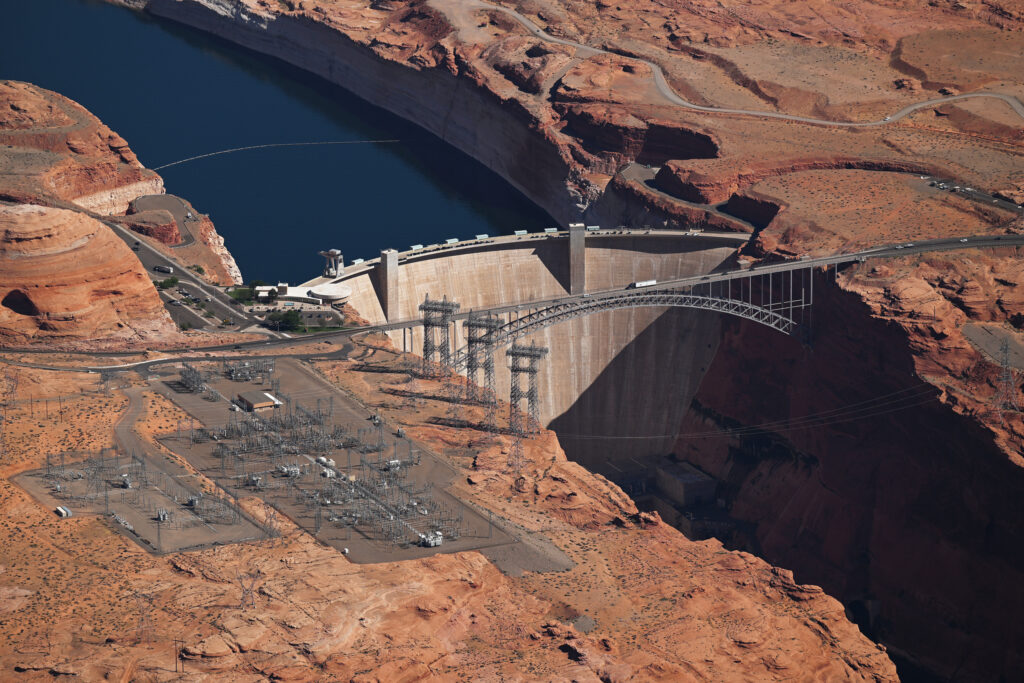
Lakes Mead and Powell, the two largest reservoirs in the U.S., would hover just above the minimum elevations required for their dams to produce electricity and maintain their structural integrity. Hoover and Glen Canyon dams would be close to operating as “run-of-the-river” facilities that store no surplus.
Another dry winter would hit farmers across the region particularly hard, said Anne Castle, a senior fellow at the Getches-Wilkinson Center at the University of Colorado Law School, a former assistant secretary for Water and Science at the Interior Department and one of the report’s authors. “It could put a lot of market pressure on agricultural water users” to sell their water to cities, she continued, which would “have a significant effect on agricultural production and rural communities.”
“It’s just so hard to make those kinds of deep cuts,” Castle said. “When you translate that into who exactly is going to get less water, it gets even harder.”
A wetter water year would bring only temporary relief. If next winter delivers large volumes of snow, akin to water year 2023,
the third wettest year of the century, and human consumption matches what was drawn from the river that year, the Colorado River could provide a surplus of 4.83 million acre feet. This would partially recharge lakes Powell and Mead, but in less than two years overconsumption would return them to today’s lows, the authors wrote.
“By and large, their analysis is right—we need to reduce consumption,” said Mark Squillace, a natural resources law professor at the University of Colorado in Boulder, who was not involved with the report. “We need to be thinking about measuring consumptive use for our individual water users, and then making sure that we are finding strategies and providing incentives for users, particularly farmers, to reduce their consumptive use.”
As reservoir levels across the Colorado River Basin continue to drop, negotiations among the basin states over a new long-term operating plan for the Colorado River have pivoted toward a
short-term deal. There is a real possibility that states will sue one another over how much water each will be required to leave in the river for the others to use, an outcome widely seen as counterproductive. The Bureau of Reclamation, which manages federal infrastructure throughout the basin, including Hoover and Glen Canyon dams, is expected to publish its record of decision this summer detailing how it will operate the river moving forward.
This story is funded by readers like you.
Our nonprofit newsroom provides award-winning climate coverage free of charge and advertising. We rely on donations from readers like you to keep going. Please donate now to support our work.
Donate Now
“There is concern that because the seven states haven’t been able to come to a consensus agreement and because Reclamation’s and Interior’s authorities are limited, the operation we’ll see described is potentially not going to be sufficient to stabilize the system,” Castle said.
The new report’s hydrological forecasts show less water in the river than Reclamation’s
May iteration of its 24-month projections, which are based on river flow measurements from 1991 to 2020. Given the recent drought, Castle called the agency’s minimum probable inflow forecast for the water year 2027 “way high.”
“The 1990s were relatively wet,” said Eric Kuhn, the retired general manager of the Colorado River Water Conservation District, the oldest and largest of the state’s four conservation districts, and another of the report’s authors. “Since 2020, we’ve had about a 10 million acre-foot river.”
Reclamation did not respond to a request for comment about how it factors aridity into its 24-month projections. The agency also makes other 2-year and 5-year projections for the river using its Mid-Term Operations Model, which Kuhn said encompasses the continued drought of the last half-decade.
“Reclamation is on their toes when it comes to improving these forecasts,” Kuhn said.
No matter what the next water year brings, Colorado River reservoirs will likely continue ratcheting downward as long as supply and demand remain imbalanced. “Every time we go through a wet period, we don’t recover enough and we haven’t reduced basic uses enough,” Kuhn said. “The next dry cycle is worse.”
“This is not a temporary situation,” he continued. “The long-term solution is a permanent reduction in the consumptive use footprint throughout the basin.”
Squillace agreed, and added that as climate change promises to upend how water is managed in the arid West, that basin cannot afford to get hung up on a short-term agreement. “That’s just kicking the can down the road,” he said.
The hydrology is “gonna get worse,” he continued. “So let’s plan for that.”
About This Story
Perhaps you noticed: This story, like all the news we publish, is free to read. That’s because Inside Climate News is a 501c3 nonprofit organization. We do not charge a subscription fee, lock our news behind a paywall, or clutter our website with ads. We make our news on climate and the environment freely available to you and anyone who wants it.
That’s not all. We also share our news for free with scores of other media organizations around the country. Many of them can’t afford to do environmental journalism of their own. We’ve built bureaus from coast to coast to report local stories, collaborate with local newsrooms and co-publish articles so that this vital work is shared as widely as possible.
Two of us launched ICN in 2007. Six years later we earned a Pulitzer Prize for National Reporting, and now we run the oldest and largest dedicated climate newsroom in the nation. We tell the story in all its complexity. We hold polluters accountable. We expose environmental injustice. We debunk misinformation. We scrutinize solutions and inspire action.
Donations from readers like you fund every aspect of what we do. If you don’t already, will you support our ongoing work, our reporting on the biggest crisis facing our planet, and help us reach even more readers in more places?
Please take a moment to make a tax-deductible donation. Every one of them makes a difference.
Thank you,
<small>Source: Inside Climate News</small>