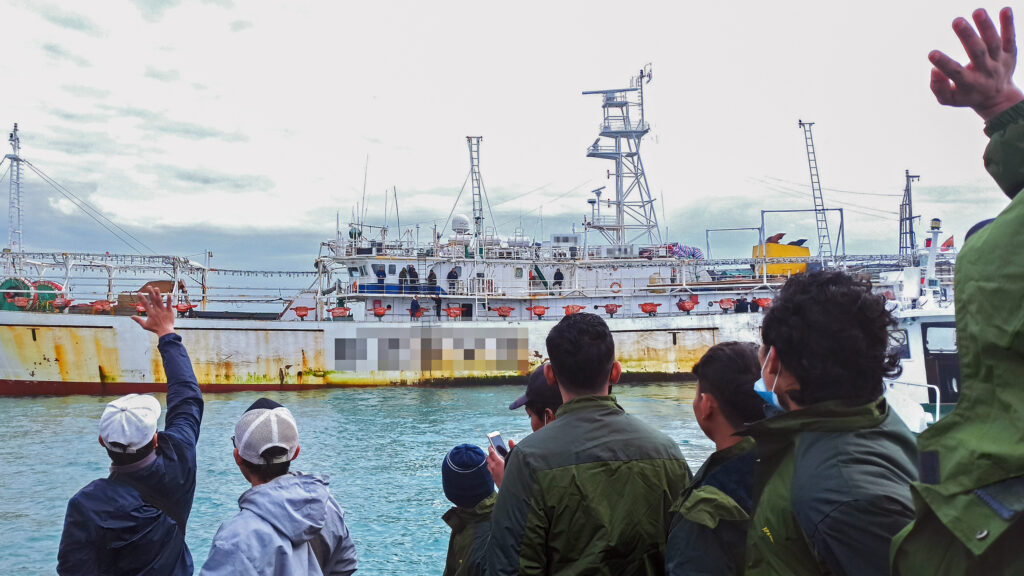
While their dazzling bright lights are visible from space, much of the global squid fleet operates in total darkness.
Hundreds of former Indonesian and Filipino crew members working onboard squid ships have exposed widespread environmental crimes and human rights abuses on the high seas every day, according to a new report by the nonprofit
Environmental Justice Foundation (EJF).
The
report focuses on three unregulated regions—the Northwest Indian Ocean, the Southeast Pacific and the Southwest Atlantic—which collectively supply over 60 percent of the planet’s squid.
“What we have uncovered through these investigations reveals a level of secrecy and opacity that would be completely unacceptable in any other industry,” said Dominic Thomson, the director of squid fisheries at EJF. “Fishers that we spoke to even reported that they contemplated suicide just because the conditions were so desperate.”
While squid has surged from a regional speciality to a highly desired
$12.7 billion global commodity in recent decades, the majority of squid fishing fleets exploit a regulatory vacuum.
The immense geographic scale, underdeveloped oversight bodies and limited data on squid numbers leave the industry devoid of governance. As no single state holds exclusive rights over high seas squid populations, fleets plunder ocean life with impunity, the report said.
“The seas are still the wild, wild west,” said Sarah Uhlemann, the senior attorney and international program director at the Center for Biological Diversity, a nonprofit focused on the protection of endangered species. “So many bad things are happening because these high seas are so far out of most people’s sight.”
The result: rampant environmental exploitation.
Squid fishing crews pose with a turtle and a juvenile shark. Credit: Environmental Justice Foundation
Squid fleets typically fish at night relying on “light-luring” gear. Bright white lights, visible from space, hang above the ocean’s surface luring photosensitive species. Large nets then either encircle the shoals, or automated barbed hooks whizz up through the water column to snag the catch.
However, the glowing ships attract more than just squid. Microscopic “phototactic” plankton crowd around, luring anchovies and sardines, which in turn entice apex predators all the way up the food chain. Dolphins, turtles, seals and manta rays frequently become entangled or hooked—a bycatch documented on more than half of the Chinese ships assessed.
“We dumped dolphins back into the ocean. Most of them were dead when released,” said an Indonesian fisher onboard a Chinese-flagged squid fishing boat. “Once, we caught up to four dolphins in one haul.”
The harm was often deliberate. “Dolphin meat is also used as a deterrent so that other dolphins will stay away,” said a Filipino worker, who described how wounded or dead dolphins would be tied to the side of the boat with their bloodied carcasses warding off other cetaceans from trying to eat the congregating squid.
On one Chinese-flagged ship, a captain ordered his crew to keep a severely wounded turtle entangled in a net as live bait for nearly three months, according to a Filipino worker.
And it’s not just protected wildlife that is illicitly harmed and hauled onboard; high-value commercial fish are targeted, too. In addition to their squid catch, light seiners in the Northwest Indian Ocean process between 10 and 15 tons of skipjack, yellowfin and bigeye tuna daily, according to the report.
“Dolphin meat is also used as a deterrent so that other dolphins will stay away.”— A Filipino worker
Yet none of the more than 200 ships in the Northwest Indian Ocean involved are registered with the relevant tuna commission, meaning hundreds, if not thousands, of tons of tuna are extracted daily without any oversight or accounting system.
While a lack of scientific data makes it almost impossible to assess current squid stocks, the fleet is ruthlessly overfishing its primary target, too. Squid are hauled at such great speed and volume that fishers reported being unable to properly process, pack and freeze them. Instead, squid were often left on deck as dawn broke.
“The squid was actually starting to spoil and rot right before their eyes,” said Thomson, highlighting an instance where over 200 sacks of squid went rancid onboard a Korean-flagged vessel off Argentina. “They had to dump a lot of this unwanted squid back into the sea—incredibly wasteful and harmful practices.”
This story is funded by readers like you.
Our nonprofit newsroom provides award-winning climate coverage free of charge and advertising. We rely on donations from readers like you to keep going. Please donate now to support our work.
Donate Now
Behind the industry’s freakish efficiency lies transhipment: the process whereby ships stay at sea for months or years, offloading their catch to refrigerated resupply ships, known as reefers. The linchpin of modern commercial fishing, transhipment is the backbone of industrial-scale environmental harms.
Of the 431 fishers interviewed, 97 percent reported relying on transhipment to remain at sea for months or years on end. And, between 2020 and 2025, the number of Chinese-flagged reefers almost quadrupled, according to the EJF assessment, which also highlighted how a longer time at sea increases the odds of crimes being committed.
As the world’s largest exporter of squid and cuttlefish, China faces relentless criticism for its role in this mass ocean extraction. However, it’s not just China’s scale that causes harm, it’s also its practices.
Chinese shark finning rates were seven times greater than those of Korean vessels and triple those of Taiwanese ships. Shark finning is a brutal practice where crews slice off a shark’s fins and
dump the animal back in the ocean to slowly and agonizingly bleed to death. The practice is largely driven by a growing demand for shark fin soup and traditional medicine in East and Southeast Asia.
“We’ve got a huge problem; seventy percent of sharks are threatened right now. Populations are sinking all over the globe,” said Uhlemann, highlighting the threats of finning alongside overfishing for shark meat. “It’s devastating. It’s awful to think of not only the individual sharks but, additionally, the harm that it’s doing to the ecosystem taking out these high-level predators.”
Chinese ships also ranked the worst for living and working conditions, logging the highest indicators of forced labor and human rights abuses, according to the report. On average, workers across all vessels experienced nine of the twelve definitional categories of forced labor, as determined by the International Labour Organization. These include debt bondage, physical or sexual abuse, working unpaid or being deceived about the job.
Across the fleet, investigators recorded 25 fishers’ deaths across 20 boats. All deaths occurred on Chinese-flagged ships and nine were suspected cases of beriberi, a vitamin deficiency disease once rampant among 19th-century merchant navy fleets.
“Our first few months were hard, we were treated like pigs. They give us leftover food,” said one Filipino fisher who worked onboard a Chinese-flagged fishing boat in the Indian Ocean. “Even the ingredients were all expired and exposed to cockroaches.”
Another Indonesian fisher quoted in the report recalled the harrowing fate of a crewmate who died. “I thought the coffin would be sent home. In fact, it was kept in the freezer first, mixed with the squid and other catches.” After four months stored alongside seafood destined for global dinner tables, his body was thrown overboard in a makeshift coffin.
The report calls for multilateral treaties, increased supply-chain traceability and a crackdown on transhipment to stop consumer markets from laundering products tied to a litany of crimes.
“What this investigation reveals is a systemic failure of governance on the high seas. In the absence of transparency and effective regulation, illegal fishing, environmental destruction and human rights abuses are not exceptions; they are the norm,” said Steve Trent, founder and CEO of EJF, in a press release.
“These products are entering global markets every day,” he said. “Without urgent action, consumers, retailers and governments risk being complicit in a system built on exploitation and secrecy.”
About This Story
Perhaps you noticed: This story, like all the news we publish, is free to read. That’s because Inside Climate News is a 501c3 nonprofit organization. We do not charge a subscription fee, lock our news behind a paywall, or clutter our website with ads. We make our news on climate and the environment freely available to you and anyone who wants it.
That’s not all. We also share our news for free with scores of other media organizations around the country. Many of them can’t afford to do environmental journalism of their own. We’ve built bureaus from coast to coast to report local stories, collaborate with local newsrooms and co-publish articles so that this vital work is shared as widely as possible.
Two of us launched ICN in 2007. Six years later we earned a Pulitzer Prize for National Reporting, and now we run the oldest and largest dedicated climate newsroom in the nation. We tell the story in all its complexity. We hold polluters accountable. We expose environmental injustice. We debunk misinformation. We scrutinize solutions and inspire action.
Donations from readers like you fund every aspect of what we do. If you don’t already, will you support our ongoing work, our reporting on the biggest crisis facing our planet, and help us reach even more readers in more places?
Please take a moment to make a tax-deductible donation. Every one of them makes a difference.
Thank you,
<small>Source: Inside Climate News</small>