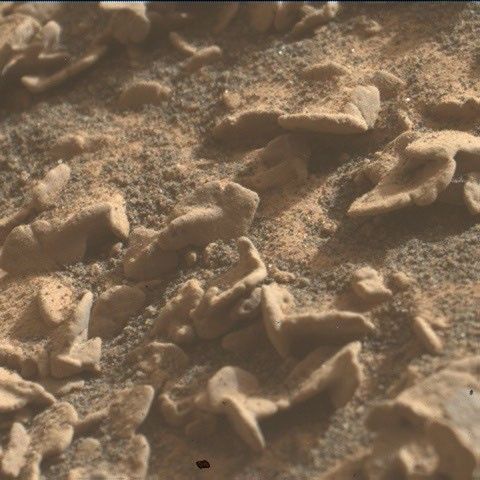
NASA’s Curiosity rover continued its scientific campaign on Mars during sols 5063‑5069, focusing on the “Nazca” drill hole and capturing a close‑up image of chip‑shaped crystal formations on 7 November 2026 (Sol 5067) at 14:07:35 UTC.
The image was taken with the Mars Hand Lens Imager (MAHLI) mounted on the turret of Curiosity’s robotic arm. MAHLI’s high‑resolution view shows the distinctive disk‑ or potato‑chip‑shaped crystals embedded in the bedrock, a feature that has been a primary target for the rover’s ongoing investigations.
During the week, Curiosity completed a drill campaign at the Nazca site, extracting samples from the crystal‑rich bedrock and delivering them to the Sample Analysis at Mars (SAM) instrument for chemical analysis. SAM’s analysis was still in progress when the rover’s weekly plan was finalized.
Mission planners outlined a series of observations for the three key days of the week:
- Monday: ChemCam laser‑induced breakdown spectroscopy (LIBS) targeted the “Ahi Veremos” crystal form; Mastcam captured additional frames to extend the Nazca mosaic; environmental monitoring included a dust‑devil survey and horizon/zenith movies.
- Wednesday: Two science blocks performed LIBS depth profiling of the “Colca” crystal and LIBS of the “Bermejo” target; a long‑distance Remote Micro‑Imager (RMI) mosaic of rock clusters beneath the “Cordillera” ridge was acquired; Mastcam added more Nazca mosaic frames.
- Friday: Three science blocks and a drive away from the drill site were scheduled; MAHLI produced a mosaic of the block side hosting the drill hole and used nighttime white‑light and ultraviolet LEDs to image the crystals; an eclipse of the Sun by Phobos was prioritized for imaging; additional LIBS observations targeted a crystal cluster, a resistant layer, and a dark float rock; a long‑distance RMI mosaic of dark lenses under the “Mishe Mokwa” ridge was taken, followed by further environmental observations before the rover resumed its southerly traverse.
These activities advance Curiosity’s exploration goals of characterizing Martian geology and assessing past habitability, building on more than a decade of data from the Mars Science Laboratory mission. The rover’s continued work at Nazca and surrounding terrains adds valuable detail to the planet’s mineralogical record as it moves toward its next scientific objectives.
<small>Source: NASA — read the original story there.</small>


