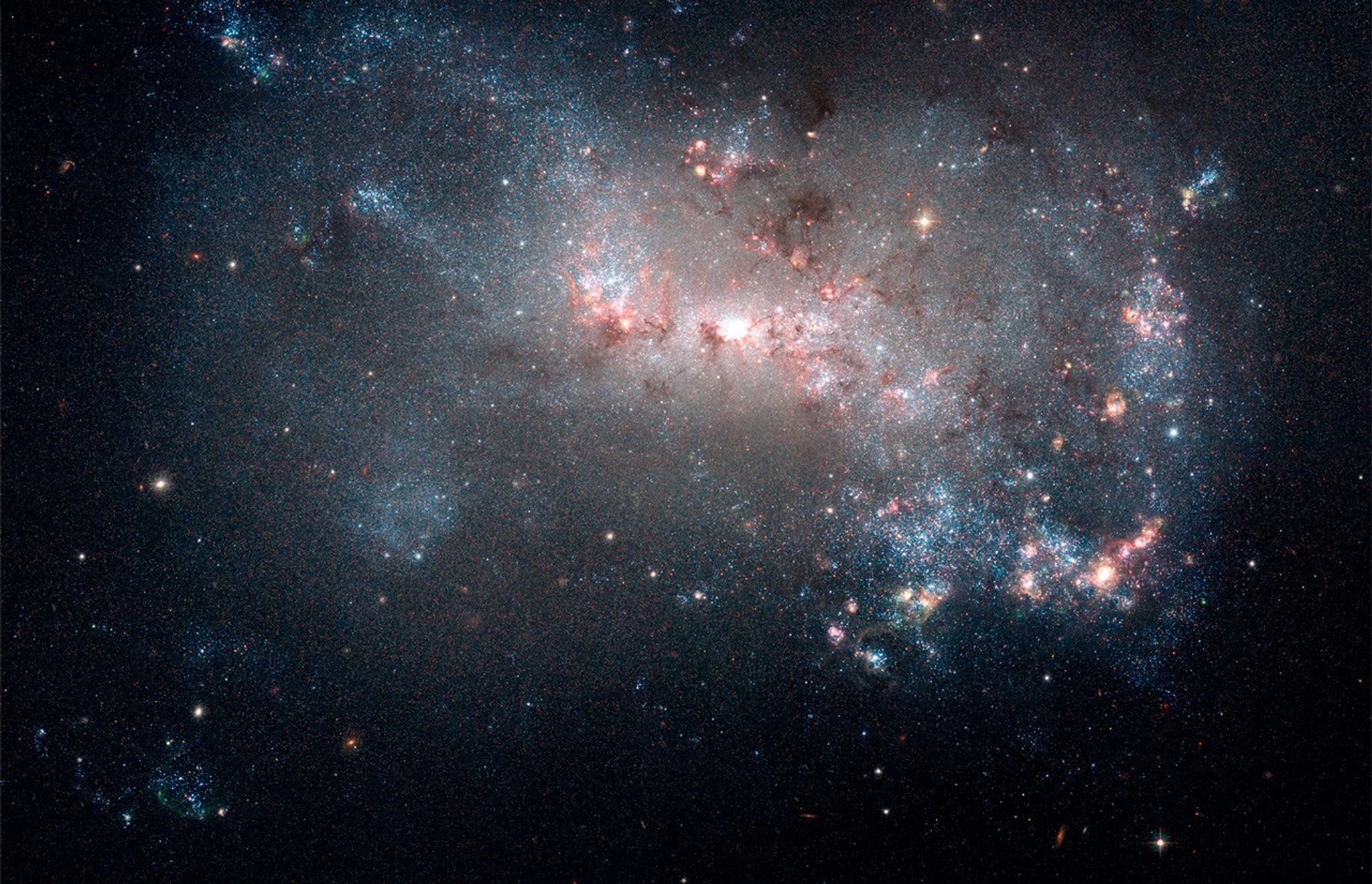
NASA’s Astronomy Picture of the Day (APOD) for November 11, 2026, features NGC 4449, a dwarf galaxy captured by the Hubble Space Telescope that challenges common perceptions of galactic scale. While the Milky Way spans approximately 100,000 light-years and contains hundreds of billions of stars, dwarf galaxies like NGC 4449 are roughly one-tenth that size and host only a few billion stars. Despite their small stature, these galaxies are the most common type in the universe, according to the explanation provided by professional astronomers.
Unexpected Oxygen Deficit
The image highlights a significant scientific anomaly: NGC 4449 and similar dwarf galaxies contain less oxygen than current models predict. This discrepancy suggests that stellar winds and supernovae within these small galaxies are surprisingly effective at expelling oxygen and other heavy elements into the surrounding space. The findings indicate that the internal dynamics of dwarf galaxies are more powerful in redistributing matter than previously thought.
“Don’t judge a galaxy by its size,” the APOD explanation notes, emphasizing the outsized influence of these small celestial bodies.
These observations imply that dwarf galaxies play a critical role in the cosmic ecosystem by spreading heavy elements throughout the universe. These elements are the fundamental building blocks for stars, planets, and life. The research underscores that even the smallest galaxies contribute significantly to the chemical evolution of the cosmos.
The featured image was captured by the Hubble Space Telescope and is credited to NASA, ESA, A. Aloisi (STScI/ESA), and the Hubble Heritage (STScI/AURA)-ESA/Hubble Collaboration. The APOD entry was authored and edited by Keighley Rockcliffe, Robert Nemiroff, Jerry Bonnell, and Cecilia Chirenti, as part of a service provided by the Astrophysics Science Division at NASA’s Goddard Space Flight Center and Michigan Tech.
<small>Source: NASA — read the original story there.</small>


