Editor’s note: In honor of America’s 250th birthday, Earth Observatory is revisiting stories about the landscapes that helped shape U.S. history. The images and text on this page were originally published on February 17, 2025. Explore the
full collection here.
George Washington was born in 1732 on his family’s tobacco plantation at
Popes Creek in Westmoreland County, Virginia. Three years later, he moved up the Potomac River to Little Hunting Creek Plantation, a property later renamed Mount Vernon. The riverside property, approximately 15 miles (24 kilometers) south of Washington, D.C., was central to the man who became the first U.S. president.
Though the family soon moved to Fredericksburg, Virginia, and resided there for much of his youth, Washington began managing the Mount Vernon property in 1759, soon after his marriage to
Martha Dandridge. Washington’s letters make clear that he cherished and longed for this place during his long absences as a surveyor, military commander, and politician—a location he called the most “pleasantly situated” estate in the United States. It was where he helped raise two stepchildren, four step-grandchildren, and an array of crops and livestock. It was also where he was laid to rest in 1799 at the age of 67.
The
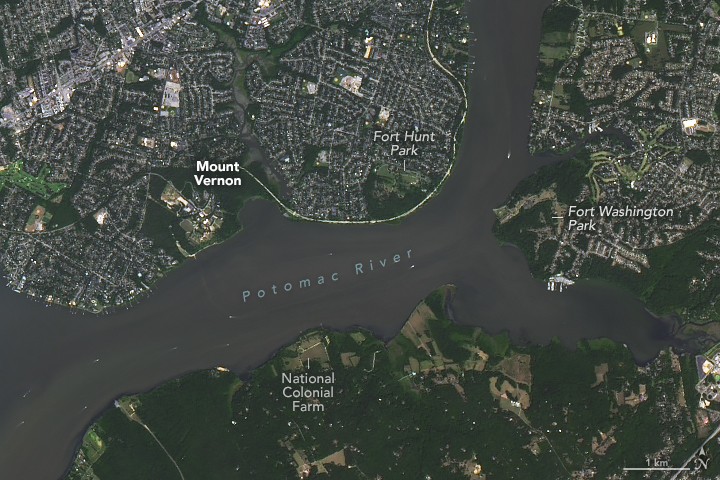
OLI (Operational Land Imager) on Landsat 8 captured this image of Mount Vernon and its surroundings on August 25, 2024. While much of the land surrounding the estate has been developed into things like suburban neighborhoods, shopping areas, and military bases, fragments of the pristine forests, farmland, and riverscapes that Washington would recognize remain.
Toward the end of his life,
Washington’s land holdings extended across five farms centered on Mount Vernon. The map below, based on one of Washington’s drawings, shows their layout. The Mansion House Farm encompassed Mount Vernon, with Union Farm and Dogue Run Farm to the west. Muddy Hole Farm lay to the north and River Farm to the east.
Washington was known as an innovative landowner who, with the labor of
hundreds of enslaved people, took unusual care to manage his crops sustainably. For instance, he shifted much of his production to wheat and corn and started experimenting with a seven-year crop rotation system and cover crops to better preserve the health of his soil after realizing that growing tobacco depleted its fertility.
While most crops were raised at the outlying farms, Mount Vernon’s gardens were showcases for visitors and laboratories for experimentation. The showy
upper garden was a formal garden near the mansion with carefully trimmed dwarf boxwood hedges and a heated greenhouse with lemons, oranges, and rare plants.
Closer to the river was the
lower garden, a kitchen garden brimming with vegetables, and a small garden that Washington called “my botanick garden,” where he spent much of his time experimenting with new varieties. Even closer to the river was the fruit garden, an experimental orchard where the estate raised pears, cherries, peaches, and apples. This may have been the source of the centuries-old preserved cherries that archaeologists unearthed in Mount Vernon’s cellar in 2024.
The lands connecting the five farms—his “wilderness,” Washington called it—were a forested area where he often spent time
hunting and fishing. Species such as oak, hickory, and heath shrubs dominated the forests in Washington’s time. Dozens of the same plant species from that period are still found on the estate’s forests in modern times, though large numbers of non-native species have established themselves as well.
One of the larger open spaces visible in the Landsat image above is
Fort Hunt Park. Once part of Washington’s River Farm, Fort Hunt was constructed in 1897 to bolster Washington D.C.’s defenses during a period of heightened tensions with Spain. Across the Potomac River stands Fort Washington Park, home to ruins of a fort that was used to defend the city during the Mexican-American War and the American Civil War.
Across the river in Maryland lies another property with a connection to George and Martha Washington.
National Colonial Farm in Piscataway Park was established in 1958 to preserve the couple’s beloved views across the Potomac. Today, National Colonial Farm is a living farm museum and features several 18th-century heirloom varieties of herbs, flowers, and vegetables, including “Orinoco” tobacco, red May wheat, and Virginia white gourdseed corn.
NASA Earth Observatory images by Michala Garrison, using Landsat data from the U.S. Geological Survey. Map of Washington’s farm courtesy of the Library of Congress. Story by Adam Voiland.
References & Resources
- Lee, J. (2006)
Experiencing Mount Vernon. Accessed February 14, 2025.
- Library of Congress (1801)
A map of General Washington’s farm of Mount Vernon from a drawing transmitted by the General. Accessed February 14, 2025.
- The Mount Vernon Ladies’ Association (2024, June 13)
Archaeologists Unearth 35 Glass Bottles from the 18th Century at George Washington’s Mount Vernon During Mansion Revitalization, Most Containing Perfectly Preserved Cherries and Berries. Accessed February 14, 2025.
- The Mount Vernon Ladies’ Association (2025)
Farm structure. Accessed February 14, 2025.
- The Mount Vernon Ladies’ Association (2025)
George Washington the Farmer. Accessed February 14, 2025.
- The Mount Vernon Ladies’ Association (2025)
The Four Gardens at Mount Vernon. Accessed February 14, 2025.
- NASA
Landsat science. Accessed February 14, 2025.
- NASA Harvest
Our Impact Areas. Accessed February 14, 2025.
- National Park Service
Fort Hunt – History and Culture. Accessed February 14, 2025.
- National Park Service
Fort Washington Park. Accessed February 14, 2025.
- Wells, E. & Brown, R. (2000)
An Annotated Checklist of the Vascular Plants in the Forest at Historic Mount Vernon, Virginia: A Legacy from the Past. Castanea, 65(4), 242-257.
- Wine Spectator (2024, June 17)
Presidential Pits: Archaeologists Find 29 Bottles of Cherries and Berries at George Washington’s Mount Vernon. Accessed February 14, 2025.
<small>Source: NASA</small>