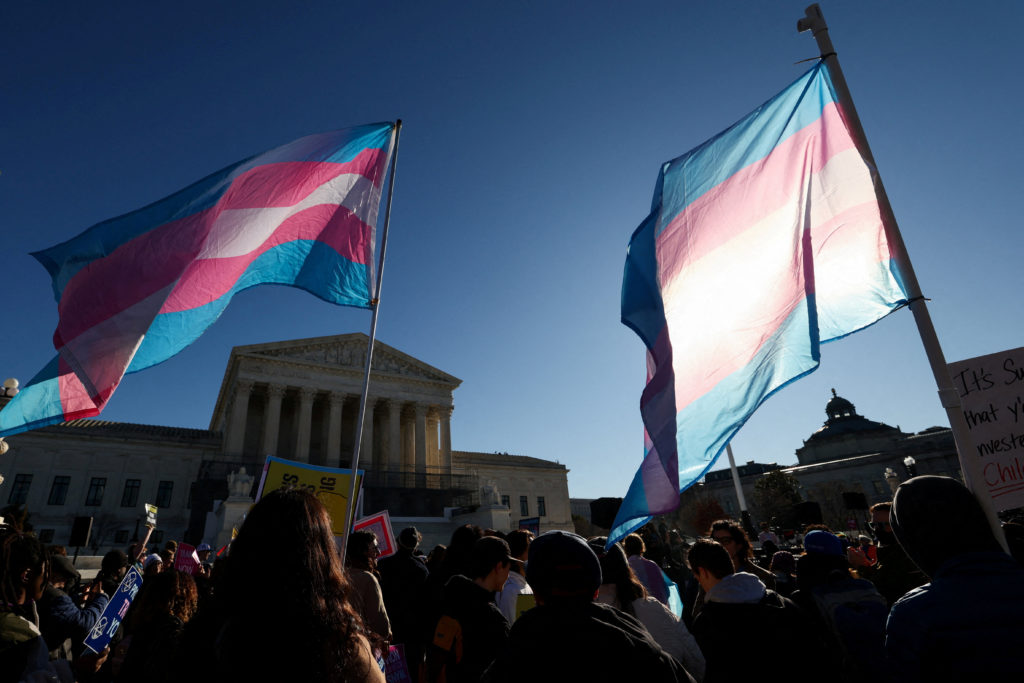
To discuss the Supreme Court upholding state bans on transgender athletes competing in girls’ and women’s sports, Geoff Bennett spoke with Katie Barnes, who covers sports and gender as a senior writer for ESPN. Geoff Bennett: We want to dig deeper now on another major case the court decided today, upholding state bans on transgender athletes competing in girls and women's sports. For more, we're joined by Katie Barnes, who covers sports and gender as a senior writer for ESPN. They're also the author of "Fair Play: Trans Athletes and the Fight for Fairness." Thanks for being with us. Katie Barnes, Senior Writer, ESPN: Thanks for having me. Geoff Bennett: So help us understand how wide of an impact this ruling will have. Who exactly will it affect? Katie Barnes: So I think the important thing is to say that it's not a nationwide ruling. The scope of the ruling is limited to the 27 states who have this legislation in place, specifically the cases in Idaho and West Virginia. The court held that those laws are allowed to stand. And so that implies that the other 25 states of similar legislation will also be able to keep their laws on the books. But it does not go a step further by saying that not only did these laws not violate Title IX, but by having transgender-inclusive policy, that is a violation of Title IX. So for the remaining states that don't have such laws on the books, their legal outcome, they're able to decide that for themselves and keep the perspective that they have had in place. Geoff Bennett: And what does this ruling mean for the plaintiffs personally, a 15-year-old in West Virginia? The other is a former Boise State University student in Idaho. Katie Barnes: So for the 15-year-old in West Virginia, her career is effectively over in girls' sports. If she wants to, she is able to compete in the men's category and the boys category. But she has said that she does not want to do that. So, in terms of being able to move forward and finish out her high school athletic career in girl sports, this ruling effectively ends that possibility for her. In terms of the other plaintiff in Idaho, she actually had petitioned the court to remove herself from the case by saying she did not want to pursue any additional athletic opportunities at Boise State University and just wanted to finish out her academic career there and get her degree and move on with her life. And it's worth speaking to the fact that that particular plaintiff spoke to the breadth of what types of sports are governed by these laws. She originally filed her -- filed her challenge on the basis of wanting to try out for the women's cross-country team at Boise State, did not make that team, and then continued her challenge on the basis of wanting to play club sports at Boise State. So it's not just competitive interscholastic athletics that are affected by this legislation. It's also club sports, as well as intramural sports, at the collegiate, as well as the school sports levels. Geoff Bennett: The states and advocacy groups that defended these bans, how are they interpreting today's ruling by the court? Katie Barnes: I think, for those who are in favor of this legislation, they are quite happy. It's been a lot of celebratory messages. I have heard from Barbara Ehardt, who wrote H.B.500 out of Idaho, and she called it a significant victory. And so for folks who want to see transgender girls not able to play girls' sports, they are feeling very good about this ruling today. Geoff Bennett: Justice Brett Kavanaugh, who once coached girls' basketball, he underlined the importance of the athletes' dedication. He tried to -- it appears, to speak to the humanity of all involved. He wrote: "No student athlete on either side of the issue, whether a biological female or transgender, deserves to be ostracized or vilified." What does fairness in competition look like now, both for the transgender athletes who want an opportunity to compete, and for the girls and women who believe it's unfair to compete against athletes who are biologically male? Based on your reporting, is there a framework or an approach that can meaningfully account for both concerns? Katie Barnes: Interesting question, because prior to H.B.500 passing in Idaho in 2020... Geoff Bennett: And we should explain H.B.500. This was the first law that was passed, and it banned transgender girls from competing in women's sports at the school and collegiate level. Katie Barnes: Yes, that's right. And, yes, before that law, there was a really robust policy mechanism that was exploring those questions and also allowed for the answer to be different at various levels of competition and through various age groups. And so there were high school associations with different policies from the Olympics, et cetera, et cetera. And even within national governing bodies, you saw different policies for different age groups and seriousness of competition. And with the passage of H.B.500, that really reframed the context for where these battles would be fought and started to really reshape the policy and legislative landscape around transgender athlete eligibility. A lot of that conversation has fallen away. And so to answer that question, it's very challenging because I think that there are those who see any inclusion or allowance of a transgender girl or woman to compete in the girls and women's category as a functional failure of policy. And there are those who would like to see transgender girls, women be eligible under some circumstances. And those two perspectives are very, very hard to reconcile. And I think some folks would like science to answer this question for us. And it's very complicated. It's a small sample size when it comes to transgender athletes. And the science is still new in terms of the effects of hormone treatments, and at what age group, et cetera, and how that can impact or not athletic advantage in sports, and at what level we should care about having more restrictive or more inclusive policy. Geoff Bennett: Katie Barnes, senior writer for ESPN and the author of "Fair Play: Trans Athletes and the Fight for Fairness." Katie, thanks again for your time this evening. Katie Barnes: Really appreciate it.
<small>Source: PBS NewsHour</small>