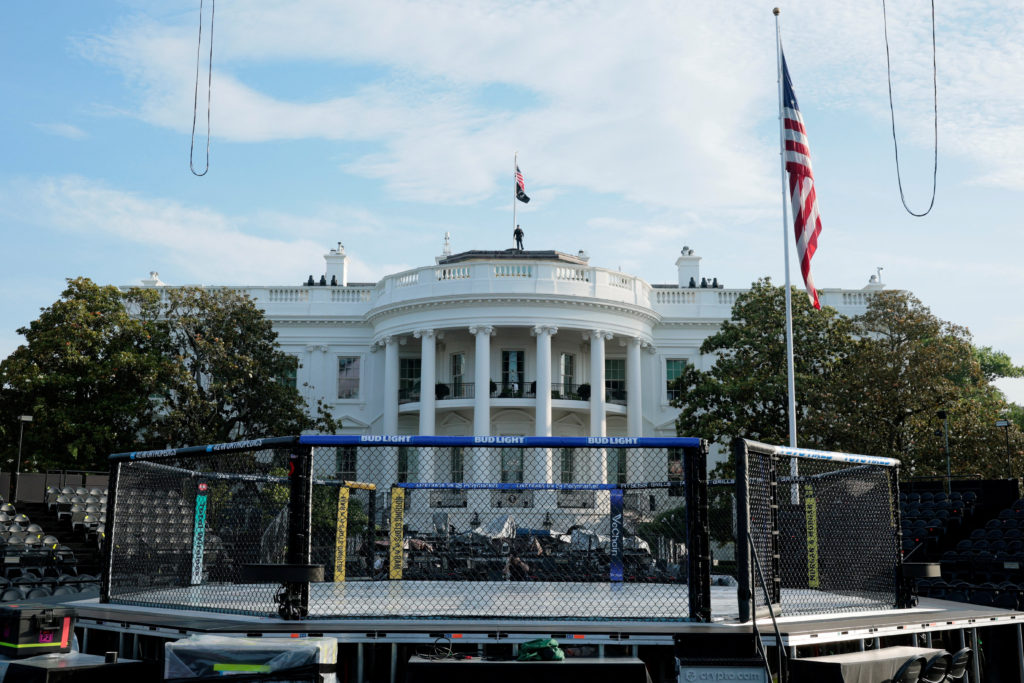
On Sunday, an Ultimate Fighting Championship event on the White House lawn will mark both President Trump's 80th birthday and Flag Day. White House correspondent Liz Landers explains how this moment for Trump and the UFC was decades in the making. Geoff Bennett: A federal judge today declined to block the White House from hosting cage fights on the South Lawn on President Trump's birthday, clearing the way for Sunday's event to move forward. White House correspondent Liz Landers reports on how the event came together and on the decades-long relationship between Mr. Trump and the UFC that helped bring a first-of-its-kind sporting spectacle to the White House. Liz Landers: Today, the Ultimate Fighting Championship is the premier mixed martial arts organization, a full contact sport that combines striking and grappling and is worth billions of dollars. On Sunday, it takes center stage in American political life. Yet this is a picture few could have imagined back in 1993, when the UFC began. Narrator: Eight street-tough warriors wage combat in a battle where anything can happen and probably will. Luke Thomas, Combat Sports Analyst: Basically, at this time, there's something called traditional martial arts. They're all making a bunch of competing claims about what works in a fight, right? And the idea was, though, that they all live in their own siloed universes. What would happen if you just put those together and created a sort of set of open rules? What would we discover? Liz Landers: That Question, the lack of rules and the spectacle of violence, attracted attention, but also scrutiny, including from boxing fan and late Arizona Senator John McCain, who described the sport as human cock fighting and led efforts to ban it in most states and on TV. The scrutiny and the UFC's state by state efforts at legalization also led to more rules and regulations, which Dana White now credits with saving the sport. Dana White, President, Ultimate Fighting Championship: I think that without senator John McCain, I probably wouldn't be sitting here having this conversation with you right now. Question: Tell me why. Dana White: because I think his stance on the UFC drove them toward -- and not only them, but us when we bought it, toward regulation and being regulated by the athletic commissions in each state. Liz Landers: Yet the UFC still struggled to stay on its feet. In 2001, White, who had been a boxing enthusiast and fitness entrepreneur, led the purchase of the league for $2 million. Narrator: Home tonight to the world's most prestigious mixed martial arts event. Liz Landers: That same year, casino owner and longtime fight fan Donald Trump opened the doors of his Taj Mahal Casino in New Jersey for a fight, a move White says was critical. Dana White: When the Trump brand was here and the UFC brand was down there, he saw it and said, I'd love to have this at my casino. Luke Thomas: As being part of the casino business, he was sort of very visible in the boxing world in the late '80s and then the early '90s. And, in fact, you will recall, he was the guy principally responsible for making the fight between Holyfield and Foreman possible at one of his casinos. This was a Donald Trump-driven effort. So he's kind of always been around the fight game. Dana White: And these guys don't realize the opportunity that they have right now. Liz Landers: But Thomas says it was "The Ultimate Fighter," a 2005 reality show on Spike TV that ultimately saved the UFC. And despite Trump joining a short-lived rival to the UFC in 2008, White and Trump became close allies. Dana White: Donald was the first guy that recognized the potential that we saw in the UFC. Liz Landers: White endorsed Trump at the 2016, 2020 and 2024 Republican National Conventions. Dana White: I know Donald J. Trump is the best choice for president of the United States. Liz Landers: In 2024, White also successfully pushed Joe Rogan, the longtime MMA announcer whose podcast is enormously popular with young men, to endorse Trump. Yet Luke Thomas says the most important thing White did for Trump was following the assault on the U.S. Capitol on January 6, when he openly welcomed Trump at UFC events. Luke Thomas: There is no mainstream actor anywhere that did as much to try and rehabilitate Donald Trump's image after January 6 as much as the Ultimate Fighting Championship. You want to see how important that was to Donald Trump. Look at what he is doing for them as part of this payback. Liz Landers: For his part, White has said he supports Trump on a personal level. Dana White: I mean, I'm not a political guy. I'm not a political guy. Question: On -- speaking at the conventions. You're at the triumphant victory party. Dana White: And what did I say? What did I say when I was at those? Question: No, they were congratulatory. They were personal, for sure. They weren't policy-oriented speeches. Dana White: A hundred -- they were absolutely personal speeches. They weren't political in any way, shape or form. Liz Landers: On Sunday, more than 4,000 spectators will attend the fight in person on the White House lawn, while tens of thousands more will watch in a nearby overflow area. Alex Pereira is hoping to be the first MMA fighter to win in a third weight class. The event will be streamed on Paramount+, which bought the TV rights to the UFC last year for over $7 billion. The owner of Paramount Skydance, David Ellison, is a Trump ally, who just received sign-off from the Justice Department on his purchase of Warner Bros. The company that now owns the UFC, TKO Group Holdings, is footing the over $60 million tab for the event. Last month, President Trump disclosed that he'd purchased TKO stock. In addition to the favors being exchanged, Thomas says Trump may be hoping the event boosts his image with the young men who make up the MMA fan base, but who have largely fallen off as supporters since his election. And while the location of this event and its nature may feel unprecedented in our 250-year history, Thomas says it fits into a long, global tradition. Luke Thomas: Why was the Thrilla in Manila in Manila? It's because a dictator paid to put it there. Why was the Rumble in the Jungle in Kinshasa, then Zaire? It's because a dictator paid to put it there. Some of the biggest fights in history are related to authoritarian strongmen who had an attachment to combat sports, either genuine or transactional, or some combination of the two trying to either make themselves look better or the country to look better or some combination of it. Liz Landers: For the "PBS News Hour," I'm Liz Landers.
<small>Source: PBS NewsHour</small>