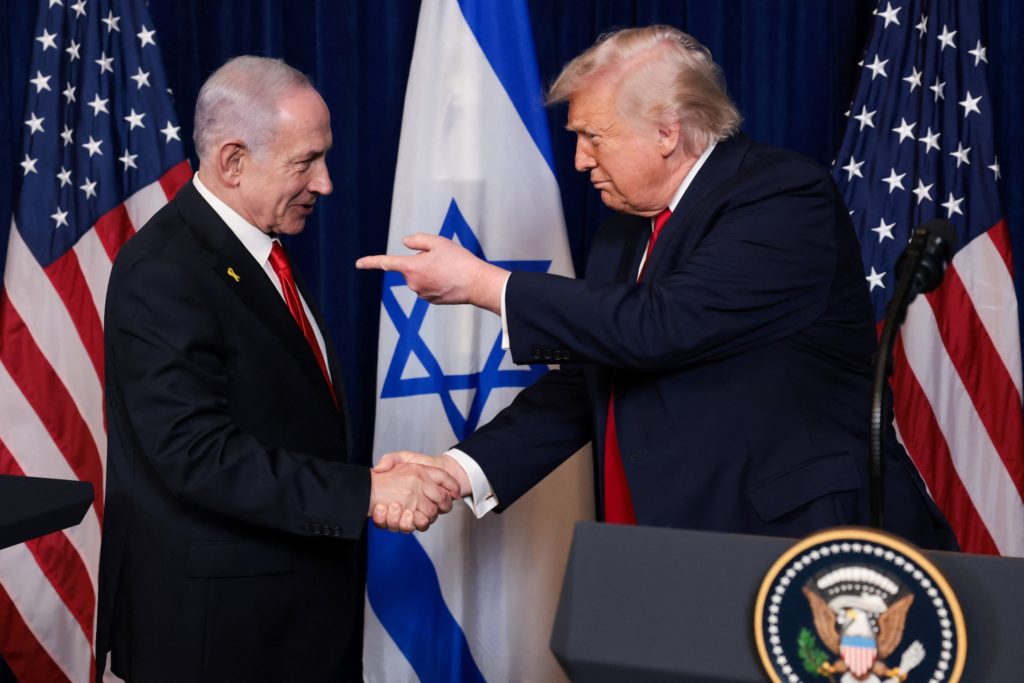
Where does the Iran deal leave U.S.- Israeli relations and the relationship between President Trump and Prime Minister Netanyahu? William Brangham discussed that with Aaron David Miller. He’s served in both Democratic and Republican administrations and is now at the Carnegie Endowment for International Peace. William Brangham: So where does all this leave U.S.-Israeli relations and the relationship between President Trump and Prime Minister Benjamin Netanyahu? For that, we turn again to Aaron David Miller. He's served in both Democratic and Republican administrations trying to negotiate peace in the Middle East. He's now senior fellow at the Carnegie Endowment for International Peace. Aaron, so good to have you back on the program. You track Israeli public opinion and the opinion of its leaders. Give us a sense of how they are seeing the announcement of this fledgling deal. Aaron David Miller, Carnegie Endowment for International Peace: I mean, I think there's grave concern, understandably, because on the issue of Iran's nuclear program, the U.S. is Mars and the Israelis are Venus. It does pose an existential threat. And where you sit has a lot to do with where you stand. So there's a lot of concern that this war of choice that the president launched, in conjunction with his Israeli partner -- and, I must say, you would have to go back to World War II to find the kind of seamless interaction of two militaries engaged in such an extraordinarily challenging and comprehensive military campaign. So, on one level, you have this sort of seamless military integration and cooperation. On the other, however, you have a growing rift, it seems to me. If a U.S. ally is defined as someone who has a high coincidence of interests, shared common values, and a strong base of domestic support, in all three of these foundations, there's more stress than at any time I have seen. And you have a president, Donald Trump, who has said things about an Israeli prime minister and has allowed his private conversations, some profanity-laced, but in the main mocking the prime minister's judgment, basically to go public. This is unprecedented. So Trump has enormous leverage because of the elections. Trump cannot elect Benjamin Netanyahu, but unless he campaigns actively for him, Netanyahu's vulnerabilities -- and there are some -- are going to expand exponentially. And Lebanon may well be part of the -- it is part of the problem right now. William Brangham: And from the Israeli perspective, the details that are trickling out about this deal feel like, what, a capitulation, giving away the farm too early? Aaron David Miller: It's not just from an Israeli point of view. This was a war of choice. And I worked and voted for Republicans and Democrats. This is a war of choice in which the administration overestimated its own capacity and underestimated the capacity of its adversary. And as a consequence, this war of choice is leading to what I would describe to you as a flawed -- I won't just -- I will say "peace" in quotes -- a flawed peace of necessity. Iran is not going to sever its relations with its proxies. There aren't going to be any restrictions on ballistic missiles. The regime has not only survived. It's weaponized geography, and it's demonstrated that it does not have to match the vaunted power, formidable power of the Israeli and American militaries. It can expand horizontally. And it's done that by attacking key Gulf states and again by demanding -- the straits will be open, no doubt. But I suspect Iran wants some measure of control and sovereignty, whether it's tolls 60 days later or navigation fees. They're not going to give this up. So, on balance, a normal human would have to ask themselves a basic question. Despite all the tactical military achievements, the degradation of ballistic missiles, drones, all of that, where is the strategic gain, not just for Israel? Where is the strategic gain for the United States? If the administration can produce, recapture diplomatically or diluting or exporting out of the country the 900 pounds of highly enriched uranium, it would be a big gain. If they could get the Iranians to agree to a moratorium on enrichment for a long period of time, the Iranians say 20 -- Trump said 20 years. Iranians, I think, say 10. It'd be a notable achievement. But the Iranians have negotiated for decades. They play this game a lot better than we do. So, on balance, I think it's not just a strategic defeat for Israel. Frankly, I'm much more concerned that it's a strategic defeat for us. William Brangham: Aaron David Miller of the Carnegie Endowment, always appreciate your insights. Thank you. Aaron David Miller: Thanks so much for having me.
<small>Source: PBS NewsHour</small>