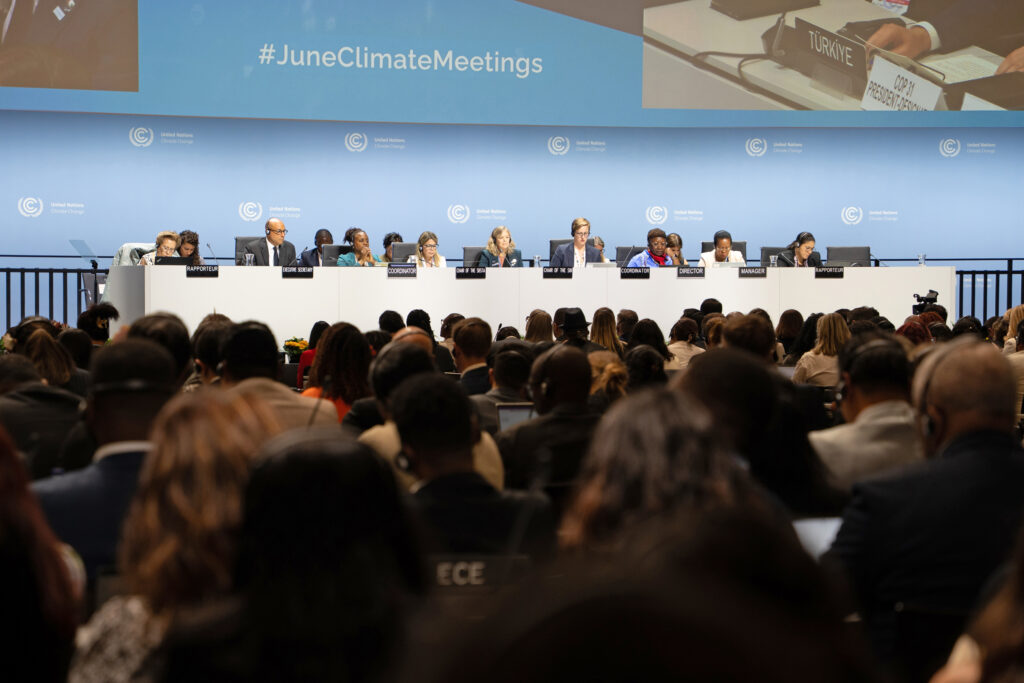
The United States did not send a federal government delegation to the latest round of high-level global climate negotiations in Bonn, Germany, but the current administration’s foreign and economic policy nevertheless partly shaped the talks, stirring both fear and hope.
The U.S. attack on Iran and its ripple effects across energy markets fueled concerns that climate action is increasingly being sidelined by military conflicts and economic rivalries. At the same time, the disruptions reinforced a growing view that shifting away from oil, coal and gas makes economical and environmental sense, as fossil fuels are linked to many geopolitical conflicts.
Both themes surfaced repeatedly during the 11-day session, where negotiators worked to reach funding goals for adapting to climate impacts, as well as on the implementation of existing climate agreements before the
United Nations Framework Convention on Climate Change summit, COP31 in Antalya, Turkey, in November.
The U.S. Department of State did not respond to Inside Climate News’ requests for comments on the Bonn talks.
“We’ve seen geopolitical tensions washing through these halls,” said
Simon Stiell, UNFCCC executive secretary. That resulted in some “side-stepping and stalling” on key issues like climate finance, such as funding for renewable energy in developing countries, he added during his closing remarks at the Bonn talks.
Stiell conceded that progress on climate action has been hard to come by. The bigger concern is going backward just as global warming is accelerating, he said.
Daily
summaries of the talks compiled by the Earth Negotiations Bulletin documented the inertia, with descriptions of delegations arguing for hours over minutiae, such as where a block of sub-bracketed text should be placed within existing brackets.
“We cannot afford to re-open previous decisions, to renegotiate existing targets or to backslide,” Stiell said. “All parties must be comfortable and confident in restating our existing global commitments, without cherry-picking those that suit tactically in the moment.”
During the closing plenary on Thursday, a delegate from Saudi Arabia portrayed his country as a victim of climate change, citing the impact of extreme heat and drought, despite a body of peer-reviewed studies documenting the nation’s efforts to delay and obstruct international climate action over the past 30 years.
The U.S. wasn’t completely absent from the talks. Youth activist
Analyah Schlaeger dos Santos from Minneapolis attended as part of a broad coalition of community, environmental and labor groups, and said it feels like the U.S. government is abandoning its global responsibilities.
“I’m going to ground us all in the continued necessary reminder that the United States is the largest historical polluter in the world, full stop,” she said during a June 16 press conference in Bonn. “That is our history. It is our reality. It’s not something that we can avoid any longer.”
Dos Santos said the multilateral process can only work if everyone participates and works toward consensus. The U.S. absence is egregious, she said, because it has “caused some of the worst of the mess, has the biggest capacity to do something, and is also making it more difficult for everyone else to do their part.”
Noting that countries have backed away from climate finance commitments by saying they need to focus on military and energy security, dos Santos said, “it’s not that we don’t have the money to meaningfully address the climate crisis, it’s that we have a serious priorities issue.”
In one example, a fund set up to pay out billions of dollars for irreplaceable loss and damage from climate impacts is languishing with only about $100 million in contributions, less than the cost of a week of war in Iran or Ukraine.
“I’m tired of having to advocate for our country to do the right thing,” she said. “I’m tired of having to come to these spaces and discuss how we, the people that care, can address the survival of everyone and everything, while in our countries, billionaires and trillionaires are making us fight for scraps.”
About This Story
Perhaps you noticed: This story, like all the news we publish, is free to read. That’s because Inside Climate News is a 501c3 nonprofit organization. We do not charge a subscription fee, lock our news behind a paywall, or clutter our website with ads. We make our news on climate and the environment freely available to you and anyone who wants it.
That’s not all. We also share our news for free with scores of other media organizations around the country. Many of them can’t afford to do environmental journalism of their own. We’ve built bureaus from coast to coast to report local stories, collaborate with local newsrooms and co-publish articles so that this vital work is shared as widely as possible.
Two of us launched ICN in 2007. Six years later we earned a Pulitzer Prize for National Reporting, and now we run the oldest and largest dedicated climate newsroom in the nation. We tell the story in all its complexity. We hold polluters accountable. We expose environmental injustice. We debunk misinformation. We scrutinize solutions and inspire action.
Donations from readers like you fund every aspect of what we do. If you don’t already, will you support our ongoing work, our reporting on the biggest crisis facing our planet, and help us reach even more readers in more places?
Please take a moment to make a tax-deductible donation. Every one of them makes a difference.
Thank you,
<small>Source: Inside Climate News</small>