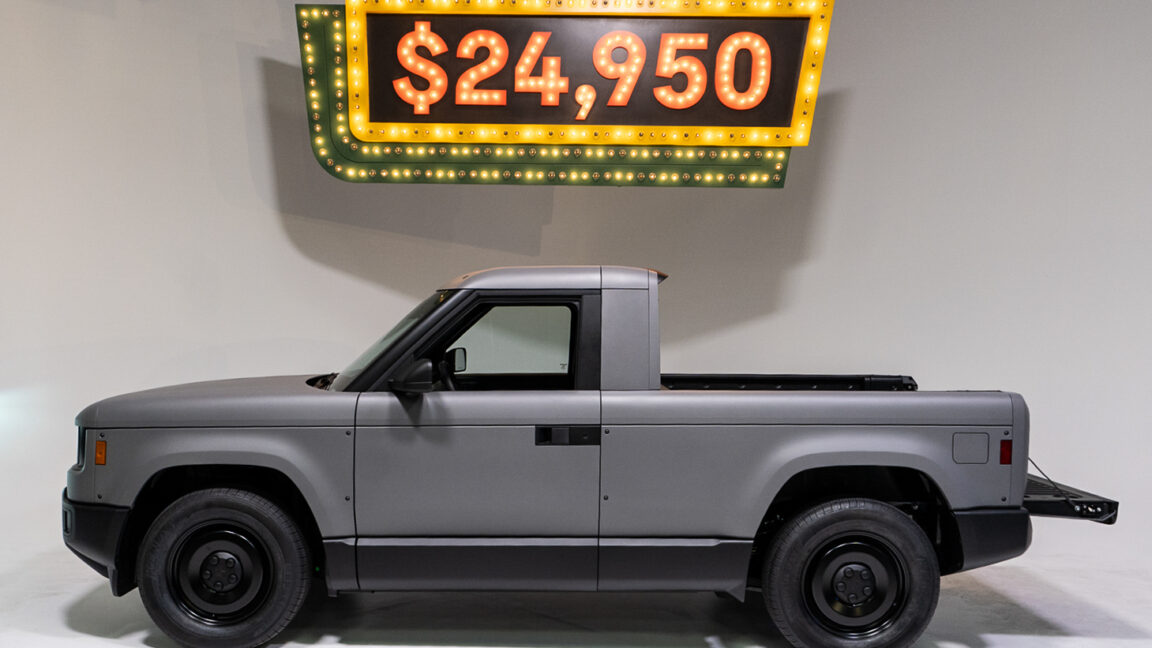
LOS ANGELES—Slate Auto has pulled a Disneyland. Let me explain.
At Disneyland, if a sign for a ride says the wait is 45 minutes, it’s actually less than that. The idea is to set expectations low and then exceed them. Slate originally said its electric truck’s entry-level battery would have 180 miles (290 km) of range, but that has expanded to 205 miles (330 km). The tow rating was originally 1,000 lbs (454 kg); now it’s 2,000 lbs (907 kg), a nice jump. Finally, the load rating was 1,400 lbs (635 kg), and it’s now 1,550 lbs (703 kg).
The automotive startup has exceeded expectations. Was it part of the plan all along? Was leaking the price of the base model of $24,950 last week guerrilla marketing? Since the truck’s unveiling a year ago, Slate’s marketing has been extremely tongue-in-cheek.
At the Slate launch event in Gardena, California, new CEO Peter Faricy told the assembled press that “Slate is so much more than an affordable truck.”
Let’s ride
Unfortunately, Slate wouldn’t let me drive the truck, so I rode shotgun. What I gathered from the passenger seat is that while the Slate has built an inexpensive vehicle, it doesn’t feel cheap. The acceleration curve was smooth as the driver stomped the accelerator while turning right at an intersection. It’s not a speedy ride; the zero-to-60 is a mild eight seconds. The top speed is 90 mph (145 km/h). Not that you’d want to go faster in the little truck. The single motor outputs 181 horsepower (135 kW) and 195 lb-ft (264 Nm) of torque to the rear wheels.
I was impressed with the pre-production vehicle’s handling of the bumps in the road and cornering. There’s an expectation that a car not quite ready for prime-time will have squeaks and some hiccups during test drives. None of that appeared during my trip around the block. I did learn that the vehicle has one-pedal-driving regenerative braking. Fans of the feature on other EVs will be happy.
<small>Source: Ars Technica</small>