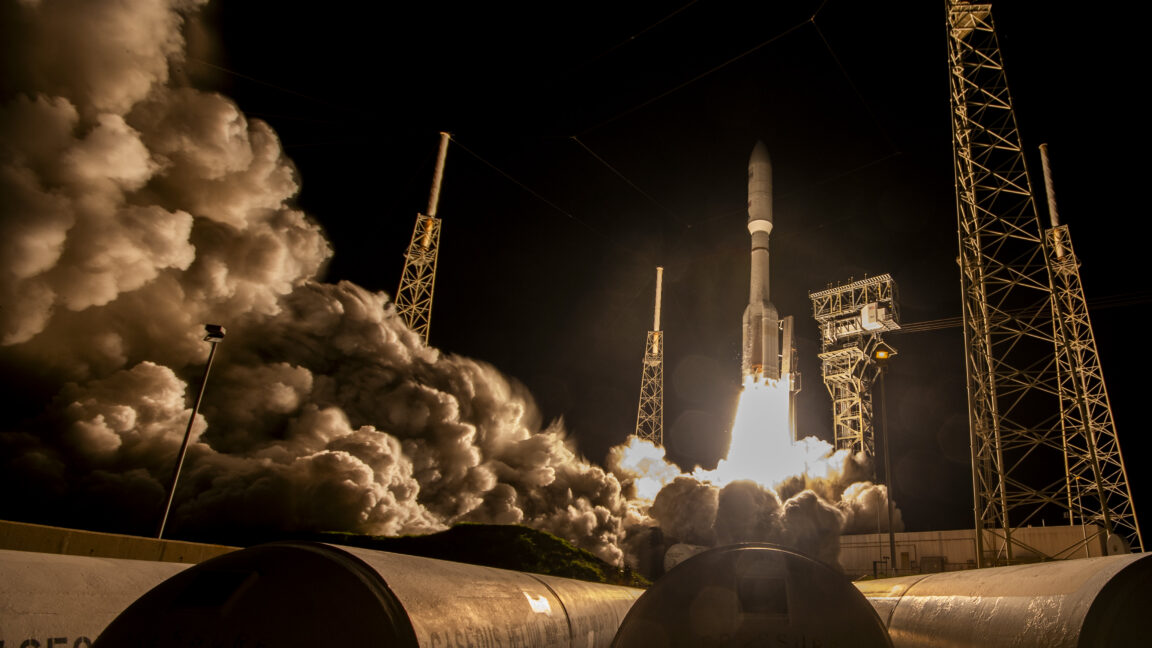
The final flight of United Launch Alliance’s Atlas V rocket is still several years off, but an important era for the once-dominant launch company came to a close last week.
The final flight of an Atlas V for the Amazon Leo broadband constellation lifted off from Cape Canaveral Space Force Station in Florida at 12:30 am EDT (04:30 UTC) last Thursday, sending 29 satellites to orbit to move the network closer to providing initial services.
All 29 spacecraft deployed from the Atlas V rocket less than an hour after launch. They will use onboard propulsion to raise their orbits from an altitude of approximately 289 miles (465 kilometers) to their final operating positions at 392 miles (630 kilometers) above the Earth.
Thursday’s launch marked the ninth Atlas V flight for Amazon Leo and the fourth Atlas V launch in less than three months, hitting a cadence the rocket has rarely seen in nearly a quarter-century of service. The surge of launches comes as the Atlas V nears the end of its near-flawless career. Thursday’s launch was the 110th flight of an Atlas V rocket since its debut in 2002.
A long goodbye
There are six more Atlas Vs in ULA’s inventory to launch Boeing’s Starliner crew capsules to the International Space Station (ISS) under contract to NASA. But it is not certain today that Boeing will use all six of those Atlas Vs. Last year, NASA reduced the number of guaranteed missions in Boeing’s commercial crew contract from six to four after
chronic delays in the program. The next Starliner flight will haul cargo to the ISS, expending one of the remaining Atlas Vs.
So what happens to the Atlas Vs left in ULA’s inventory if Boeing doesn’t need to use them all? One idea would be to repurpose the rockets for other missions, perhaps to add launch capacity for the Amazon Leo network. But there’s a catch.
<small>Source: Ars Technica</small>