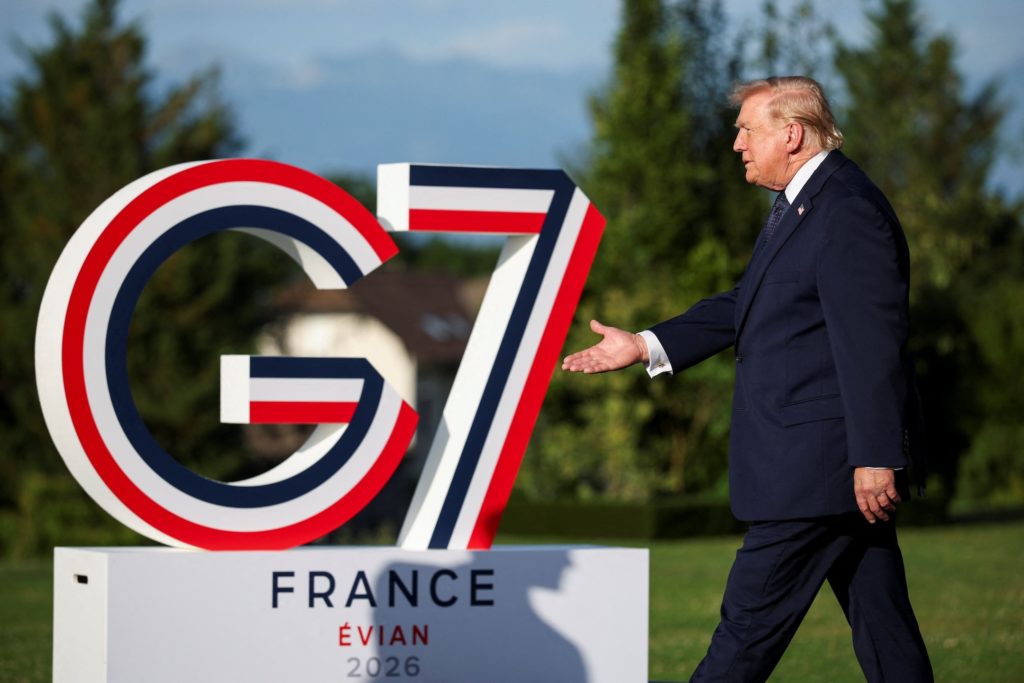
The United States and Iran appear closer to extending their shaky ceasefire after both sides electronically signed a memorandum that aims to end the war. But key questions remain ahead of its official signing later this week. The deal was center stage in France on Monday, where President Trump joined other world leaders for the G7 summit. Liz Landers reports. William Brangham: Welcome to the "News Hour." The president and his top lieutenants spent today heralding an initial deal signed electronically to extend the cease-fire and reopen the Strait of Hormuz. The war with Iran began with U.S. and Israeli attacks nearly four months ago. But details and key questions remain murky ahead of an official signing later this week. The talk of a deal was center stage in France today, where President Trump joined other world leaders for the G7 summit. White House correspondent Liz Landers begins our coverage. Liz Landers: Today, all eyes were on the quiet French alpine town of Evian for the annual G7 summit. President Trump arrived to again herald the news of a weekend cease-fire deal, which he says will bring an end to the U.S. war with Iran. President Donald Trump: The deal's all signed, and the Strait is already partially open. Liz Landers: Alongside French President Emmanuel Macron today, Trump lauded it as a major step forward. Donald Trump: A lot of great things are going to happen in the Middle East right now, and, very importantly, the oil is plummeting down and the stock market is shooting up like a rocket. And the main thing is that Iran will not have a nuclear weapon. They fully agree to that with strong policing powers, and they won't have a nuclear weapon, which is what it was all about. Ursula Von Der Leyen, President, European Commission: Let me start also by welcoming the agreement reached between the United States and Iran. Liz Landers: World leaders attending the summit were cautiously optimistic about the agreement brokered by Pakistan and Qatar. The text of the memorandum has not been released, though a senior U.S. official said it would be within 24 to 48 hours. Officials say it would bring shipping through the Strait of Hormuz back to pre-war levels, adding that the priority will be on heavy tankers with oil and gas. Last night, President Trump proclaimed -- quote -- "Ships of the world, start your engines. Let the oil flow." But a U.S. military advisory to merchant ships warned the blockade will remain in place -- quote -- "pending execution of the deal." Esmaeil Baghaei, Iranian Foreign Ministry Spokesman (through interpreter): Over the past 24 hours, we have witnessed major developments. Liz Landers: Today, a spokesperson for Iran's foreign ministry emphasized additional terms. Esmaeil Baghaei (through interpreter): The release of Iran's foreign or restricted assets alongside the issue of compensation for damages are two important economic matters. The American side is committed to taking action in both cases. Liz Landers: Vice President J.D. Vance reiterated the ultimatum on CBS this morning. Iran will only get their side of the deal, including a $300 billion reconstruction fund, if they cooperate. J.D. Vance, Vice President of the United States: When people say that billions of dollars of assets will be released, that's not true. What is true is that Iran will have a much better and much more prosperous future if they meet the obligations they make in this agreement. We will of course, see. That's one of the things we're going to work out in the technical talks that will follow the official signing on Friday. Liz Landers: A senior U.S. official said that the amount of Iranian assets unfrozen by the United States or any other country remains at zero. Another condition, peace in Lebanon. Iran says the memorandum calls for -- quote -- "respect of Lebanon's sovereignty and territorial integrity." But since the announcement, Israel launched another drone strike there, killing one person, and Israel's defense minister said the military will not withdraw from land already seized in Lebanon. One senior U.S. official says that the Israeli withdrawal from Lebanon is not a condition of the agreement between the U.S. and Iran, adding that if Iran does not -- quote -- "control" the militant group Hezbollah and that group attacks Israel, they will -- quote -- "have the right to defend themselves and respond." At a news conference this afternoon, Israel's Prime Minister Benjamin Netanyahu doubled down. Benjamin Netanyahu, Israeli Prime Minister (through interpreter): We will need to continue to be vigilant, to remain strong and determined, to defend ourselves as necessary. This is true not only against Iran, but against Iran's terrorist arms, which we have struck in an unprecedented manner. Liz Landers: Still, news of the deal brought hope to more than the one million people in Southern Lebanon, whose lives have been uprooted by the fighting. Today, for the first time in months, some families returned to where their homes once stood, devastated, but at the same time anxious to rebuild. Ali Haydar, Nabatiyeh, Lebanon, Resident (through interpreter): This used to be our home, our childhood home, where we grew up, and now it's gone. At the end of the day, this is our country, and we must return, even if it's destroyed. We will return to rubble and sand. It's better than being displaced. Liz Landers: As the terms of the formal deal are hammered out in weeks to come, the U.S. military presence in the region will stay at current levels, according to one official, who says the administration hopes to draw those 50,000 military personnel down soon, but it's not happening yet. The vice president, Jared Kushner, and Steve Witkoff are all expected at the signing ceremony on Wednesday on Friday, in addition to Iranian officials, according to a senior U.S. official. Just to underscore the uncertainty here with this memorandum of understanding, the president told reporters today in France that the text would be released by Friday, while senior U.S. officials who briefed reporters earlier today told us it would be between 24 and 48 hours that we would see that. William Brangham: Liz, as you mentioned, President Trump landed in France for the G7 summit, but not before last night he attended this unprecedented Ultimate Fighting Competition cage match. Liz Landers: Yes. William Brangham: You have done a lot of reporting on this. Tell us about that. Liz Landers: It was a spectacle at the White House last night. It marked President Trump's 80th birthday. This is the second year in a row that he has had a big celebration. Last year, it was that military parade near the White House. And there were a number of notable attendees who were there last night, including David Ellison, the CEO of Paramount, who had the exclusive streaming rights to the fight last night, Mark Zuckerberg, the CEO of Meta, Pope Leo's brother. I was asked by ambassadors in the last few weeks if I knew how to get tickets. That's how hot this was to try to get there here in D.C. There were also military personnel who were in attendance there last night. And there were military assets, like the Blue Angel fighter jets that flew over the White House twice last night. As someone who covers the White House, I was amazed to see how they staged some of these very formal rooms and the whole campus really into this UFC fight night. The Diplomatic Room, where you usually see heads of state come and go, that was the staging area where fighters were waiting before they walked out onto the South Lawn. The Eisenhower executive office building was a sort of warm-up area and locker room for some of these fighters as well. And the fights themselves went into the wee hours of the night. One of the fighters though, sort of drummed up controversy with some inappropriate and offensive comments about the former first lady Michelle Obama, saying that -- quote -- "She was a man." He presented President Trump with a chain -- this was Josh Hokit -- and then said these comments shortly after. Dana White, the head of UFC, was asked about this by "TIME" magazine. And he said in a text message: "I understand that the Obamas are public figures, but I'm completely against saying nasty and false things about people's families. Everyone knows my position on free speech, but I hate that kind of nonsense." White also said that he is not expected to stage anything like this again at the White House because he can't afford to do it. William Brangham: Incredible event last night. I also want to ask you about this other controversy. And that is the legal fight over the removal of President Trump's name from the Kennedy Center. Tell us about that. Liz Landers: This has been a controversy since the Trump-appointed board added his name in December to the facade and to all the branding around the Kennedy Center. There's been a legal fight that has been playing out since. And a judge decided at the end of May that the board acted beyond their authority and said that they had to remove his name. I got this memo a few days after that judge's decision. And it came from the general counsel of the Kennedy Center. And it was sent to all the staff there. And it directed them to take the president's name off of all the signage there, off of their Web site. And it said that everything, including the brochures and the signage in front, had to be removed by June 12. That was on Friday. The board of the Kennedy Center filed this late motion. It was rejected by the judge. So, Friday night, there was this spectacle around the Kennedy Center. People were watching. And there were tarps in scaffolding that went up. And the president's name was removed from the Kennedy Center on the late hours of Friday into the early hours of Saturday there. But it was not visible to the public when it came down. So I asked the Kennedy Center about this tarp still being up there. And the Kennedy Center spokesperson told me that the scaffolding and tarp will remain up as crews address maintenance needs of the marble and the soffit panel, William. William Brangham: Liz Landers, thank you so much. Liz Landers: Of course.
<small>Source: PBS NewsHour</small>