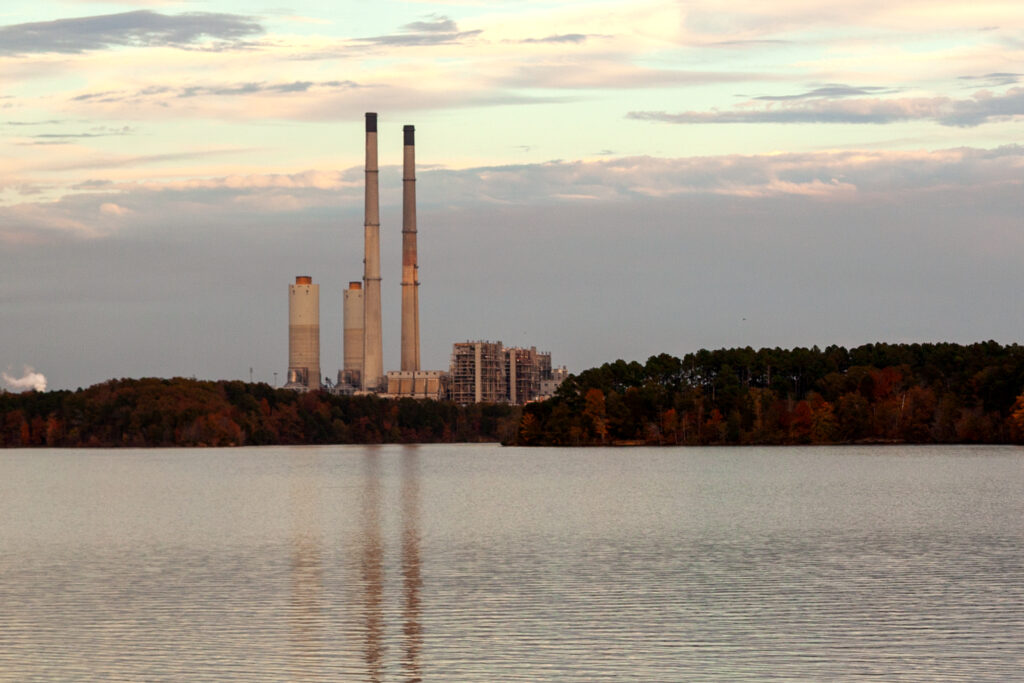
Duke Energy could receive $28.4 million in taxpayer money to upgrade two coal-fired power units in Person County, North Carolina, where residents are already contending with the construction of new natural gas plants, a pipeline and a proposed Microsoft data center.
The Roxboro plant in Person County is one of 13 projects nationwide expected to
receive grant funding from the U.S. Department of Energy. The agency is invoking the Cold War-era Defense Production Act to fund the projects as critical to natural security, in the latest push by the Trump administration to boost the climate-damaging fossil fuel.
The utility will negotiate the terms of the grant with the agency over the next six months, according to the agreement, with an implementation date between 2027 to 2029. Duke is matching the federal money with $44 million in ratepayer funds.
Duke applied for the grant funding late last year to improve Units 2 and 3 through plant boiler fan, turbine and pulverizer projects, according to a utility spokesperson. The units are scheduled to burn coal until retiring Jan. 1, 2034.
“This funding supports previously planned critical upgrades that help ensure we can continue delivering reliable power to our North Carolina customers while keeping costs as low as possible,” said Kendal Bowman, president of Duke Energy’s utility operations in North Carolina, in a prepared statement.
“As our state continues to grow, investments like these help us meet increasing demand, support local communities and maintain the dependable service our customers expect.”
Units 1 and 4, which also burn coal, are scheduled to be phased out as two new natural gas plants come online by Jan. 1, 2029.
The Roxboro plant is 60 years old and sits on the shores of Hyco Lake 1.5 miles from an elementary school. In 2020, state environmental regulators
required Duke to excavate 17 million tons of coal ash stored at the plant’s west basin and two extension impoundments. The material is being moved to a double-lined landfill on-site.
The cleanup is scheduled to be complete by 2036.
Previously, the unlined coal ash basins leaked and contaminated some private drinking water wells near the facility. Duke provided alternate water supplies to nearby residents as part of a 2019
settlement agreement between the utility and environmental groups.
“The Roxboro coal plant is a source of toxic coal ash that contaminated an entire community’s well water,” said Steph Gans of Clean Water for North Carolina, which has advocated for the residents. “Using the Defense Production Act to allow Duke Energy to produce more coal ash while the EPA seeks to weaken
coal ash regulations is not keeping Americans safe. It is choosing to put them in harm’s way.”
The grant does not alter the coal-fired plants’ retirement dates, according to the utility.
However, the N.C. House of Representatives passed a bill this week that would require the state Utilities Commission to allow Duke to operate the coal and natural gas plants until it receives a certificate of public convenience and necessity for a large nuclear facility.
Duke has not publicly identified a location for that facility, although Utilities Commission filings show it is scheduled to receive the certificate in 2028. That would predate the plant retirements, but the schedule is subject to change, and nuclear plants are routinely delayed.
Although the legislation is titled the “Ratepayer Protection Act,” customers will likely face higher bills as fuel and construction costs rise, critics say. The measure also could allow Duke to forego its goal of net-zero carbon emissions by 2050.
The bill now goes to the Senate.
Proponents of the bill, including state Rep. Dean Arp, a Union County Republican, say coal and natural gas are necessary for reliability. They cite Winter Storm Elliott in 2022, when several utilities in the eastern and southeastern U.S., including Duke, had to curtail power.
But the coal-burning Roxboro was among the plants that failed, prompting Duke to institute unprecedented rolling blackouts for 500,000 customers on Christmas Eve. Frozen switches and sensors tripped a pump that fed a boiler, according to
N.C. Utilities Commission documents.
Several coal conveyer belts broke down, although documents show that failure was not weather-related.
The blackouts were not solely related to mechanical issues, according to a North American Electric Reliability
report. Duke significantly underestimated demand and couldn’t purchase power from other utilities, which needed it for their own customers, the report said. Automated software to manage the outages also failed.
Meanwhile, Duke, which earned $5 billion in profit last year, is asking the Utilities Commission to approve a 15 to 18 percent rate hike. The commission has been holding public hearings, where hundreds of Duke customers have testified about the financial burden of an additional $30 to $40 on their monthly electric bills.
The additional revenue would pay for distribution, transmission and power plant projects, as well as the legally required excavation and cleanup of coal ash basins, including those at Roxboro.
Other projects near the Roxboro facility include Enbridge’s T15 natural gas pipeline to fuel Duke’s new plants and a proposed Microsoft data center on 1,300 acres bought from Person County.
“During Duke Energy’s rate hike hearings this year, customers said again and again how they resented being charged for Duke Energy’s coal ash clean up,” Gans said. “This action will keep those high costs going into the future.”
About This Story
Perhaps you noticed: This story, like all the news we publish, is free to read. That’s because Inside Climate News is a 501c3 nonprofit organization. We do not charge a subscription fee, lock our news behind a paywall, or clutter our website with ads. We make our news on climate and the environment freely available to you and anyone who wants it.
That’s not all. We also share our news for free with scores of other media organizations around the country. Many of them can’t afford to do environmental journalism of their own. We’ve built bureaus from coast to coast to report local stories, collaborate with local newsrooms and co-publish articles so that this vital work is shared as widely as possible.
Two of us launched ICN in 2007. Six years later we earned a Pulitzer Prize for National Reporting, and now we run the oldest and largest dedicated climate newsroom in the nation. We tell the story in all its complexity. We hold polluters accountable. We expose environmental injustice. We debunk misinformation. We scrutinize solutions and inspire action.
Donations from readers like you fund every aspect of what we do. If you don’t already, will you support our ongoing work, our reporting on the biggest crisis facing our planet, and help us reach even more readers in more places?
Please take a moment to make a tax-deductible donation. Every one of them makes a difference.
Thank you,
<small>Source: Inside Climate News</small>