Maria Ramirez Uribe
Maria Ramirez Uribe
Leave your feedback
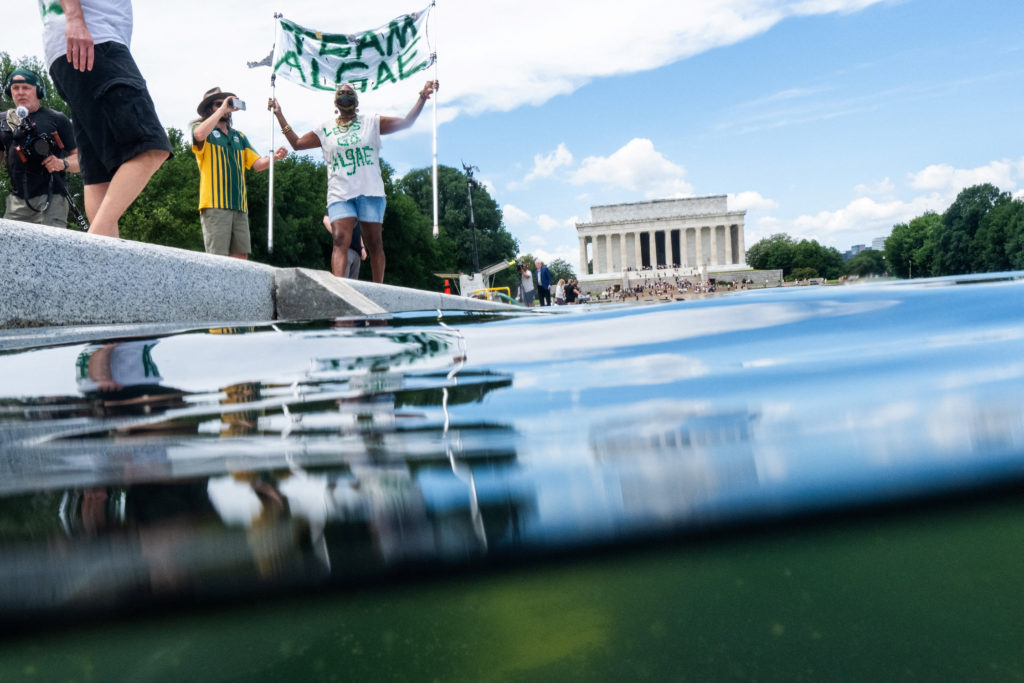
Green water, floating liner chunks, and workers dumping jugs of hydrogen peroxide. These are the images that have characterized the Lincoln Memorial Reflecting Pool in the weeks since its reopening following President Donald Trump's ordered renovations.
Pool and environmental science experts told PBS News the algae bloom is a common and natural occurrence.
Trump says otherwise.
Without evidence he has blamed people of vandalizing the Reflecting Pool by using a "box cutter or a knife" to make a 300-foot slit on the bottom of the pool and dumping "fertilizer in the water" to produce algae.
WATCH: Plagued by algae and peeling paint, Reflecting Pool set to undergo more repairs
Six people have been arrested for vandalism, Trump said in a social media post Tuesday. Among the arrested is former U.S. Olympic canoeist David Hearn who said he was detained after touching part of the loose coating that was still attached to the bottom of the pool.
Subscribe to Here’s the Deal, our politics
newsletter for analysis you won’t find anywhere else.
Thank you. Please check your inbox to confirm.
Trump announced his plans in April to refurbish the Reflecting Pool, which he described as a "dirty disgusting place," in preparation for the country's 250th anniversary. At the time he said the pool's renovation, which included painting the bottom "American flag blue," would take around two weeks, cost up to $2 million and last "30, 40, 50 years."
Two months later, the project has cost $14 million so far and is expected to require additional repairs, including emptying the pool again.
Here's what we know.
Algae is a naturally occurring, microscopic organism that feeds off nutrients such as nitrogen and phosphorus. It's likely the water used to refill the Reflecting Pool had enough of those nutrients for the algae to grow, experts told PBS News. And the warm weather, sunlight and stagnant water gave the algae the perfect conditions to thrive.
Steve Goodale, a swimming pool expert, refers to this phenomenon as "new pond syndrome." As a new pool starts filling up, there's the opportunity for algae to form because there isn't enough beneficial bacteria yet present to counteract the plant-like organisms.
Algae blooms in the Reflecting Pool are neither new nor unique, especially in the hot summer months.
A combination of pictures show the renovations of the Reflecting Pool taken June 12, June 16 and June 18, 2026, which was painted blue at the directive of President Donald Trump, ahead of the 250th anniversary of U.S. Independence, in Washington, D.C. Photos by Eric Lee, Evan Vucci and Annabelle Gordon/Reuters
"D.C. is a wet humid climate with plenty of sunlight and lots of natural and human-caused nutrients. We expect to see algae growth in all stagnant water bodies," Jason Davison, an assistant professor of civil and environmental engineering at Catholic University, said in an email. "It is honestly unrealistic to eliminate all algae growth in a Reflecting Pool."
Problems with the Reflecting Pool have been ongoing since its 1924 completion. A 2009 National Park Service report details two cleanings in 1978 during which 10 to 15 truckloads of debris were removed from the pool each time. Weeks after a $34 million renovation under former President Barack Obama's administration, the pool was covered in algae, The Washington Post reported at the time.
"The pool covers nearly eight acres of surface area and contains more than six million gallons of water, making it fundamentally different from a typical swimming pool or fountain," said Tim Auerhahn, chair of the Aquatic Council, in an email. "Large, shallow bodies of water exposed to sunlight naturally create favorable conditions for algae growth, which is why maintaining clear water has historically been an ongoing management challenge."
Water for the Reflecting Pool comes from the Tidal Basin, which is connected to the Potomac River. The water goes through a filtration system that is intended to treat the water to reduce the nutrients algae feeds off of, Davison said.
However, it's difficult for a filtration system to control algae in such large bodies of waters, Greg Boyer, a professor emeritus of biochemistry at the State University of New York, said in an email.
Water experts said it's unclear to what extent Trump's renovations led to the algae blooms.
"His renovations at best had no effect," Boyer said, adding that they did not address underlying issues. "At worst, painting the bottom a dark color increased the warming of the pool and made things worse."
Watch the clip in the player above.
Even though the darker paint color isn't the main reason for the algae growth, "open air aquatic systems are intensely complex, so changing even small variables can have big (sometimes unexpected) results," Goodale said in an email.
In response to the algae blooms, workers started dumping containers of hydrogen peroxide into the reflecting pool.
Hydrogen peroxide acts as an oxidizer that kills algae. It's effective in killing blue-green algae in "some but not all situations," Boyer said.
The method seems to have worked on the pool's blue-green algae, also known as cyanobacteria, said Hans Paerl, an environmental sciences professor at the University of North Carolina at Chapel Hill. This type of algae can be toxic.
As the hydrogen peroxide knocked out the blue-green algae in the pool, it made room for "a more persistent and harder-to-get-rid-of green algae," to grow, said Wayne Carmichael, a biological sciences professor at Wright State University.
A National Park Service worker dumps bottles of hydrogen peroxide in the Lincoln Memorial Reflecting Pool on June 16, 2026 as part of their effort to mitigate an algae bloom which followed the completion of recent renovations in Washington, D.C. Photo by Jonathan Ernst/Reuters
The National Park Service has also been implementing a nanobubble filtration system to counteract the blooms. The technology uses tiny bubbles, which don't float to the surface, to kill algae and suppress the phosphorus it feeds off of, Goodale said.
However hydrogen peroxide and nanobubble technology is "a management technique," Carmichael said. "It's not a remediation or prevention technique,"
The experts PBS News spoke with agreed that the algae is likely to return unless there are larger structural changes made to the Reflecting Pool.
"Successful algae management in a body of water this large typically requires a comprehensive approach that includes circulation, filtration, chemical treatment, and ongoing maintenance," Auerhahn said.
Trump has repeatedly made unverified claims that the problems with the Reflecting Pool are a result of vandalism.
"It is absolutely impossible that anyone could have inoculated that pool and shown an effect in literally hours," Carmichael said. "Absolutely a silly notion."
READ MORE: Fact-checking Trump on National Mall's Reflecting Pool renovations
Paerl said adding any amount of algae from a lab or the outside to the Reflecting Pool would "have a very minimal effect."
Goodale agreed, saying the size of the pool is so large that adding any small amount of fertilizer "would be diffused into a massive body of water."
He said one way to investigate these claims would be to test the amount of phosphate in the source water that was used to refill the Reflecting Pool and compare it to the pool's current phosphate levels.
Paint peels from the bottom of the Lincoln Memorial Reflecting Pool on June 18, 2026 after recent renovations following a directive from President Donald Trump to paint it blue ahead of the 250th anniversary of U.S. Independence, in Washington, D.C. Photo by Annabelle Gordon/Reuters
Asked by a reporter for evidence of the vandalism, Trump said he had seen the slit in the pool lining and said the government had pictures that would be shown in court.
Goodale said he has seen no evidence of such an act and noted that a delamination tear could be confused for purposeful damage as they can look similar.
"My experience with interior surfaces similar to the products used in the Reflecting Pool renovation is that they are extremely strong, durable and relatively puncture resistant," he said in an email. "That is precisely why products like this are used in commercial and industrial environments."
Goodale emphasized the complexities of installing surface coatings such as the one used in the Reflecting Pool. He said there are several variables that need to be accounted for when preparing and installing surface lining. Problems with any of those variables "could lead to a systemic failure of the system as a whole."
"It is literally a technical masterclass of challenging conditions," he said.
Support trusted journalism and civil dialogue.
Support Provided By:
Learn more
<small>Source: PBS NewsHour</small>