Earth is the only planet we know of with buoyant, silica-rich continents. But, despite decades of research, geologists still don’t agree on how they formed. “The continents started appearing around about four billion years ago—that’s the oldest continental rock we know about,” said Tim Johnson, a geologist at Curtin University in Perth, Australia. “The Earth is four and a half billion years old, so why they started appearing then is unknown, as is the mechanism to make that continental crust.”
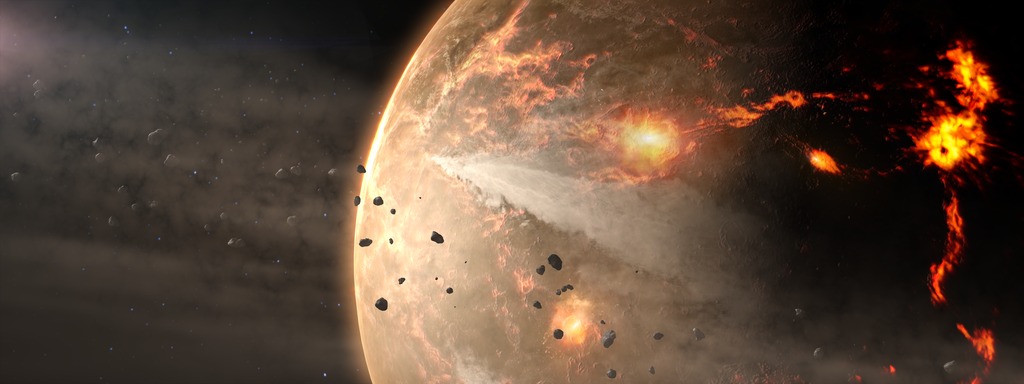
Johnson and his colleagues are now arguing that the formation of continents on Earth was caused largely by an intense, sustained barrage of asteroid impacts that kept the early crust hot and thin enough to make buoyant continents possible. In short, the lands we live on are here because of ancient bombardment from space.
Plates and plumes
The problem with studying the formation of continents is that the geological evidence of this process is almost gone. The oldest known continental-type rocks crystallized around 4.03 billion years ago, right at the end of the Hadean eon (the earliest era in Earth’s history, spanning the first 500 million years of its existence). Rare basaltic rocks date back about 4.2 billion years, and a handful of the oldest zircon crystals push the record back to 4.4 billion years. Beyond that, there’s hardly anything else. So, scientists looking into the origin of continents had to rely largely on educated guesses. “There are huge debates about what was going on in the early Earth, because the data is so scarce,” Johnson said.
One dominant idea holds that plate tectonics, much like today’s, was already running in the Hadean, with continental crust forming above subduction zones—areas where tectonic plates collide. The other claims that early Earth was too hot for rigid plates, and that crust instead formed above mantle plumes rising from deep within the planet, a phenomenon comparable, Johnson said, to the wax blobs rising inside a lava lamp.
<small>Source: Ars Technica</small>