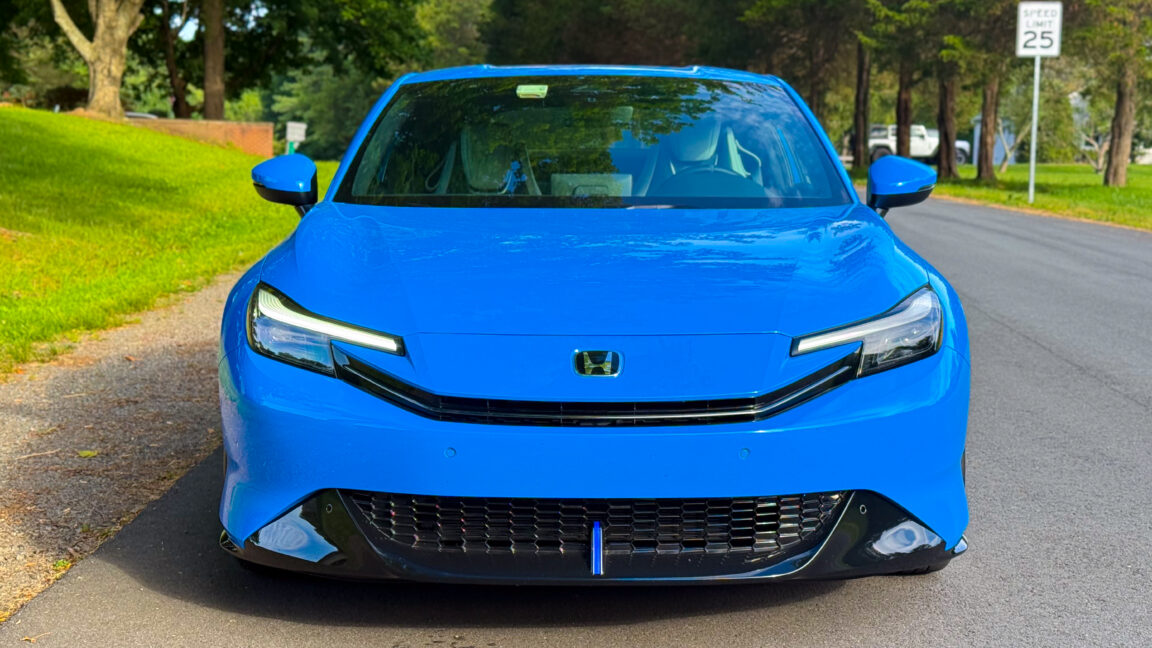
You can tell Honda was trying to manage expectations when it emailed me to stress that “the Prelude is not a sports car.” And I can understand why. On paper, the specs make the sleek coupe—technically a three-door hatch—seem underwhelming. Especially if you start comparing it to alternatives.
A Mazda MX-5 or Subaru BRZ weighs hundreds of pounds less, and the Subaru packs more power than the Prelude’s 200 hp (149 kW). A Volkswagen Golf GTI weighs about the same as the Prelude at 3,261 lbs (1,479 kg), but it delivers 20 percent more power and offers rear seats that actually accommodate adults. But after a week with the bright blue Prelude, it’s hard to care about the specs. This might be one of the best cars we’ll drive all year.
Then again,
looking back across the previous five generations, the Prelude was never really a sports car. It has always been a technology showcase for Honda, introducing features like fuel injection, four-wheel steering, variable valve timing, and active torque transfer. For the sixth-generation Prelude, the headline feature is Honda’s S+ shift, which adds some sporty character to the OEM’s four-cylinder hybrid.
Fuel sipper
Most of the time, the front wheels are driven by the Prelude’s 181 hp (135 kW), 232 lb-ft (315 Nm) electric traction motor, which is powered by either the 1 kWh battery for a pure EV drive or the 2.0 L four-cylinder Atkinson cycle engine via a second electric motor/generator unit that converts the engine’s output into electrical energy for use by the traction motor. But like the Chevrolet Volt and some other hybrids, the gasoline engine can directly drive the front wheels at highway speeds, where it’s more efficient.
And efficiency is the name of the game, resulting in a combined 44 mpg (5.3 L/100 km). On a full tank, that means 466 miles (750 km) between fueling stops—talk about a proper grand tourer. And if you leave the drive mode set to Comfort and never touch the paddles behind the steering wheel or the big round S+ button on the center console, the new Prelude might just be a slightly less efficient two-door Toyota Prius lookalike. (At least head-on—I still don’t know how Honda’s designers got away without a cease and desist from their colleagues at Toyota for using a near-identical front.)
<small>Source: Ars Technica</small>