In 2011, a short but catastrophic cloudburst hammered Copenhagen, flooding parts of the Danish city with more than 5 inches of rain in a single day.
The storm caused more than $1 billion in damages. It also catalyzed a
transformation across the city. Officials spent the next decade implementing a matrix of green spaces and engineered stormwater infrastructure to sop up future flooding.
Other cities around the world—from Hong Kong to New York—have adopted similar green-gray approaches to curb urban inundation. But as the aptly named “Sponge City” movement grows worldwide, experts say major challenges are keeping cities from reaching their full spongy potential. And with global warming giving rise to wetter storms and more severe droughts, research shows nature’s absorbent abilities are being pushed to the brink.
Sponge Cities
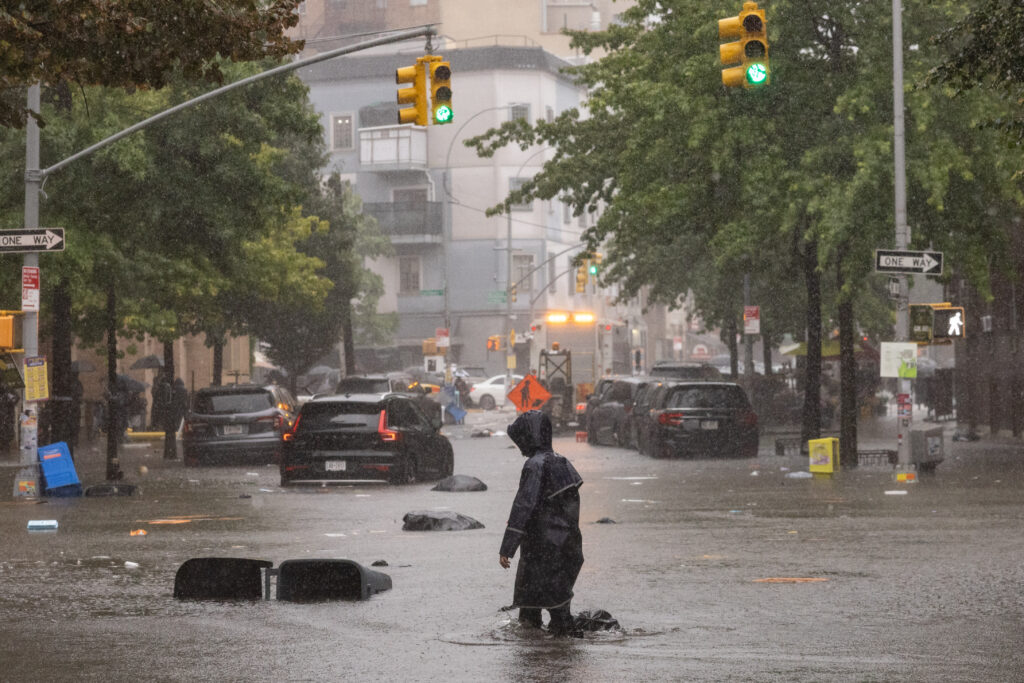
From sprawling skyscrapers to busy highways, many of the characteristics that make major cities so iconic also put them at risk of severe flooding. When a rainstorm hits, the mostly impermeable materials used to construct roads and sidewalks—such as concrete and asphalt—often wick water into other streets or storm drains.
“We superimposed what we wanted onto the landscape … and then by doing that, we essentially sealed the surface of the landscape,” Franco Montalto, a civil engineer at Drexel University, told me.
While these drainage systems may have held up to storms when they were first constructed, many aren’t equipped to withstand the increasingly severe rainfall brought by climate change, he added.
In New York City, for example, roughly 60 percent of the sewers are part of a centuries-old combined system where stormwater and sewage run through the same pipes to wastewater treatment plants. That means extreme rain events often trigger sewage overflows into key waterways, as my
colleague Lauren Dalban reported in 2024. As an NYC resident, I’ve seen (and smelled) this firsthand.
But in recent years, the
Big Apple and many other American cities experiencing similar problems have spent billions of dollars installing a mosaic of rain gardens, green roofs, constructed wetlands and other stormwater-control measures. In Los Angeles, green spaces and shallow basins with porous soil implemented in recent years helped soak up 8.6 billion gallons of water when an atmospheric river hit in 2024, as I covered that year.
The problem? At the moment, these green-gray efforts are more of a patchwork than a network in the U.S., according to Montalto.
“I think the problem with the way green infrastructure has happened in the United States is that it’s been this sort of opportunistic approach where we do it where we can, where it’s easy, where it’s not too expensive, and that hasn’t really turned out to be enough,” he said. “Yes, we have a lot of green infrastructure, but that green infrastructure is not designed, cited, scaled [and] implemented in a way that helps us to reduce flood risks from the extreme events.”
That’s partially because it’s difficult and costly to retrofit existing city infrastructure to accommodate the amount of green space and engineered stormwater structures necessary to take on climate-fueled inundation. Montalto noted the sponge city concept is a “more radical transformation of landscapes,” and that some areas in China—where the sponge city movement took off after Chinese President Xi Jinping endorsed it about a decade ago—are seeing more success because officials are able to integrate this effort earlier in the process of urbanization.
On top of that, extreme storms supercharged by climate change may hinder nature’s ability to help us handle them, experts say.
Nature’s Sponge
A
study published in May forecasts that the annual rainfall in much of the world will condense: more rain falling in heavy storms faster than the land can absorb it, which means that the water pooled on the surface is more readily evaporated. Overall, this phenomenon actually dries out the land, the research found.
Additionally, prolonged droughts can also kill organic matter and dry out certain types of soils enough to make them relatively hydrophobic, repelling rainwater rather than soaking it in.
Too much water
can also be bad, as any plant owner has likely learned the hard way. In 2021, China’s Zhengzhou—which has invested billions to construct sponge city elements—was overwhelmed by the heaviest rainfall in the city’s recorded history. Experts told Reuters that it’s doubtful any level of green infrastructure in the developed area would have been able to handle this storm, which brought more than a year’s worth of rain in a few days.
“There’s kind of a sweet spot, like you want your soils to be a little bit wet,” climate scientist Justin Mankin told me. He’s an associate professor of geography at Dartmouth College, and he co-authored the May study.
But Boise State University climate scientist Jen Pierce stressed that increasing tree cover and vegetated areas in cities has a number of benefits for people and the environment, including
improving mental health, cleaning up waterways and absorbing climate-warming carbon. And even in the most severe storms, green spaces are always going to be better at absorbing water than impermeable cement or asphalt, she told me.
“If you’ve already paved paradise and put in a parking lot,” Pierce said, “then you really don’t have many options.”
More Top Climate News
Last week, a federal judge temporarily blocked the Trump administration’s effort to remove or edit signs and materials at national parks that “inappropriately disparage Americans” or cast the United States “in a negative light,”
Maxine Joselow reports for The New York Times. After President Donald Trump issued the directive, the National Park Service took down signs all over the country related to such issues as slavery, racial inequality and climate change. In this latest ruling, the judge wrote: “Not only does this undermine the integrity of the national parks; it sets a dangerous precedent of censorship and sanitization.”
An Ebola virus is spreading across Africa, with hundreds infected in the hardest-hit Democratic Republic of the Congo. Humans aren’t the only ones at risk: Experts are concerned the outbreak could hurt vulnerable western lowland gorillas in the country,
Kayleigh Long reports for Mongabay. The DRC has had at least 17 Ebola outbreaks over the past 50 years, and many of them have jumped into critically endangered gorilla populations, killing thousands of the animals since the early 2000s. The gorillas’ highly social nature makes them more at risk of spreading the disease if they catch it, according to virologists.
A new United Nations report found that around half of the world’s children are regularly exposed to at least three climate hazards,
Mason W.C. Bunting reports for the Guardian. From heat waves to intense floods, these threats are disrupting pediatric health, education and quality of life. Developing countries are most affected, though children in high-income countries are not immune, according to the report.
“The lives of children continue to be upended by the impact of heatwaves, wildfires, droughts, and floods,” Catherine Russell, executive director of the United Nations Children’s Fund, said in a statement.
About This Story
Perhaps you noticed: This story, like all the news we publish, is free to read. That’s because Inside Climate News is a 501c3 nonprofit organization. We do not charge a subscription fee, lock our news behind a paywall, or clutter our website with ads. We make our news on climate and the environment freely available to you and anyone who wants it.
That’s not all. We also share our news for free with scores of other media organizations around the country. Many of them can’t afford to do environmental journalism of their own. We’ve built bureaus from coast to coast to report local stories, collaborate with local newsrooms and co-publish articles so that this vital work is shared as widely as possible.
Two of us launched ICN in 2007. Six years later we earned a Pulitzer Prize for National Reporting, and now we run the oldest and largest dedicated climate newsroom in the nation. We tell the story in all its complexity. We hold polluters accountable. We expose environmental injustice. We debunk misinformation. We scrutinize solutions and inspire action.
Donations from readers like you fund every aspect of what we do. If you don’t already, will you support our ongoing work, our reporting on the biggest crisis facing our planet, and help us reach even more readers in more places?
Please take a moment to make a tax-deductible donation. Every one of them makes a difference.
Thank you,
<small>Source: Inside Climate News</small>