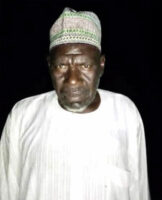
He’s now 78, being born in 1948. But tragedy struck very early in his life. And he has never remained the same again. He was jailed at 13 and regained freedom at 60.
Who is this? How did it happen? He told his story himself in a trending post. He put his face to the post. But opted to remain nameless. He’s entitled to his choice. And it is constitutional. His uncommon travails will touch you. And your innermost part.
The post went viral late last week. And here’s no stopping it. It’s overwhelming and bewildering. Ravaging our stifled and suffocated space. It instantly brought back eerie memories of my 32-day odd detention experience. Particularly at the Agodi Prisons, Ibadan, Oyo State.
Courtesy: Nigeria’s military maximum ruler and tyrant, General Sani Abacha. He and his evil cohorts made it happen to me. And 39 other “Prisoners of War.” So they chose to deride us and christened us. Without firing a shot. Yet they insisted we were captured on the war front. In thick of the Ibadan May Day Riots, 1998. One of the protests flowing from the annulment of June 12, 1993, election. The rest is a living history.
This post aptly tallies with those sordid reminiscences. It speaks volumes to the much-talked-about horrors in our prisons. Now deodorised as “correctional centres.” A poor wheelbarrow pusher, “jailed” at 13. Regained freedom at 60. And now 78. What’s correctional in that?
That’s how warped, bent, twisted and distorted they elect to run our justice system. Collapsing it by the second.
Dr. Lasisi Olagunju, Editor, Saturday Tribune, reinforced this much. He did it marvellously in his column, Monday Lines, this week. That’s the stuff he is made of. I remain eternally grateful to him. He extracted an intriguing part of my soon-to-come book detailing my detention days.
Instantly. That got me inspired. The urge made the re-run of that part of Olagunju’s piece inevitable. It will come after this post.
Have a bite of a lifetime tale of agony and excruciating pain. A moving horror. The unnamed author succinctly tagged it: “I was jailed at 13, regained freedom at 60.” Then, what followed? He poured out. His exact words:
“I was 13 years old, living in Maiduguri, the state capital of Borno. After school, I used to hawk sugar cane for my father. He was a sugarcane farmer.
“I still remember how he would hire a wheelbarrow for 20 kobo. We’d arrange the sugarcane on it and push it around the city to sell.
“On one fateful day, after school, I was pushing my sugarcane around. The weather was unbearably hot. Anyone who has lived in the North knows how hot Maiduguri can get. I was looking for shade under a tree to rest.
“In the process, I accidentally scratched and knocked off the headlight of a car parked by the roadside leading to the garage. I was terrified. I wanted to run, but my conscience wouldn’t let me. So, I stood there for 30 minutes, waiting for the owner.
“I didn’t know the owner was praying nearby in the mosque inside the park. When he came, I was still holding the broken side light in my hand. I couldn’t speak.
“Instead of listening, the man started beating me. People tried to intervene, but he brought out a pistol and threatened to shoot anyone who came close.
“He shoved me into his car and drove straight to the police station. That was when I realised he was a police officer. He ordered his men to put me in a cell. They obeyed.
“I spent the whole night there. No food, nothing. The only thing we got was bread that was shared among us in the morning.
“Around 10am the next day, one officer asked, ‘Who is this small boy?’
“A woman at the counter replied, ‘Oga said we should keep him there. Who are you to question Oga?’
“One week passed. Then two. One month. I kept asking myself: Has this man forgotten me? I tried to talk to the officers on duty. No one listened.
“I was barely 13 years. I cried every night, tasting the bitterness of life at such a young age.
“After a month, some officers gathered a group of us and took us to court. The court didn’t sit that day. The officer said, ‘let’s take them on remand.’
“That’s how I ended up in Maiduguri Prison. One year passed on remand. I was later drafted to the laundry section.
“After two years, I was moved out of Maiduguri. I didn’t even know where until a fellow inmate told me: Bauchi. By then I was 15.
“You never know where they’ll transfer you to. One morning they just wake you up, put you in a vehicle and take you to another state.
“From there I was transferred to prisons in the East and West, like someone serving in the force.
“My last stop before returning North was Ibadan prison. From there I was taken to Kano State prison. By then I was already 60 years old.
“Everyone called me ‘Baba in the prison’ I was well known. But no one believed my story. Behind those walls, people assume everyone is a criminal.
“God remembered me at 60. A governor visited the prison near the end of his eight years in office. As he walked through the yard, his eyes landed on me.
‘Baba, come here,’ he said. ‘How old are you, and what brought you here?’
“Tears fell. My heart was swollen, bleeding, empty. After 59 years, someone was finally asking what they should have asked many years ago.
“I am 60 years old, I replied. I came here when I was 13. Everyone shouted, prisoners and officials alike. Even the governor wept.
“I told him everything. How it happened. How I was moved from prison to prison. Even the condemned armed robbers in shackles were shivering as they listened.
“An investigation started. They found out the officer who put me in that cell was now a king — a respected and powerful monarch.
“The governor took me in his car, still in my prison uniform. The warders tried to make me change. The governor said no.
“When we entered the palace and our eyes met, the monarch lowered his head. He turned to the governor and asked, ‘will God forgive me?’ I made an emir cry.
“Rich people think money is everything. But money is not everything. He took my youth. He took my future. He took my life. I lost contact with my family. No one to trace. I became like an alien who came into the world alone. No mother, no father, no siblings. Though I had them, someone stole my identity.
“He stood up, held my shoulder, and said, ‘I will marry for you. I will build you a house. I will give you everything you want.’
“I replied, I don’t need a house or a wife. My life is prison, and prison is my life. At this age, what life will fit me? Is it kids? Is it a wife?
“He lowered his head. I told him, “In this life and the next, I will never forgive you.
“One of his guards in a red babariga tried to whip me with a koboko. They held his hand, and he got the insult of his life.
“After my last words, I walked out of the palace to wait for the governor outside. I was granted amnesty. The governor did everything for me. He even opened a provision shop for me.
“I’m 78 years old today. I am alive. Happy birthday to me.”
This pathetic post is similar to so many I encountered in Agodi Prisons. I saw them in legion. Languishing in jail for minor offences. But nobody cared to care for them. None wanted to hear them out. And oblige them a prized second chance.
Unknowingly but graciously. Olagunju picked one of such from my book materials. And crafted it beautifully for illustration of the metaphor playing out in Nigeria today. He wrote:
“Mr Femi Adeoti was the editor of the Sunday Tribune during the years of General Sani Abacha’s war against his enemies – the media and the political class. The editor published a story in May 1998 against Abacha and was arrested and detained at Agodi Prisons, Ibadan. There, he lived among, and interacted with, some of the most hardened inmates. He remained in custody until Abacha expired in June 1998.
“Because every good editor is first a reporter, Adeoti spent his days in prison harvesting stories. When he regained his freedom, he told story after story about the inmates and the circumstances that brought them to jail.
“The man published the first of his prison reports in the Sunday Tribune sometime in July 1998. I felt an irresistible urge to reproduce it here because I see it as a metaphor for what I feel about Nigeria and the leaders it is blessed with.
“The prison story: ‘In Agodi Prisons, Ibadan, I interacted with different characters. The moment they knew me as a journalist, I gained instant recognition and popularity. I kept receiving notes from the inmates—convicts and Awaiting Trial Males (ATMs). The characters were queer. Their stories were pathetic and interesting. The first person whose confession we will take today is a corpse robber.’
“The voice above is the editor’s. What follows is the prisoner himself telling his story, raw: ‘My name is…, but the inmates call me Orieku. I was born in 1972. I abandoned school in Primary Two. I just felt like leaving, so I left. I also left home in 1981. Since then, I have slept outside, mostly at Bode and under the Molete Bridge (Ibadan).
‘One night under the bridge at Molete, an elderly man walked up to me and woke me. He was surprised to find me under the bridge at that odd hour, sleeping alone.
‘He asked me to follow him to his house. He lived at Bode near Molete. It was at his house that I discovered he was a Babalawo (herbalist). I wanted to run away, but he calmed me down.
‘I told him how I ran away from home and that my father died in 1973. My mother abandoned me and married another man. I did not want to follow her to her new matrimonial home. The Babalawo said he had a good job for me if I would do it.
‘He told me he (Babalawo) specialised in using human parts for rituals and that he would like to recruit me to look for these human parts. He said I would look for where the dead had just been buried and go there in the night to exhume the body. That’s how I came into the business and became a corpse robber.
‘This Babalawo was the only customer I knew. He would tell me what part(s) of the body he needed. And I would go for it.
‘I had a very reliable informant. He knew almost every village around Ibadan. He would go into these villages to locate where they had just buried somebody. He would come back and give me a “perfect” description of the place. Unfortunately, this informant is dead now. I would go to the location in the dead of the night to perform the “operation.” I would dig the grave, bring the corpse out and cut whatever part I needed. I would then re-bury it.
‘I never cared to find out whatever happened after I might have exhumed the corpse. That was not my headache. Once I got what I wanted, my business with the corpse was over.
‘I did not spare even my relations in my business. I went for their body parts and made good use of them.
‘Christian corpses were very difficult to exhume. They were buried more deeply, unlike Muslim corpses.
‘I was in business as a corpse robber between 1981 and 1986. Prices for these human parts were very cheap. Maybe that Babalawo was cheating on me. He would pay N500 for head, N100 for fingers, N1,000 for the two eyes and N500 for tongue.
‘Throughout my career as a corpse robber, I sold only to that Babalawo. He would not allow me to sell to any other customer. He would always threaten me with charms.
‘Then I left the business. Why I left was a long story.
‘You see, my customer, that Babalawo, told me to look for the smallest toe on the left leg. And that it must be fresh. He said I must produce it within two days.
‘It was a difficult task. I got in touch with my informant. He set to work. He told me a man was buried that morning in central Ibadan. I will not tell you the exact area, because people will easily remember the man.
‘After giving the description, I prepared for my mission. I gathered my tools – digger (pick axe), cutlass and shovel. I set to work. I located the grave with ease because it is a popular area in Ibadan.
‘They buried the man in an uncompleted building. So, nobody stayed near the building. I started work at about 1:30am, the grave was not deep, so the job was easy.
‘Immediately I took the corpse out, I knew there would be trouble. The man was having beads on his neck, his two hands and legs. He was a Babalawo! I just summoned up courage and cut the toe. I put it back roughly and left the place hurriedly. I was afraid.
‘I went straight to my customer and gave him the toe. The Babalawo was very happy and told me to come back later in the morning for my money.
‘Because it was an emergency case, he said he would pay me N1,000 for the toe. I was happy and went home to sleep.
‘But when I woke up in the morning, the unusual happened. My wife suddenly woke me up and shouted: ‘What is wrong with your leg? Why the blood?’ I checked my leg and discovered that the smallest toe on my left leg was gone! The very toe that I cut from the dead Babalawo that night. I was terribly afraid and could not sleep again.
‘I jumped up and went straight to my customer’s house. Immediately he sighted me, he began to rain abuses on me. He was angry and cursing me. “Why should you cut your own toe for me because of N1,000?” he shouted at me. “Why didn’t you tell me it is your own toe? I wanted the toe of a dead person, not a living human being.”
‘I tried to explain, but he would not listen. He just threw the toe at me and refused to pay me any money. He said the toe did not work because it was the toe of a living person. I took the toe, wrapped it in paper and hid it from my wife. It became rotten and was carried away by a rat. The mark on my leg is this. You can see it (shows the editor his toeless leg).
‘Why do people call me Orieku (rat head)? Well, not much. They had wanted to call me Orioku (ghost head), but that would be too frightening. So, they chose Ori Eku.’
“Orieku said he left the business in 1986 and joined a popular theatre group in Ibadan as an apprentice. Then he diversified into petty stealing and burglary. It was that new vocation that took him to Agodi Prisons where he met the editor.”
No matter the state of the mind. Or how hardened the heart is. You can’t but be moved, scared and shivered. The tales are everything: dreadful, frightening, horrible, et al.
Yet. They’re true life stories. No pranks. No skits. No make-believe. The two narrations are unique in all senses. They are close relations; cousins, uncles and what have you…
The duo depicts our huge societal rots and failures. The absurdities ruling our waves, running us and ruining us.
Be expectant!
“Orieku” is just one of other equally weird stories embedded in my soon-to-come memoir.
It’s a comprehensive account of “My Sojourn Through Agodi Prisons.”
The book is almost here with us. Deep appreciation for being expectant.
The post Scary tales from our sordid past appeared first on The Sun Nigeria.
<small>Source: The Sun Nigeria — read the original story there.</small>