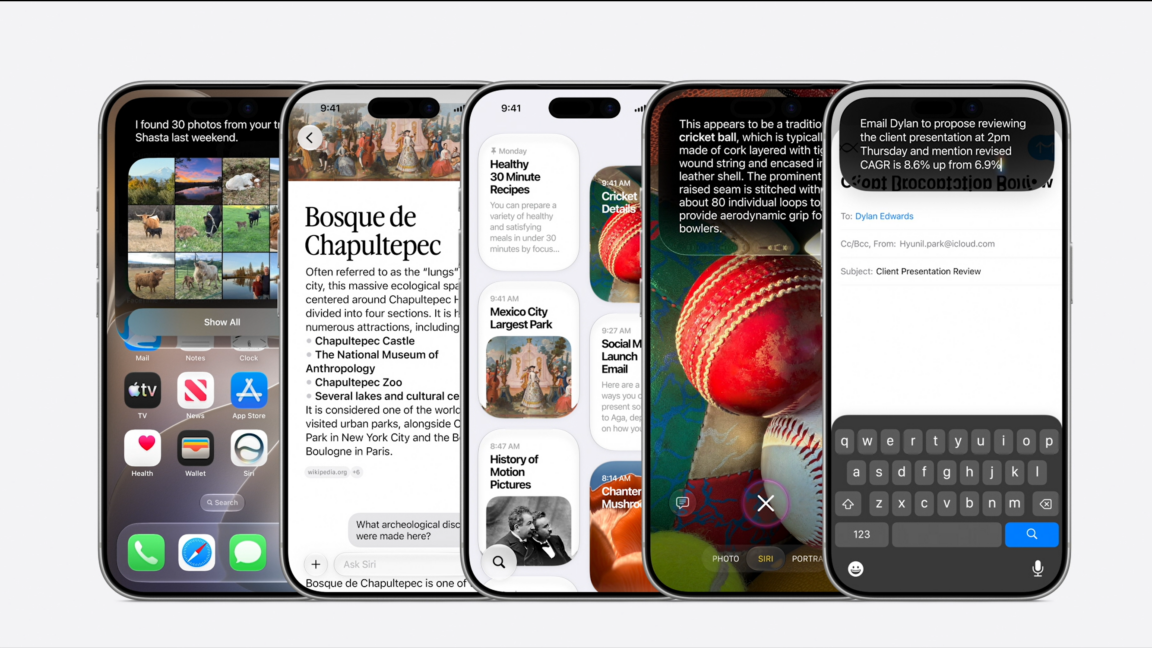
Today at its pre-filmed Worldwide Developers Conference keynote, Apple was finally prepared to fully introduce the
long-delayed “Apple Intelligence” update for its Siri voice assistant. The new “Siri AI”—now being promised for OS updates rolling out “this fall”—will come alongside a new Google-powered update to Apple’s on-device Foundation Models, as well as tighter integration of all these AI capabilities across Apple’s many operating systems.
Unlike other companies that “appear to be racing forward, seemingly pursuing AI for the sake of AI, with little regard for the people… it’s meant to serve,” Apple’s SVP of Software Engineering Craig Federighi said, “we believe that truly helpful AI must be centered around you and your needs.”
Just a friendly chat with your AI assistant
The company highlighted this kind of focus in
a series of scripted conversational demos with Siri AI, complete with seemingly unedited, multi-second pauses between each spoken prompt and Siri’s response. In these demos, Apple executives showed Siri AI bouncing between different usage modes and app-based tasks as needed in an effort to highlight how Apple Intelligence can now be used “well beyond one-shot tasks” for a “brand new conversational experience” with the virtual assistant.
In one example, for instance, a user asked about schedule information for the World Cup, followed by a request for recipes inspired by a Brazil vs Morocco match, then asked for a dessert he remembered had been mentioned recently by his friend Maria (which Siri found in his Messages app). He then asked Siri to integrate this all into a watch party menu and to send that menu to his group chat alongside an invite.
In another demo, the Siri conversation started with a question about where a photo of an arch was taken, then moved to finding the address of a friend named Jeff who had recently moved. With those answers in hand, Siri was able to “give me directions to the arch with a stop at Jeff’s” directly via Apple Maps, without having to juggle the information manually.
<small>Source: Ars Technica</small>