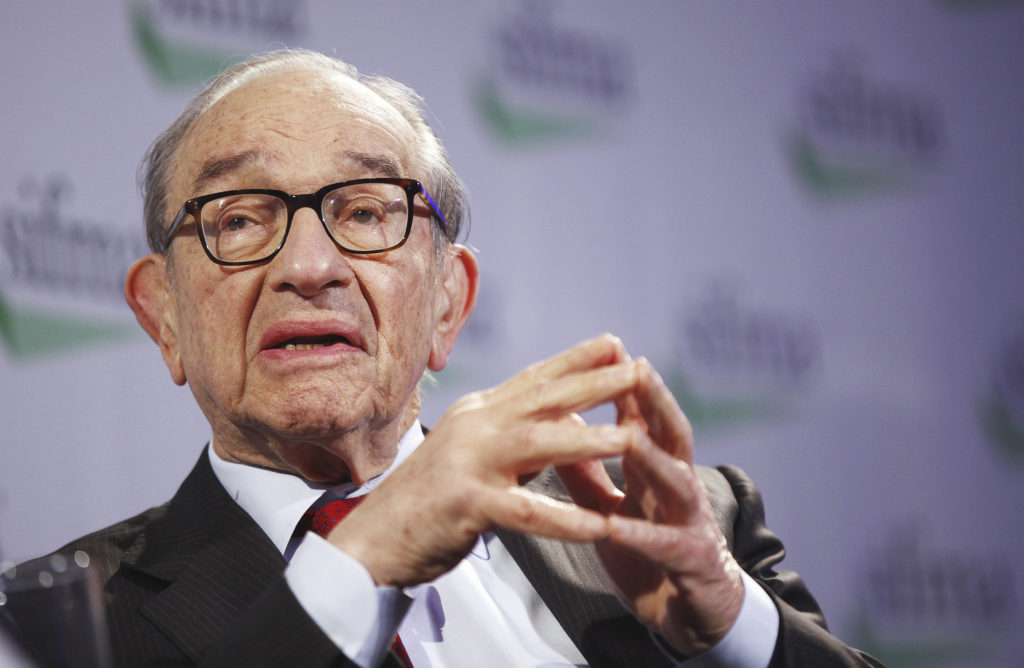
Alan Greenspan, the former chairman of the Federal Reserve, died Monday of complications from Parkinson’s at the age of 100. Greenspan was widely considered the most powerful Fed chair in modern times, largely presiding over a period of long prosperity, but his strong beliefs in the free market came under criticism during the financial crisis. Paul Solman looks back at Greenspan’s legacy. Nick Schifrin: Today, the former Chairman of the Federal Reserve Alan Greenspan died from complications of Parkinson's at the age of 100. Greenspan was widely considered the most powerful chair in modern times, serving for nearly two decades and largely presiding over a period of long prosperity. He was frequently credited for helping manage inflation and foster growth. But his strong beliefs in the free market and less regulation came under sharp criticism during the financial crisis. Paul Solman has our remembrance. Paul Solman: Alan Greenspan born in New York City in 1926, he told Jim Lehrer in 2007 that he was a whiz with numbers from the beginning. Alan Greenspan, Former Federal Reserve Chairman: The math was a big deal when I was very young and my mother used to parade me out. She would have me add 45 and 162 in my head. And I was a kid. And... Jim Lehrer, Co-Founder and Former Anchor, "PBS NewsHour": You were just being kind of there to show off for. Alan Greenspan: Showoff. Jim Lehrer: Yes. Yes. Yes. Alan Greenspan: I was a prop for parties. Jim Lehrer: You were, yes. Paul Solman: But Greenspan's first career was in music, studying at Juilliard and playing jazz professionally. It wasn't long, though, before he gave up gig work to go back to numbers. Alan Greenspan: The best economic decision I ever made in my life was to decide to leave the music business and go into economics. Paul Solman: Young economist Greenspan was soon drawn to Ayn Rand, fierce opponent of government regulation. Ayn Rand, Writer and Philosopher: Each man must live as an end in himself and follow his own rational self-interest. Paul Solman: The author of "The Fountainhead" and "Atlas Shrugged" became Greenspan's mentor. Sebastian Mallaby, Author, "The Man Who Knew: The Life and Times of Alan Greenspan": He was almost a quasi-son, I would say. Paul Solman: Sebastian Mallaby wrote a biography of Greenspan, "The Man Who Knew." Sebastian Mallaby: His roots were in the extreme libertarian anti-government circles. And it's remarkable, therefore, that he spent most of his career very successfully in power, in politics, in Washington, and doing all the things that a libertarian might appall. Paul Solman: Greenspan got into politics as an adviser to the 1968 Richard Nixon campaign, chaired the Council of Economic Advisers under President Ford, was a member of President Ronald Reagan's economic policy board. George H.W. Bush, Former President of the United States: I, Alan Greenspan... Alan Greenspan: I, Alan Greenspan... Paul Solman: And, in 1987, he became chairman of the Federal Reserve. Ronald Reagan, Former President of the United States: Chairman Greenspan will bring all his skill to bear upon the task of promoting our continued economic growth while keeping inflation low. Paul Solman: He went on to serve five terms under four different presidents, trusted by Republicans and Democrats alike. Sebastian Mallaby: He just had this ability to go into a room in a one-on-one meeting, spout a bunch of very obscure data, and make the other person feel that the only way they could understand this stuff is they ask for his advice. Paul Solman: Just two months after he became Fed chair, the stock market crashed by over 22 percent in one day, October 19, 1987. Sebastian Mallaby: And he issued a statement saying that the Fed would do what it took effectively to stabilize the markets, and that was enough to get the markets to bounce back. Paul Solman: Whenever the stock market threatened to plunge again, says Mallaby: Sebastian Mallaby: Greenspan seemed to pop up, say something which stabilized everybody's nerves, offer maybe to cut interest rates, and then that would make the markets go up again. Paul Solman: Greenspan was credited with steering the Fed through two recessions. For stabilizing global markets in the late 90s, he was lionized and praised for intervening again after September 11. And, in fact, Greenspan's reign coincided with the longest economic expansion in U.S. history, prompting the title maestro of the U.S. economy. Sebastian Mallaby: He really was in a way that I think it's hard to imagine today a sort of technocrat hero. Paul Solman: In one widely noted speech, Greenspan worried openly about the stock market overheating. Alan Greenspan: How do we know when irrational exuberance has unduly escalated asset values, which then become subject to unexpected and prolonged contractions? Paul Solman: But, more typically, he kept markets up, though using opaque language to explain himself, especially when asked a question he didn't want to answer. Sebastian Mallaby: And so he would let his sentence sort of go around with multiple subclauses, and it would just be incomprehensible. It was a tactic and a very successful one. Paul Solman: No wonder his testimony before Congress could be hard to follow. Alan Greenspan: We, at the Federal Reserve, recognizing the powerful forces of productivity growth and global restraint on inflation, have not perceived to date the need to tighten policy in response to strong demand beyond what has occurred through falling inflation's upward pressure on the real federal funds rate and the modest increase in the nominal rate. Paul Solman: As Greenspan later told Jim Lehrer: Alan Greenspan: One of the problems that surprised me when I got into public life was that open, clear talk is -- often creates problems. Paul Solman: In 2007, there were serious worries about a financial bubble. Greenspan's response? Alan Greenspan: When you get bubbles like this, there is no way of diffusing them until the speculative fever breaks on its own. Paul Solman: Soon after came the 2008 financial collapse, and Greenspan's reputation quickly reversed. He was widely criticized for having allowed the housing bubble. Sebastian Mallaby: You know, financial bubbles are super disruptive, and to ignore them is a big mistake. And Greenspan made that mistake. And that is where I fault him. Paul Solman: But when he appeared before a House committee in 2008, Greenspan sort of admitted that he'd put too much trust in markets to self-correct. Alan Greenspan: Those of us who have looked to the self-interest of lending institutions to protect shareholders' equity, myself especially, are in a state of shocked disbelief. Paul Solman: For much of his tenure, Greenspan presided over a rapidly changing economy, one transformed by technology and globalization, but it was all part of a business he never tired of. Alan Greenspan: I have been an economist since the latter part of the 1940s. And that's my profession. I love it. Paul Solman: Alan Greenspan is survived by his wife of 29 years, journalist Andrea Mitchell. For the "PBS News Hour," Paul Solman.
<small>Source: PBS NewsHour</small>