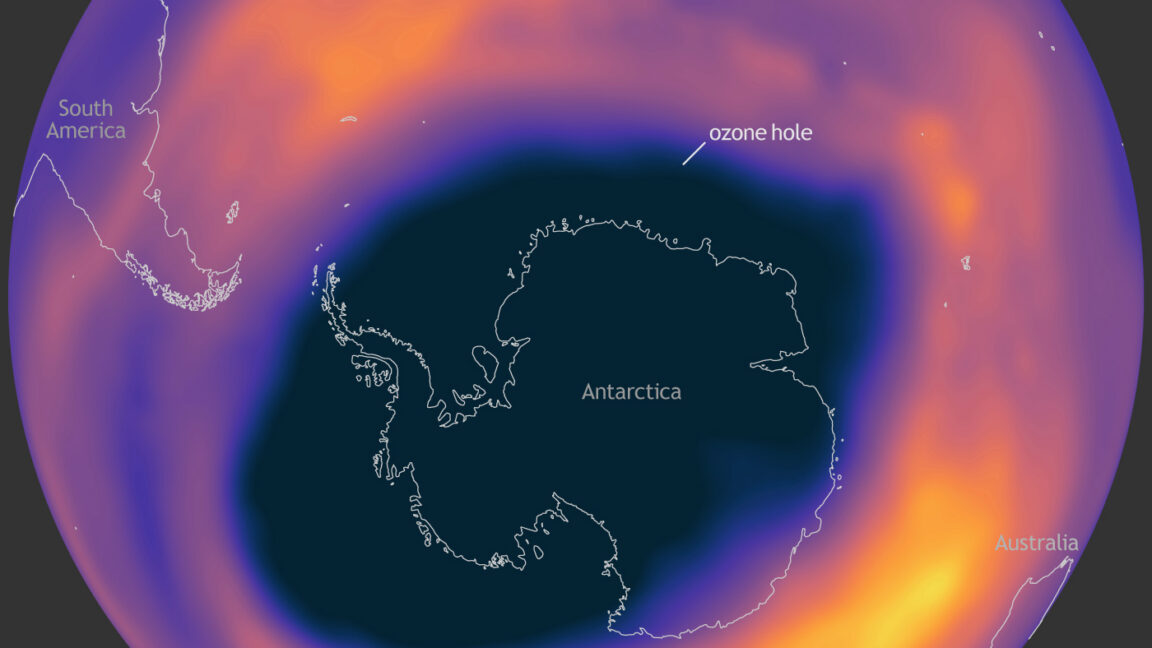
The ban on ozone-depleting substances that successfully reversed the growth of the hole in the ozone layer isn’t seen as a missed opportunity. On the contrary, the quick global response is one of the best cases of common-sense environmental action. But what if it could have been done even earlier?
The fact that chlorofluorocarbons (CFCs)—chemicals once common in aerosol cans and refrigerant loops—could destroy ozone in the atmosphere was
discovered in 1974. Within just a few years, bans on CFCs began to roll out based on the projected consequences. The seasonal ozone “hole” discovered over Antarctica in 1985 pushed things along even faster, and in 1987 an international agreement was signed to phase out CFCs everywhere.
A new study led by Jian Guan at MIT asks an interesting what-if question: Would it have been possible to detect this problem even sooner with today’s scientific tools?
Beyond CFCs
The use of CFCs started in the 1950s and ramped up through the 1960s, but they weren’t the first ozone killer to enter the picture. The industrial solvent carbon tetrachloride had been around for several decades before that. Not only do we have estimates of how much was produced for use, but records from the dense snow atop ice cores can confirm how much was in the atmosphere. This data shows that in 1950, carbon tetrachloride was about 3–4 times as prevalent as initial CFC levels.
This would have had some impact on ozone, but detecting that effect could be difficult given that ozone levels vary naturally for several reasons.
The formation of ozone (O3) is driven by the interaction of sunlight and oxygen gas (O2), it’s sensitive to the 11-year cycle in solar activity, for example. Emissions from volcanic eruptions can also cause some chemical chaos in this system. And because these processes can vary at different altitudes, just examining the total amount of ozone in a column through the atmosphere can obscure a depletion trend at a specific altitude.
<small>Source: Ars Technica</small>