Inside Lagos community where fishing sustains life through unwritten division of labour
When members of the National Association of Judiciary Correspondents (NAJUC), Lagos State chapter, converged on the serene Hermitage Garden Resort in Tiye Village, Eti-Osa Local Government Area of Lagos State, last weekend for a three-day in-house training on emerging developments in the judiciary and ways to improve professional journalism practice, many anticipated nothing beyond intensive learning sessions in a peaceful environment.
What they did not expect was that beyond the resort’s calm surroundings lay another classroom, one without walls, where the Atlantic Ocean itself teaches enduring lessons on resilience, cooperation, tradition and survival.
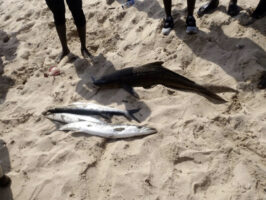
Away from the towering skyscrapers, endless traffic and relentless pace of metropolitan Lagos, Tiye Village which is among the fishing communities along Lagos /Calabar Coastal Road, presents a completely different world. The community is not only abode of Nigerians alone but many West African countries citizens.

In Tiye Village, life is dictated not by the clock but by the tides. The sea is far more than a picturesque backdrop.
It is the community’s workplace, marketplace, bank, classroom and cultural heritage. For generations, it has fed families, created livelihoods and shaped an identity that has remained intact despite the rapid urbanisation transforming the Lekki corridor.
As the first light of dawn breaks over the Atlantic, the village awakens to a ritual that has remained largely unchanged for decades. The salty breeze fills the air as fishermen push their wooden canoes towards the shoreline.
Nets are carefully untangled and inspected. Paddles are checked, while those fortunate enough to own outboard engines ensure they are in working condition before setting off into the open sea.
For the visiting journalists, watching the day’s activities begin was a reminder that some of Nigeria’s oldest occupations continue to thrive, sustained not by modern technology but by experience passed down through generations.
Unlike the hurried pace that defines Lagos, mornings in Tiye Village are calm yet purposeful.
Every movement reflects years of accumulated knowledge. Young fishermen learn by observing their fathers and grandfathers, mastering skills that no classroom can adequately teach.
The sea, however, offers no guarantees. Some days, it rewards the fishermen with abundant catches that sustain households and supply markets across Lagos. On other days, after battling rough tides and uncertain weather for hours, they return with far less than they had hoped for.
Yet every sunrise brings renewed determination because fishing here is far more than an occupation.
It is an inheritance. One of the most remarkable aspects of Tiye Village is the natural division of labour that keeps the community’s economy functioning seamlessly.
While the men venture into the Atlantic, women and other family members remain ashore preparing for the arrival of the day’s catch.
Some sort the fish according to species and size. Others preserve, smoke and package them for sale. Children assist wherever they can, gradually learning the trade that has sustained their families for generations.
Fishing in Tiye Village is not the responsibility of a few individuals. It is a collective enterprise in which virtually every household plays a role.
Life in the community revolves almost entirely around the sea. Nearly every family depends directly or indirectly on fishing for survival.
The simplicity of the operation is striking.There are no sophisticated fishing trawlers equipped with satellite navigation systems or advanced fish-finding technology.
Most fishermen rely on wooden canoes, nets, paddles and where available, small outboard engines. Their greatest asset is experience.
Older fishermen can often predict changing weather conditions simply by observing cloud formations, the direction of the wind and the behaviour of the waves.
They instinctively know where different species of fish are likely to gather and understand how changing seasons influence their catch.
These lessons are not found in textbooks. They are passed from one generation to another through daily practice.
Long before many children begin formal education, they are already learning how to read the sea.
Although the fishermen are the most visible face of Tiye Village, the women provide the commercial backbone that keeps the fishing economy alive.
Many specialise in negotiating with wholesale buyers. Others clean freshly caught fish for customers for a fee, while another group has mastered the traditional art of smoking and drying fish to preserve it for longer periods without compromising quality.
Without their efforts, a significant portion of the day’s catch would spoil before reaching consumers.
The women have built trusted relationships with seafood traders from different parts of Lagos who depend on them for regular supplies of fresh and processed fish.
Their contribution demonstrates that fishing is not simply about catching fish. It is an economic chain involving harvesting, processing, preservation, transportation and marketing.
As the day progresses, another fascinating phase of the fishing process unfolds.
A team of energetic young men heads back into the sea carrying massive fishing nets. Their task is to strategically spread the nets across selected sections of the water to trap schools of fish.
While they work, rhythmic songs echo across the shoreline. Colleagues beat drums and chant traditional work songs, lifting morale and synchronising movements.
The music is not entertainment alone; it is part of the labour itself, fostering teamwork and helping workers maintain a steady rhythm.
Then comes perhaps the most dramatic moment of the day.
Once the nets are fully set and the time comes to retrieve them, the entire community comes alive.
Men, women, children and elderly residents line up along the beach, each grabbing a section of the long ropes attached to the nets.
Slowly, they begin pulling.
The task demands strength, patience and perfect coordination.
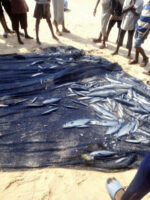
With every collective effort, the heavy nets inch closer to shore, revealing their harvest beneath the waves.
Excitement grows as fish begin to appear, wriggling beneath the mesh. Laughter, cheers and instructions fill the air.
It is impossible to tell where individual effort ends and collective effort begins.
For a few intense moments, the entire village works as one.
Once the catch reaches the shore, another well-organised process begins almost immediately.
The fish are quickly sorted according to species and size. They are weighed on scales before prices are determined based on weight, freshness, species and prevailing market demand.
Wholesale buyers negotiate directly with the fishing team leaders before purchasing in bulk for onward distribution to retailers and urban markets.
Nothing is wasted. Crabs, shrimps and other seafood are separated and sold according to their market value, while women offering fish-cleaning services attend to customers who prefer ready-to-cook seafood.
Those interested in smoked fish hand their purchases to specialists who preserve them using traditional smoking techniques perfected over generations.
Every activity creates another opportunity for income.
Even residents who never venture onto the sea earn their living through businesses connected to fishing.
Some repair damaged nets. Others maintain canoes and engines. Transporters move seafood to markets across Lagos, while traders connect producers with consumers.
Without consciously designing an economic model, Tiye Village functions like one coordinated production system.
Interestingly, the organisation of labour in the community mirrors one of the world’s most influential economic theories.
More than two centuries ago, Scottish economist Adam Smith argued in his landmark book, The Wealth of Nations, that productivity increases when work is divided into specialised tasks rather than expecting one individual to perform every stage of production.
Tiye Village demonstrates this principle every single day.
Ironically, many of the fishermen have never heard of Adam Smith.
Some have never attended formal school. Few, if any, have read about it, yet through generations of practical experience, they have built an economic system that closely reflects Smith’s theory.
No fisherman attempts to perform every task alone. Those most experienced at navigating the sea concentrate on fishing. Women skilled in commerce focus on marketing.
Experienced processors preserve fish to reduce spoilage. Boat builders maintain canoes. Net makers repair damaged fishing gear.
Transporters distribute seafood to markets. Every individual performs the task best suited to his or her experience and ability.
The result is remarkable efficiency, not born from academic theory but from necessity, tradition and cooperation.
The benefits become obvious throughout the day. While fishermen remain offshore, processors prepare smoking ovens and drying racks.
Before the canoes return, traders are already waiting on the beach.
Fresh fish destined for immediate consumption are separated from those requiring preservation.
Within hours, seafood harvested from the Atlantic begins its journey to markets across Lagos.
Because responsibilities are shared, valuable time is saved.
Fishermen do not abandon the sea in search of buyers.
Traders do not interrupt business to repair nets. Boat craftsmen remain focused on maintenance instead of marketing fish.
Everyone contributes to a larger economic process that benefits the entire community.
It is an assembly line created not by industrial engineers but by generations of shared experience.
For the visiting journalists, Tiye Village offered more than picturesque scenery.
It provided a powerful reminder that some of society’s most efficient economic systems exist far from corporate boardrooms and university lecture halls.
The post One sea, many hands appeared first on The Sun Nigeria.
<small>Source: The Sun Nigeria — read the original story there.</small>
