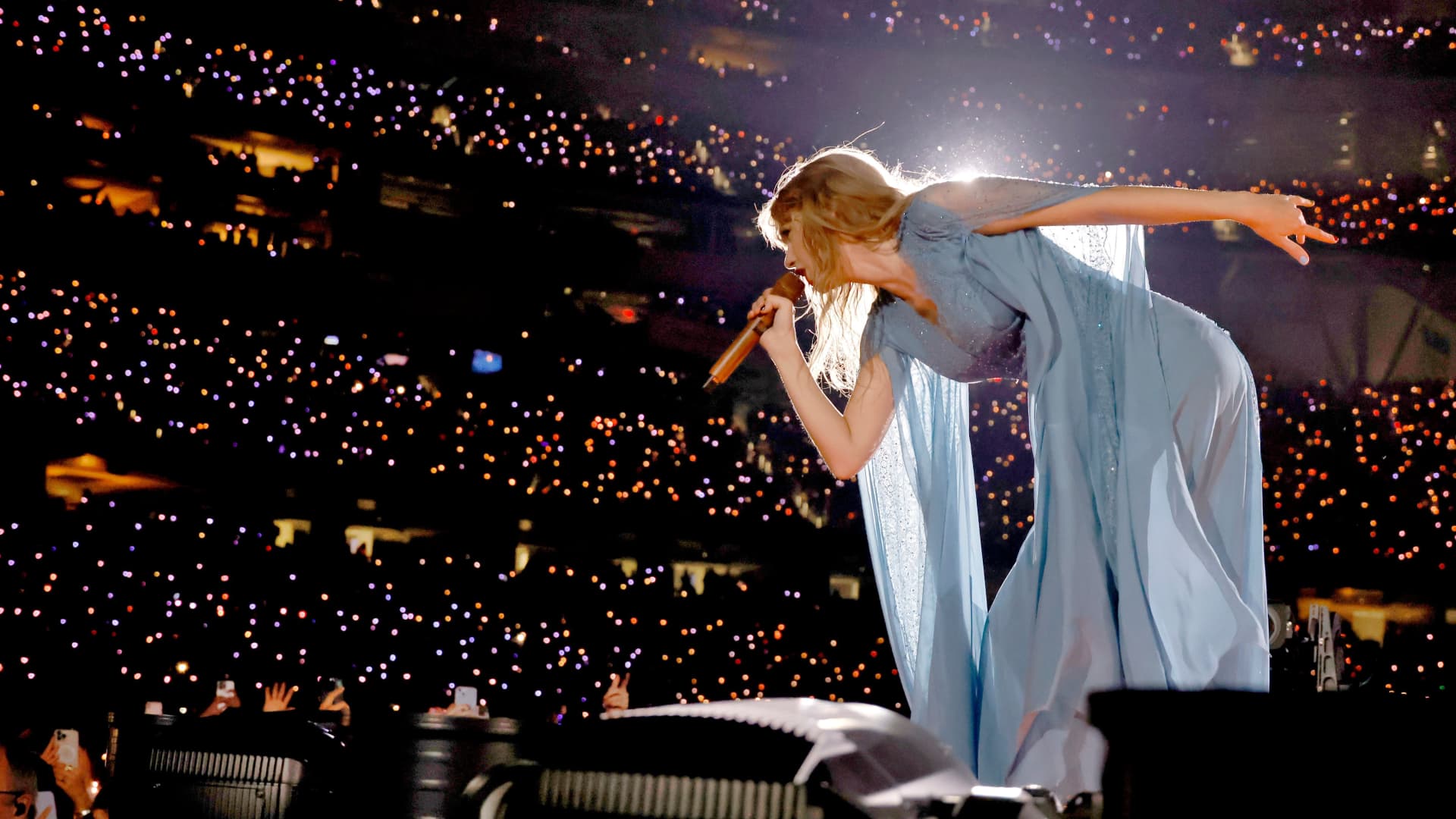
(This is The Best Stocks in the Market , brought to you by Josh Brown and Sean Russo of Ritholtz Wealth Management.) Josh — If you've been watching the " Halftime Report " for the last five years or so, you know that Live Nation (LYV) is one of my permanent positions. I've never been out of the stock because I know a really big thing that you probably also know too. Live music has been in demand for thousands of years, and so long as there are human beings with a little bit of disposable income, there's money to be made. And Live Nation owns this business. Literally, they own it. They run it. There aren't two or three of them. It's LYV or nothing in the public markets. Every once in a while, some state attorney general or Justice Department official takes a run at this company and tries to force a divestiture or wrangle or a settlement check. They don't like that the venue business and tour promotion business is tied to the ticketing entity (Ticketmaster). These legal issues crop up all the time, and the stock takes a temporary pause. And then you close your eyes for a few weeks or months and, before you know it, the stock is back to making new highs. It's not a secret why — no matter what anyone says, people cannot stay away from going to concerts, performances or festivals. It's more consistent than any form of entertainment in our society with the lone exception of the NFL. And anywhere in America (and, increasingly, in the world) where there's a popular artist playing to a sold out crowd, it's very likely that Live Nation is the company counting the money. Tickets. Concessions. Merch. Parking. Liquor. VIP upgrades. It's bulletproof. (CNBC's Justin Zacks made a bullish call on Live Nation. Read it here.) There were people saying that, post-Covid, once everyone got the whole "experiences" thing out of their system, concert ticket sales would fall off. They thought the same thing about travel. Wrong and wrong. It hasn't stopped and it's not stopping. Experiential businesses are the gleaming gemstones within the consumer discretionary bucket. And among these gemstones, Live Nation is shining the brightest, lawsuits and anti-trust investigations be damned. Here's Sean on the fundamentals. I'll be back at the end with some risk management commentary. Best Stock Spotlight: Live Nation Entertainment, Inc. (LYV) Sean — What makes the post-2022 world so confusing is the market has had to live in a state of constant cognitive dissonance. For every compelling reason to believe the consumer is tapped out, there's an equally compelling reason to believe the opposite. Inflation is running at its hottest pace in three years, a black swan in oil supply has spiked energy prices and housing, the single largest engine of the U.S. economy, has been frozen for four years. Those are legitimate concerns, and yet the rebuttals are just as logical. Credit quality remains stable, household debt relative to disposable income sits at its lowest level since 2003, and consumer spending is hitting highs. So which consumer is real — the one squeezed by prices and locked out of the housing market, or the one with a clean balance sheet and a plane ticket to Ibiza? The unsatisfactory answer is both. In an economy where consumers are deferring cars, housing renovations, and other big-ticket purchases, live experiences have almost turned into an inelastic good. Bank of America data across its 69 million customers showed the average customer spent $150/month on entertainment, while credit card holders who bought live event tickets spent an average of $300/month. People are yearning for in-person events. If you can't buy a house, you might as well make some memories, right? These are the in-real-life memory stocks. Companies selling concerts, trips and nights out that live on in your camera roll or Instagram feed forever. Live Nation is the IRL memory stock we're talking about today, a long-time Downtown Josh Brown pick. Ticketmaster's parent touches nearly every step of a night out — the promotion, the ticket, the venue, even the $19 cocktail. Revenue hit a record $25.2 billion in FY2025, more than double pre-pandemic levels, with operating income up 52% to $1.25 billion. In Q1 2026, revenue grew another 12%, fan attendance rose 7% to 23.8 million, and sponsorship revenue jumped 20%. But the stat that best captures consumer demand is deferred revenue — cash that fans have already paid for shows they haven't seen yet. This figure hit 22% year over year to $6.6 billion. Right now, more than 85% of 2026's large-venue shows are already booked and ticket sales are pacing up 11% to over 107 million. CEO Michael Rapino was asked directly on the Q1 call whether demand was cracking anywhere — by income level, geography or genre. His answer: "We see no slowdown in any genre, no demographic. We see across the board, whether it's a club show, whether it's an amphitheater in Indianapolis or an expensive stadium show in New York, we've seen no demand pull back anywhere." LYV is leaning into the premium experience as well. Management is retrofitting amphitheaters from as little as 1% premium capacity toward 25% and designing new arenas with up to 30% premium inventory. Crucially, the premium push isn't crowding out lower-income spenders. 75% of U.S. tickets remain priced under $100. The top of the pyramid gets a more custom, high-level experience while the base stays accessible to most people. Until Americans stop prioritizing these live experiences, Live Nation will continue to price in consumer strength. Now here's Josh on the risk management… Risk management Josh — LYV has spent the better part of a year building a constructive base, and the chart is now paying off. After bottoming near $122 in November, the stock launched a persistent recovery that carried it through both moving averages and into new high territory. The 50-day moving average, now at $166, acted as a trampoline on multiple pullbacks along the way, and price has since pulled away from it to the upside. The next level worth watching is $190, where sellers may begin to appear after such a sustained move. RSI is at 71, which puts momentum in firm but not extreme territory. Given how long the stock spent building its base, the current reading reflects a stock that has earned its strength rather than one that sprinted there overnight. Traders can use the 50-day moving average at $166 as their reference on the downside. Investors can look lower to $154, where the 200-day moving average currently sits and where price found support on multiple tests earlier in the recovery. A close below that level would be the signal that the trend has changed character. (CNBC Pro subscribers can read more about Live Nation here.) DISCLOSURES: (None) All opinions expressed by the CNBC Pro contributors are solely their opinions and do not reflect the opinions of CNBC, or its parent company or affiliates, and may have been previously disseminated by them on television, radio, internet or another medium. THIS CONTENT IS PROVIDED FOR INFORMATIONAL PURPOSES ONLY AND DOES NOT CONSTITUTE FINANCIAL, INVESTMENT, TAX OR LEGAL ADVICE OR A RECOMMENDATION TO BUY ANY SECURITY OR OTHER FINANCIAL ASSET. THE CONTENT IS GENERAL IN NATURE AND DOES NOT REFLECT ANY INDIVIDUAL'S UNIQUE PERSONAL CIRCUMSTANCES. THE ABOVE CONTENT MIGHT NOT BE SUITABLE FOR YOUR PARTICULAR CIRCUMSTANCES. BEFORE MAKING ANY FINANCIAL DECISIONS, YOU SHOULD STRONGLY CONSIDER SEEKING ADVICE FROM YOUR OWN FINANCIAL OR INVESTMENT ADVISOR. Click here for the full disclaimer.
<small>Source: CNBC</small>


