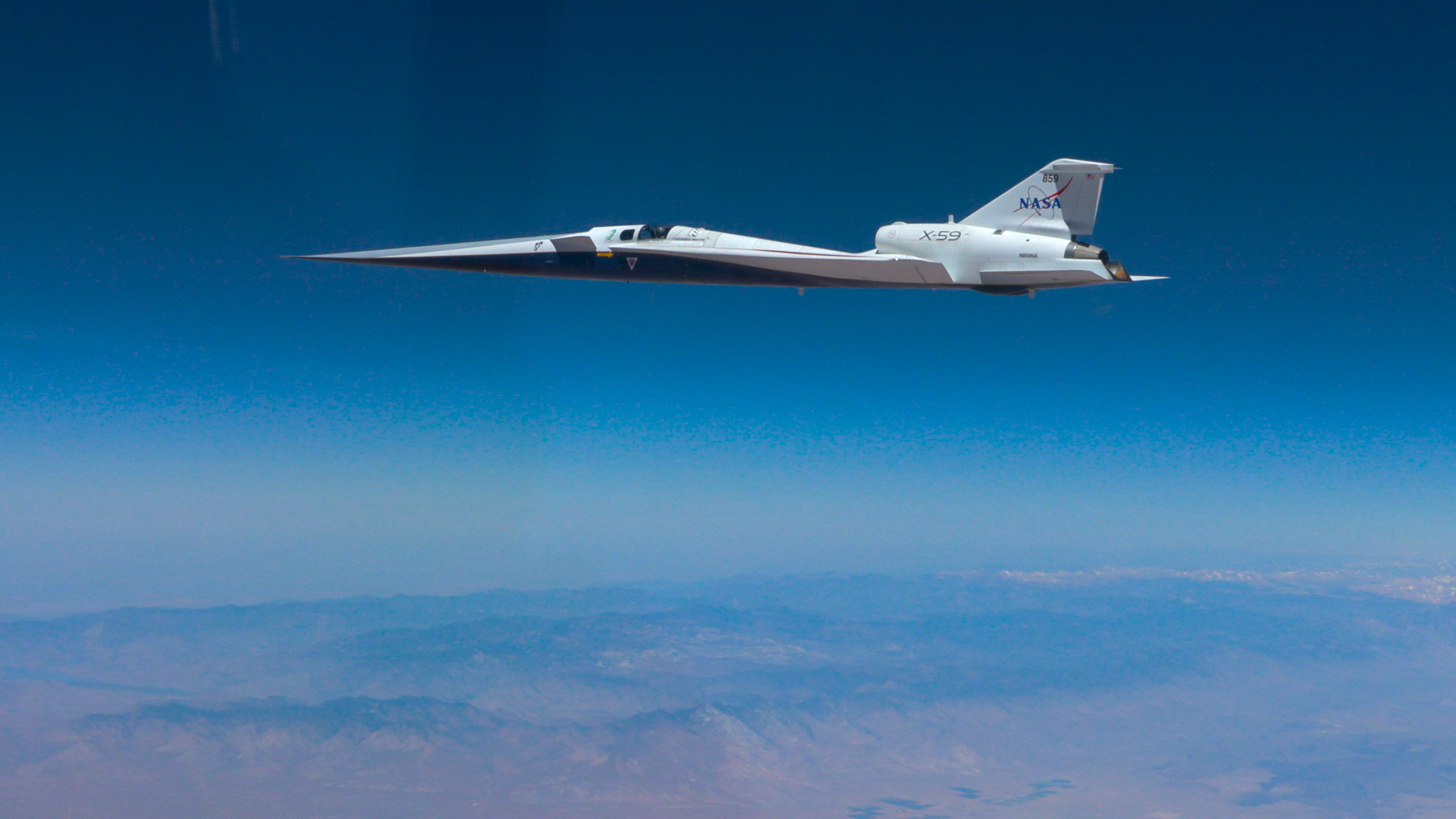
More than two decades since the Concorde supersonic airliner last took to the skies, NASA has been flying an experimental aircraft designed to replace loud sonic booms with a quieter thump equivalent to a car door slamming shut 20 feet away. A successful NASA flight test program could influence the design of future supersonic airliners capable of flying overland routes without rattling buildings—and people’s nerves.
The Lockheed Martin X-59 Quesst—an acronym for Quiet SuperSonic Technology—first took flight late last year and recently began supersonic test flights. But unlike with many experimental “X-plane” aircraft that may never leave restricted airspace near Edwards Air Force Base in California, NASA plans to eventually take the X-59 on a tour around the United States so residents of various cities and towns can provide feedback on the quieter sonic “thumps” it produces.
“Usually an X plane is kind of bare-bones—‘cobble it together from a bunch of parts from other airplanes and just demonstrate one thing,’” said
Jim “Clue” Less, a NASA test pilot and aerospace engineer, in an interview with Ars. “We need to demonstrate that one thing, but then we need a plane that’s robust enough that we can fly it all over the place and gather that data.”
The move comes at a time when the US Congress has been
advancing legislation that could legalize overland supersonic travel. That would reverse a 1973 ban implemented by the US Federal Aviation Administration, which was informed by the public backlash and noise complaints following US military tests of supersonic flights over Oklahoma City, Chicago, and St. Louis in the 1960s.
But even if the X-59 program shows that quieter supersonic travel is possible, any potential revival of commercial supersonic flights would still have to prove financially viable despite challenges such as massive fuel consumption costs.
Less and
Peter Coen, the mission integration manager for NASA’s Quesst mission and former manager of NASA’s Commercial Supersonic Technology project, spoke at length with Ars about the quirks of piloting a supersonic aircraft with no front window, the X-plane’s “frankenjet” design, a harrowing early flight test, and what people around the United States can expect once the X-59 starts doing its national tour.
<small>Source: Ars Technica</small>