Your support makes our work possible.
Marcia Dunn, Associated Press
Marcia Dunn, Associated Press
Leave your feedback
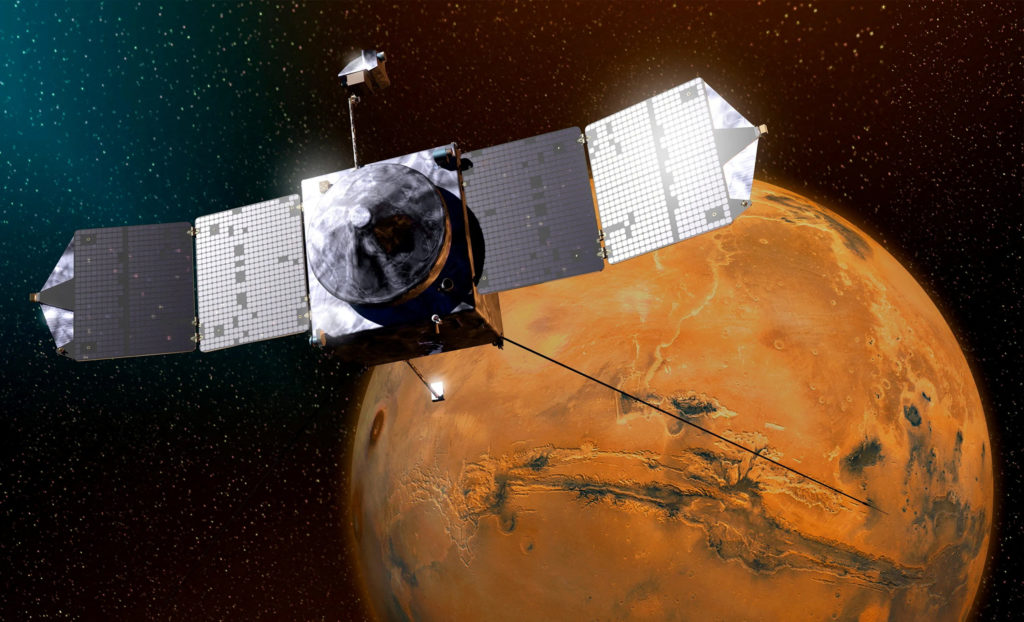
CAPE CANAVERAL, Fla. (AP) — After six months of radio silence, NASA's Maven spacecraft around Mars has been declared dead.
The space agency confirmed Wednesday that the mission had ended after more than a decade of observations.
READ MORE: NASA loses contact with Maven spacecraft orbiting Mars for the past decade
"The team really did experience the loss of a loved one with the end of the mission here," said NASA project manager Mike Moreau.
Launched in 2013 to study the red planet's atmosphere from orbit, Maven mysteriously fell silent in early December after passing behind Mars. Data indicated the spacecraft went into a fast spin, which disrupted its orbit and drained the onboard batteries.
Subscribe to our Science Newsletter to explore the
wide worlds of science, health and technology.
Thank you. Please check your inbox to confirm.
A review board convened by NASA earlier this year concluded that the spacecraft is useless and unable to be recovered. It's expected to remain in orbit for another 50 to 100 years before crashing into the planet, posing no issue to other spacecraft until then. An investigation continues into what caused the problem.
READ MORE: What colors paint Mars' northern lights? New results from NASA's MAVEN mission
Besides studying Martian weather and observing a stray interstellar comet last year, Maven helped relay information from NASA's Curiosity and Perseverance rovers on the surface. NASA officials said four other spacecraft around Mars — two U.S. and two European satellites — will pick up the slack, with no rover science lost.
Technicians work on NASA's next Mars-bound spacecraft, the Mars Atmosphere and Volatile Evolution (MAVEN) spacecraft, at the Kennedy Space Center in Cape Canaveral on Sept. 27, 2013. File photo by Joe Skipper/ Reuters
"The team is certainly broken up about this, but at the same time we are incredibly proud of the science we've accomplished over the last decade," said Maven's lead scientist, Shannon Curry of the University of Colorado Boulder.
The spacecraft advanced scientists' understanding of the Martian atmosphere and evolution, Curry said.
Support trusted journalism and civil dialogue.
Support Provided By:
Learn more
Subscribe to Here’s the Deal, our politics
newsletter for analysis you won’t find anywhere else.
<small>Source: PBS NewsHour</small>