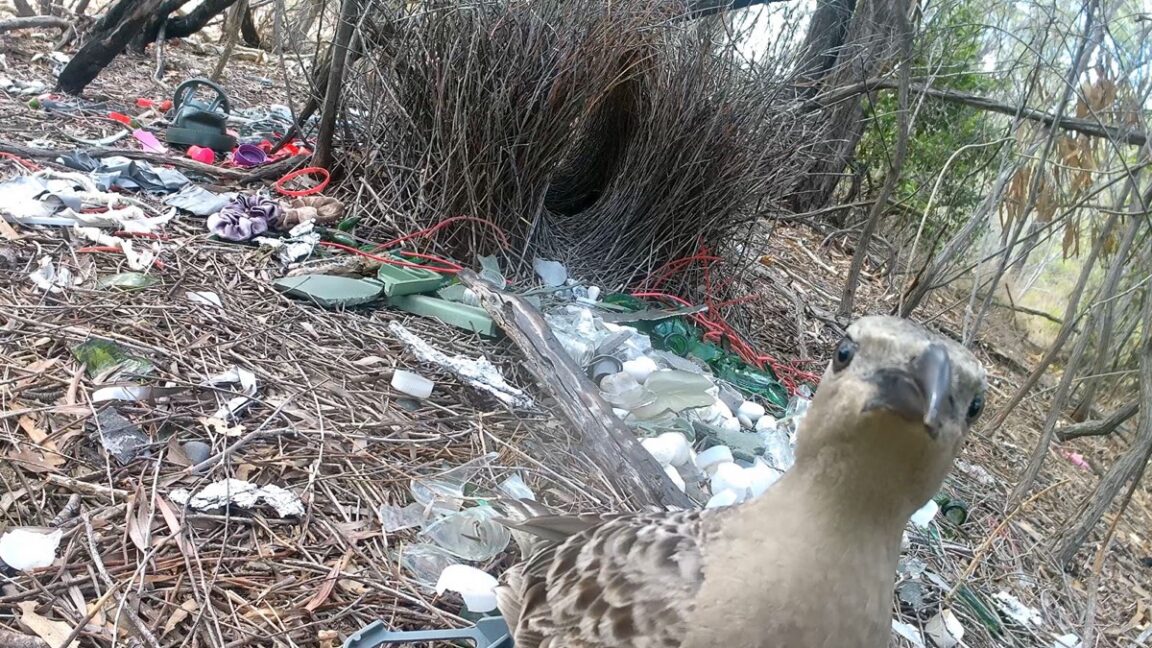
Male bowerbirds are notorious for their complex mating rituals. They build intricate tunnels out of twigs—the bowers from which they get their name—and then decorate them with random colorful items gleaned from the environment. When a female of the species shows up to check out a male’s fancy digs, the male tosses his shiniest objects in her direction and shows off his plumage in hopes of impressing her.
According to a new paper published in the journal Royal Society Open Science by University of Exeter scientists, urbanization and the associated growing availability of brightly colored human-made items have had a significant impact on courtship display behavior in Australian male bowerbirds. There are marked differences in the choice of decorations for bowerbirds in urban versus rural environments. This might be because urban birds simply have greater access to the items than their rural counterparts, since birds in both environments show a marked preference for human items.
The University of Exeter researchers monitored the bowers of 61 male great bowerbirds in two sites in Australia’s northern Queensland—the rural Dreghorn Cattle Station and the urban Townsville City—during the prime breeding season (September–December 2023). Then they photographed the bower decorations in situ from above in both visible and UV light (bowerbirds can see in the UV range), using an umbrella to create diffuse lighting.
Next, they selected the 10 decorations closest to the bower entrance, since these were the most likely to be used by the male bird for his displays. These were also photographed and marked to identify the original source. Then the team removed all existing decorations from each bower and created a mixed slush pile of 10 randomly selected urban bowers and 10 randomly selected rural bowers, and they left the site alone for three days. Males were never offered any items from their own bower.
<small>Source: Ars Technica</small>