MONTGOMERY, Ala—Sheila McNeil thought she knew the race ahead of her.
Without a primary challenger, McNeil knew she was slated to be the Democratic nominee for a seat on the Public Service Commission, the state agency charged with regulating utilities like
Alabama Power.
Then, after the conclusion of the Republican primary process, McNeil would compete against the GOP nominee in the November general election for a seat on a three-person commission with nearly unilateral authority over utility regulation in the state. That was the path forward.
Then came the annual meeting of the Alabama legislature.
In a whirlwind conclusion to its annual session, under pressure from Alabamians concerned with high energy prices, Alabama lawmakers passed a law that significantly restructured the PSC and made it more difficult for utility regulators to call a formal rate case to assess Alabama Power energy prices, a process that hasn’t taken place since the 1980s.
The lawmakers also expanded the PSC from three to seven seats and called the new measure “reform” legislation, having watched two Democrats in neighboring Georgia capitalize on voter anger over high electricity prices and unseat two Republican incumbents.
Under the new law, the agenda of the expanded PSC including the question of whether to call a rate case, will be largely set by a secretary of energy, to be appointed by the governor. Without the approval of the secretary, a supermajority of five commission members would be needed to call a rate case and formally determine utility rates in public hearings, a commonplace process in other states.
In a lawsuit filed last week,
McNeil claims that’s not the gig she signed up for. In fact, her lawyers argue in a federal complaint, the legislature’s last minute changes to the Public Service Commission in the shadow of an election are unconstitutional and have caused irreparable harm to the candidates and the voters they seek to represent.
In her lawsuit, filed in the U.S. District Court for the Middle District of Alabama, McNeil argues that the implementation of the legislature’s PSC restructuring law ahead of the November elections “disrupts an ongoing election by changing the fundamental character of the office being contested mid-campaign” in violation of the 14th Amendment’s Equal Protection Clause.
Implementation of the new law would also violate the Voting Rights Act by diluting minority voting power, the lawsuit argued, relegating Black voters to electing their candidates of choice in only one or two seats—under the new law, each of the state’s seven congressional districts gets one PSC seat—and preventing them from working together to influence elections on the old three-seat PSC, each of which was elected statewide.
No Black Alabamian has ever served as an Alabama Public Service Commissioner, whose
previous membership includes Bull Connor, Birmingham’s infamous segregationist police chief. No Democrat has served on the body since 2012.
Read More
In Alabama Primary Elections, Incumbent Utility Regulators Feel the Squeeze of High Energy Prices
By Lee Hedgepeth
Other “particularly arbitrary” changes outlined in the new PSC law, like the creation of the secretary of energy position, will effectively strip commissioners of power they would have retained before the law’s passage, the lawsuit said.
“In doing so, HB 475 converts the office of PSC Commissioner from a position of independent regulatory authority into one that is substantially subordinate to the executive branch,” the suit said. “A candidate who won this office in 2026 would serve on a commission whose agenda is controlled not by the elected commissioners but by someone the Governor selected.”
Lawyers for McNeil have asked the judge in the case to issue a preliminary injunction, a court order preventing Alabama officials from implementing the changes outlined by the new PSC law before McNeil’s case can be fully heard in court.
McNeil wasn’t the only candidate whose outlook changed after the passage of HB 475.
John Northrop, a Democratic candidate for the second contested PSC seat, withdrew from the race following the law’s adoption earlier this year.
“The law has changed the PSC’s function, authority, size, and the term length of commissioners,” Northrop said in a press release announcing his withdrawal. “The new job is not the job I signed up to win. It’s a job I believe others are better suited to fill.”
In a statement, Daniel Tait, executive director for statewide environmental group Energy Alabama, said the clean energy nonprofit is pleased to see the new law put to the test in court.
This story is funded by readers like you.
Our nonprofit newsroom provides award-winning climate coverage free of charge and advertising. We rely on donations from readers like you to keep going. Please donate now to support our work.
Donate Now
“The provisions being challenged are the same ones we warned would hand two officials in the executive branch—the governor and the energy secretary—effective control over the body that sets Alabama Power’s rates,” Tait said. “Alabamians, who’ve been paying record-high electric bills while Alabama Power’s profits doubled, deserve something better than a law that enacts regulatory capture. We welcome judicial review of this law.”
McNeil’s November opponent hasn’t yet been determined. Incumbent Commissioner Chris Beeker, who’d been appointed to fill the remainder of his father’s term in 2024, was forced into a runoff for his seat by Jim Zeigler, a perennial candidate who served on the PSC for a single term from 1975 to 1979. The Republican primary runoff will be held June 16.
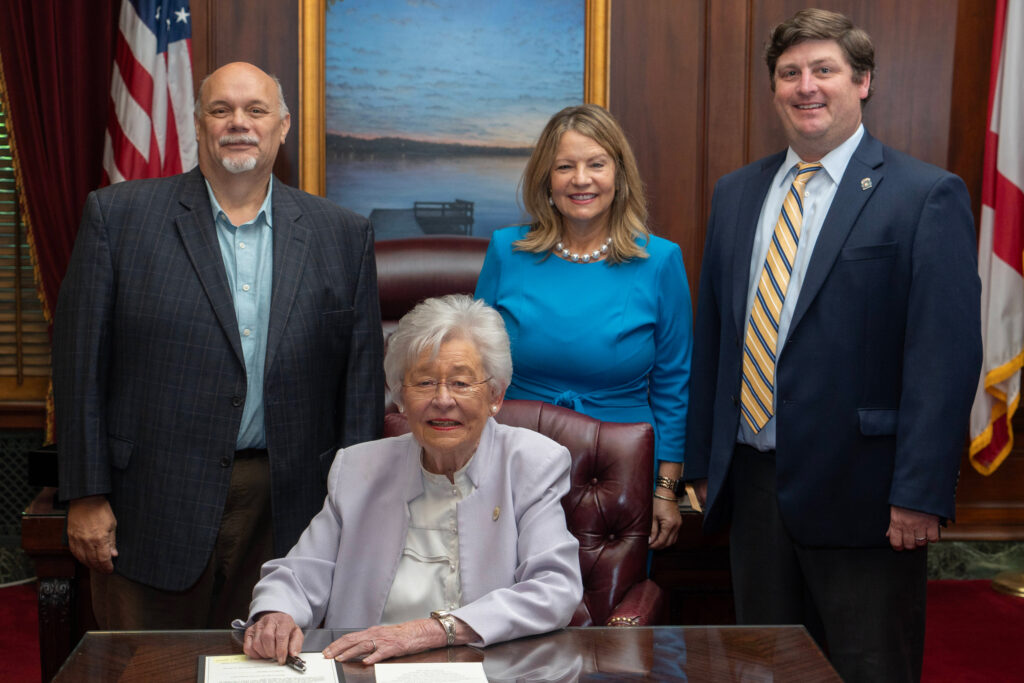
So far, neither Gov. Kay Ivey nor Attorney General Steve Marshall has responded to the lawsuit.
Barring court intervention, Ivey is required to appoint four new interim PSC commissioners by July 15.
The general election for the two contested PSC seats is scheduled for November.
About This Story
Perhaps you noticed: This story, like all the news we publish, is free to read. That’s because Inside Climate News is a 501c3 nonprofit organization. We do not charge a subscription fee, lock our news behind a paywall, or clutter our website with ads. We make our news on climate and the environment freely available to you and anyone who wants it.
That’s not all. We also share our news for free with scores of other media organizations around the country. Many of them can’t afford to do environmental journalism of their own. We’ve built bureaus from coast to coast to report local stories, collaborate with local newsrooms and co-publish articles so that this vital work is shared as widely as possible.
Two of us launched ICN in 2007. Six years later we earned a Pulitzer Prize for National Reporting, and now we run the oldest and largest dedicated climate newsroom in the nation. We tell the story in all its complexity. We hold polluters accountable. We expose environmental injustice. We debunk misinformation. We scrutinize solutions and inspire action.
Donations from readers like you fund every aspect of what we do. If you don’t already, will you support our ongoing work, our reporting on the biggest crisis facing our planet, and help us reach even more readers in more places?
Please take a moment to make a tax-deductible donation. Every one of them makes a difference.
Thank you,
<small>Source: Inside Climate News</small>