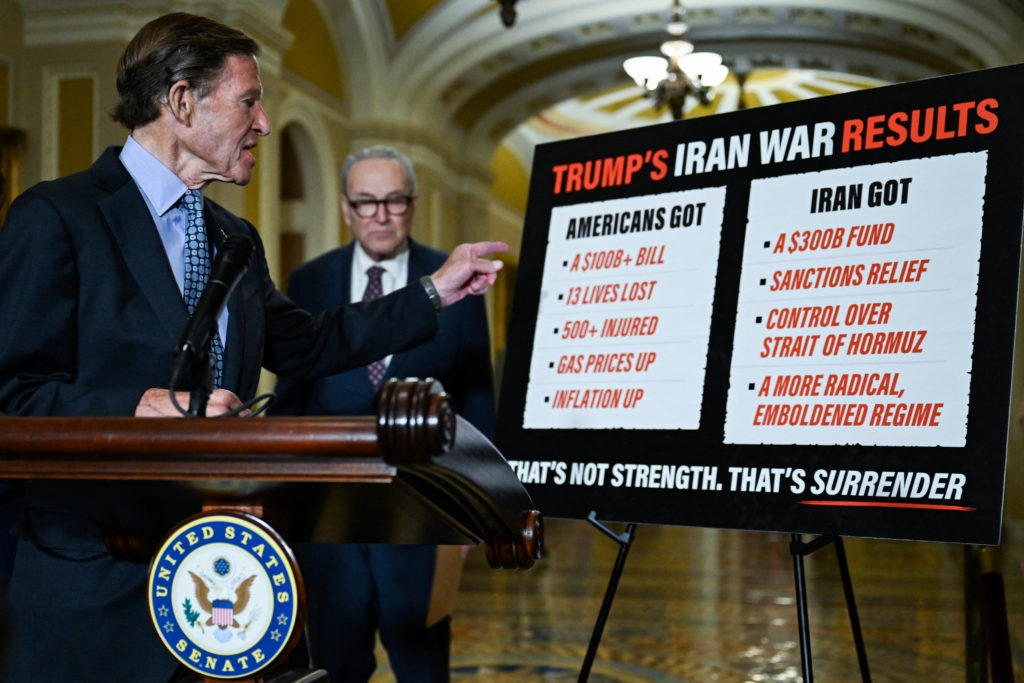
Congress never authorized military action in Iran, but the U.S. Senate today voted to limit President Trump’s Iran war powers in a rare rebuke. White House correspondent Liz Landers caught up with Senators on both sides of the aisle. Geoff Bennett: Well, Congress never authorized the military action in Iran, but the U.S. Senate today voted to limit President Trump's Iran war powers in a rare rebuke. White House correspondent Liz Landers caught up with senators on both sides of the aisle on this issue of the Iran war and joins us now. So, Liz, what are Republicans saying about this 14-point agreement with Iran signed by the Trump administration and the ongoing talks? Liz Landers: Yes, so we have seen some fractures in the Republican Party on this conflict and on this agreement, and that was reflected in the conversations I had on the Hill today. I talked with Senator Thom Tillis. He's a lame-duck senator retiring at the end of this year. He's sparred with the president. And I asked him about these sanctions that were lifted yesterday by the Treasury Department. And he said that, if what Nick laid out in that piece is true, that Iran is going to buy U.S. agricultural products, he said that's fine. But he says that if the U.S. is lifting these sanctions on Iran that predate even the Obama era Iran deal, that, until that happens, the U.S. -- or until the U.S. is closer to a deal, he does not think that that's a good idea. Here's more on him being asked about whether this conflict has been worth it. Sen. Thom Tillis (R-NC): An estimated $100 billion spent today; 13 service members lost their lives. Over 360 people have been injured. That doesn't include the collateral and physical damage of our partners. If all we do is get back to the JCPOA, that would be an absolute catastrophe, in my opinion. The investment that we made, I expect a much higher return than just getting back to where we were with different language. Liz Landers: There's another part of the Republican Party, though, that wants to give President Trump the benefit of the doubt and time to negotiate this. I also caught up with Senators Rounds and Kennedy, who are a bit more wait and see. Sen. Mike Rounds (R-SD): He wants peace. He wants peace in the Middle East. He's made that very, very clear. We have got to give the president an opportunity to get his work done, while at the same time making clear that none of us trust the Iranians. Sen. John Kennedy (R-LA): We won't know for 60 days. I think it's clear that the MOU is two things. Number one, it was an agreement to have the oil flow. And, number two, it was a deal to try to make a deal. Geoff Bennett: Meantime, Liz, you have the GOP-controlled Senate voting today to cut off the U.S. military campaign against Iran. They are approving this anti-war measure, followed by the Republican-controlled House recently. Bring us up to speed. Liz Landers: This passed in the House recently, and then today the Senate took this symbolic vote largely. It is a resolution, so the enforceability of this is in question. And there were some senators who acknowledged that on the Hill today. But it is a rebuke of the president. There were 50 senators who voted against -- voted for the measure, I should say, telling the president to end the war. And there were four Republicans that joined Democrats. There was one Democrat who voted against it, Senator Fetterman. But this did pass both of these chambers. The -- whether the president has any sort of enforceability on this, we will see going forward. But this is a rebuke of him nonetheless. Geoff Bennett: You also spoke with, heard from Republicans in leadership today? Liz Landers: Yes, I spoke with Senator John Thune, who is the Republican leader. He too has had a few differences with the president of late. And I asked him about the congressional oversight aspect of this Iran deal. Here's what he told me. What is Congress' role in approving whatever comes out of this deal with Iran in 60 days? What do you hope the Senate will do? Sen. John Thune (R-SD): If there is some deal that is struck, I would expect at some point Congress would have some sort of vote on it. And I whether -- that's a resolution of disapproval or something, I don't know the answer to that. Liz Landers: I also caught up with Senator Wicker -- he is the chairman of the Armed Services Committee -- and asked him about that sanctions relief that Iran is now experiencing. He paused for a moment and said: "I don't think they're entitled to any sanctions relief whatsoever, and I'm disappointed, he said. Geoff Bennett: What about what about Democrats? What are they saying about all this? Liz Landers: Democrats have been largely opposed to the war since it started and also to this memorandum of understanding since this came out last week. I caught up with Senator Andy Kim and also Senator Angela Alsobrooks about these sanctions and overall their feeling of this MOU. Sen. Andy Kim (D-NJ): Absolutely not a good deal. I mean, this is a good deal for Iran. This is a good deal for a brand-new grand ayatollah, who is younger and more hardened, more in line with the Iranian Quds Force. This is a strategic failure. And this is something that we're going to have to -- we're going to pay the price for. Sen. Angela Alsobrooks (D-MD): None of us trust, we cannot trust now and never trusted the leadership of this president, who took us into a war without a plan, didn't know how to get us out of the war. And the people who are paying for this war are the hardworking people of America. Liz Landers: Senator Alsobrooks acknowledged that, as the party in the minority right now, the Democrats can't do too much, but she was encouraging voters, if they don't like what they're seeing with these policies, to go out and vote November. Geoff Bennett: So a range of views among lawmakers, and this is as the Trump administration is asking Congress for $80 billion, an extra $80 billion supplemental funding to pay for this war. Liz Landers: There has been this reporting just that came out in the last 24 hours or so, and I asked President Trump about this in a very short phone call. I just got one question to him this morning on the phone. And I said, why should the American people support spending more money on this conflict? And why is this costing so much? He told me -- quote -- "Because Iran will never have a nuclear weapon. It's simple. Iran will never have a nuclear weapon. That's not costing much at all. That's very cheap compared to what we're doing. Iran will never have a nuclear weapon. Iran will never be able to use a nuclear weapon. And if you don't do it, then they will have a nuclear weapon, and then you will see real money." I asked a Democratic Senator, Catherine Cortez Masto, about this on the Hill. Will Congress approve $80 billion in supplemental funding? And she said to me, look, she said if the war is no longer on and there's this cease-fire that's in place right now, then why do they need the supplemental funding and more money? Geoff, I think that's a question we're going to hear on the Hill in the coming days. Geoff Bennett: Liz Landers, a busy day for you at the White House, on Capitol Hill. Our thanks to you and our politics producer, Kyle Midura. Appreciate it. Liz Landers: Yes, of course.
<small>Source: PBS NewsHour</small>