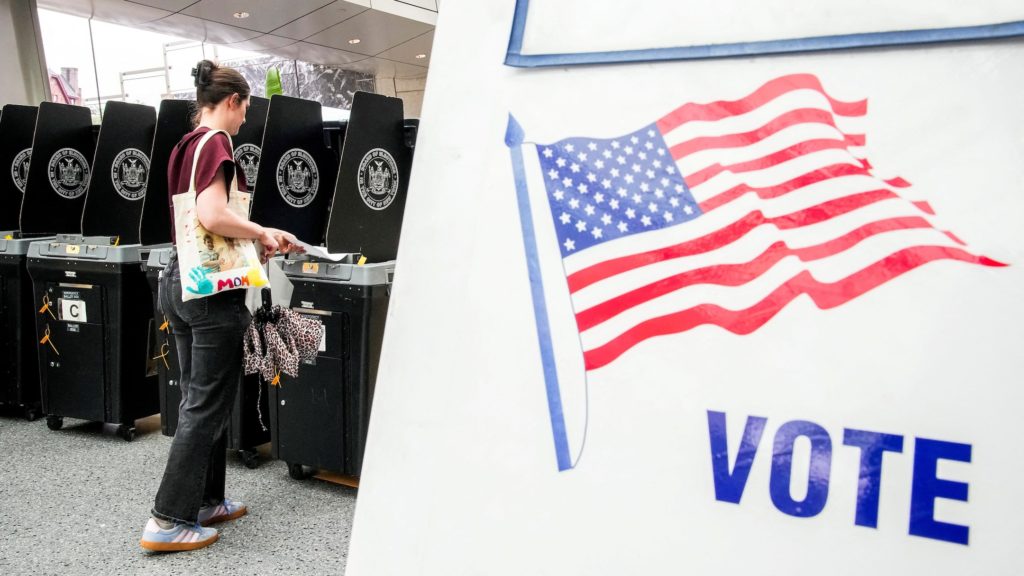
The Trump administration has made multiple efforts to reshape how elections are run with just months before the midterms. The debate over election security has led to tension between the White House and election administrators as the president falsely claims voter fraud is rampant nationwide. Liz Landers discussed more with Gabe Sterling of the Georgia Secretary of State's office. Amna Nawaz: The Trump administration has made multiple efforts to reshape how elections are run with just months before the midterms. And the debate over election security has led to tension between the White House and election administrators, as the president falsely claims voter fraud is rampant nationwide. Our Liz Landers has more. Liz Landers: The Trump administration has taken broad efforts over the last several months to assert control over elections. Today alone, a federal judge blocked the administration from using a revamped immigration database to check voter rolls. And the postmaster general told the Senate the Postal Service won't deliver mail ballots in states that refuse to hand over their voter lists. For perspective on what all this means heading into November, I'm joined by Gabe Sterling of the Georgia Secretary of State's Office. Gabe, thank you so much for joining "News Hour." Gabriel Sterling, Georgia Election Official: Happy to be here. Liz Landers: So we mentioned this testimony today that the postmaster general had on Capitol Hill saying that they will not deliver these mail ballots if states don't comply with this demand to provide a list of names of who is voting in that state. If the Postal Service denies this kind of service, how many people in your state would be impacted by that? Gabriel Sterling: Well, it's interesting. Vote by mail is really big out West. They really -- because the large land masses and everything. It would really affect people in Alaska and California and Washington and Utah. I mean, the irony -- and Florida is the biggest one in the east of Mississippi who uses the. So you're talking about millions of voters being affected by this potentially. But I don't understand the legal mechanism hook that would allow them to say, if you don't do this, then we will do that. Congress has been silent on this. I cannot see any legal way that will actually come to fruition, because we are 132 days away from the election. Liz Landers: Yes, we're close. You're certainly right about that. The president canceled a bill signing ceremony earlier today on housing legislation, saying that he was canceling it until the SAVE America Act has passed. That legislation would require voters to show proof of citizenship when they're registering to vote and photo I.D. at the time of voting. It's already illegal to vote in this country if you're not a citizen. So is that legislation necessary, in your view? Gabriel Sterling: Look, I think, as a public policy, it's good to have guardrails in place to prevent noncitizen voting. The reality is, it is microscopically small in existence right now. But this adds a lot of layers of problematic issues for lots of voters. I'm not sure where my birth certificate is. But, in Georgia, we already have all these kinds of systems in place. But there are other states, the reality is, it would take millions, if not billions of dollars, and two to three years of planning and thought and execution, so you would make sure you're not disenfranchising voters. You can't just pass a law and all of a sudden these things happen. This would cause chaos. Again, there's normally -- in federal lawsuits, we have the Purcell doctrine, which basically says you can't change the rule so close to an election. We have already been through the primaries, and a lot of the states, they will be wrapping up in September. Trying to do massive changes like this would just cause chaos. Liz Landers: And what sort of precedent does it set when the federal government uses federal resources as a leverage over decisions that the Constitution has assigned to states? States are the body that implements elections in this country. Gabriel Sterling: Time, place and manner. It's very clear. Now, the Congress can pass laws, and they can legitimately put what they want to have in there. But one of the great systems of security we have in this country is the fact that there's 10,000 separate jurisdictions running these things, not running them under the same rules. And as a Republican, I think the idea of a centralized national database of voters is a horrifically bad idea, because, at some point, a Democrat will take this over as the president, and they can wave a magic wand and say, I am now -- they're saying all these people are now ineligible to vote, despite any state laws. We have to make sure we protect the federal rules and laws that say the states do this, the states empower this, and then even the states, the localities run the elections. Liz Landers: Final question for you. You ran in the Republican primary for secretary of state, and you lost in that contest recently. You were the only candidate to defend the 2020 election and the administration of that election. What does that say about the Republican Party in Georgia and across the country right now? Gabriel Sterling: There's still a massive belief that the president is right. But just because he says it doesn't make it true. There's people who are undermining people's faith in the elections. And it's not good for either party to do this thing. In Georgia in 2018, Stacey Abrams said it was stolen. In 2020, we had Donald Trump. The only thing stolen in 2020 was Stacey Abrams' playbook. And the reality is, there's a grifting community that will always talk about this. And there's an entire industrial complex that gets money and power and prestige from saying the election is stolen. Every court case, every single one has shown it hasn't been. And that's how you're supposed to do this in this country. And every two years, you come back and fight again. If you lose an election, you concede. I called the two people I lost to in the run-off and conceded, because that's the right thing to do, because we need the loser's consent. That's how the system works. Liz Landers: Gabe Sterling, thank you for your time. Gabriel Sterling: Thank you.
<small>Source: PBS NewsHour</small>