How Eriksen's heart device kicked into action

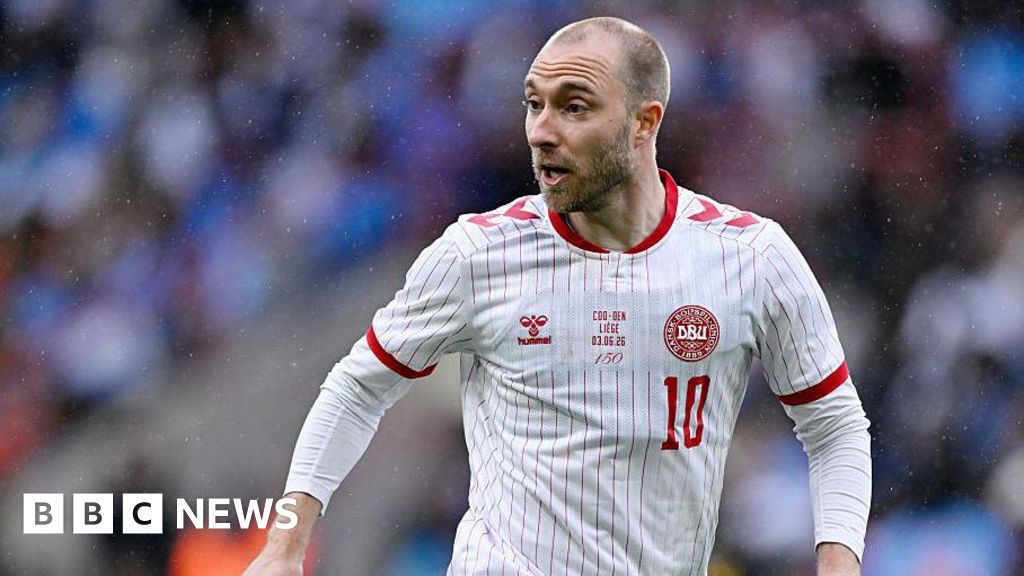
The 34-year-old Dane, whose heart stopped following
a cardiac arrest five years ago, was able to walk off the pitch after regaining consciousness - thanks to a tiny device implanted in his chest, called an ICD (implantable cardioverter defibrillator).
Denmark's national team doctor Morten Boesen said the device - which he called a pacemaker - "responded as it should".
How does an ICD work?
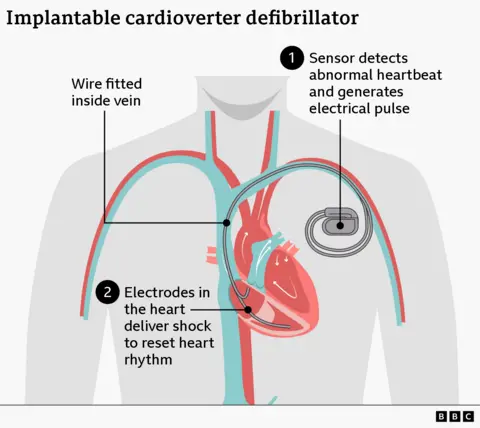
The ICD is a small life-saving device which detects problems with the heart's rhythm and immediately tries to correct them.
It's a treatment rather than a cure.
There are two main types of ICD - one is fitted under the skin, usually near the armpit and acts like a mini defibrillator with wires running under the skin to the chest.
The other main type is connected directly to the heart and, like a pacemaker, also sends regular electrical signals if the heart is beating too slowly.
In Eriksen's case, the ICD is likely to have delivered an electrical shock after detecting a dangerously fast or abnormal rhythm, to restore the heart to its normal pattern.
And it would have been quite a jolt.
"It feels like being thumped in the chest," says Prof Aneil Malhotra, sports cardiologist at the Institute of Sport, Manchester Metropolitan University.
Resetting the heart "is like switching a computer off and on again", he explains, adding that ICDs are "highly effective devices".
In 2021, mid-match at the European Championships, Eriksen had a cardiac arrest - when blood stops pumping around the body. He collapsed and lost consciousness.
Surrounded by concerned and emotional teammates, he was given CPR on the pitch, before a portable machine called a defibrillator was used to reset his heart.
Experts say the immediate medical attention he received saved his life.
This time, the defibrillator was inside his body - implanted during an operation several days after his previous collapse.
It acted as a safety net and kicked in straight away when his heart was in trouble, allowing him to recover much more quickly.
"Because he had the ICD in place, he didn't have to wait," explains Prof Malhotra.
Prof Michael Papadakis, cardiology expert at St George's, University of London, calls the device a "shock box".
"It looks after your [heart] rhythm and, if it detects a very fast, life-threatening irregularity, it will shock you out of it and jump-start the heart," he says.
Why do heart problems like this happen?
A cardiac arrest, which is different from a heart attack, can happen for a number of different reasons.
These include when the electrical impulses that regulate heartbeats don't function properly, or when the walls of the heart become inflamed or damaged.
In young people, the underlying cause can either be genetic or acquired in some way - after an infection or an allergic reaction to medication, for example.
Very rarely, the cardiac arrest can be a one-off with the reason never properly identified.
Heart problems affecting young professional athletes are unusual but not unheard of.
Former Bolton midfielder Muamba retired aged 24 on the advice of his doctors, but others have continued to play with an ICD - including former Manchester United midfielder Daley Blind, who returned to play for Ajax and the Netherlands after being diagnosed with a heart condition in 2019.
Two years on from suffering his cardiac arrest, Lockyer returned to football with Bristol Rovers.
How common are these conditions?
Outside of professional sport, sudden cardiac arrests kill 12 people a week under the age of 35 in the UK, according to charity Cardiac Risk in the Young (CRY).
"This second, sudden collapse of Eriksen is a reminder of the potentially devastating impact that cardiac conditions can have on so many young people every day in the UK and across the world," says chief executive Dr Steve Cox.
He adds that in around 80% of cases, there are no signs or symptoms before collapse.
Screening programmes, where healthy people's hearts aged 14-35 are tested to look for dangerous underlying issues, have found that around one in 300 could be affected.
If left untreated, those conditions could become life-threatening.
Prof Malhotra says that his research on young footballers suggests that one in 250 could have a heart condition that requires monitoring.
And black athletes tend to have a higher incidence of cardiac death than white athletes, although it's not clear why.
Dr Cox says that there is still much to learn about these conditions, although major advances have been made in preventing and managing them.
Every player across England's 92 Premier and Football League clubs is now screened when they sign their first professional contract, and again at the ages of 18 and 20, using an electrocardiogram to check the heart's rhythm and electrical activity.
An ultrasound can also look at the structure of the heart itself to see if there are any defects.
Does it stop you from playing sport?
Not any more.
Research shows that many people with ICDs can return to sport, whatever level they play at, after taking medical advice.
In fact, studies suggest that around 10% receive a shock from their device after it detects an abnormal heart rhythm.
This means the device is working, says Prof Rachel Lampert, sports cardiologist and an electrophysiologist at Yale School of Medicine.
"We used to spend a lot of time telling people what they should and shouldn't do," she says.
But now, doctors talk to athletes about the risks and benefits of having an ICD, and together they decide on a way forward, she adds.
The rules do vary in different countries.
In Italy, footballers are strictly forbidden to play at amateur or professional level with the device fitted.
Whether Eriksen continues to play professional football after this latest scare is not yet clear.
Prof Lampert says Eriksen's doctors will need to work out why his heart rhythm changed during the match, and if there is anything they can do to make it less likely to happen again.
"Shocks can happen at any time," she says.
"People who aren't athletes have them [ICDs] so it doesn't mean if he stops [playing], he won't get another one."
Eriksen said in 2022, when he returned to playing football at Brentford, that he knew the ICD would one day save his life.
"There was always the possibility this could happen," Prof Lampert says.
<small>Source: BBC Health</small>