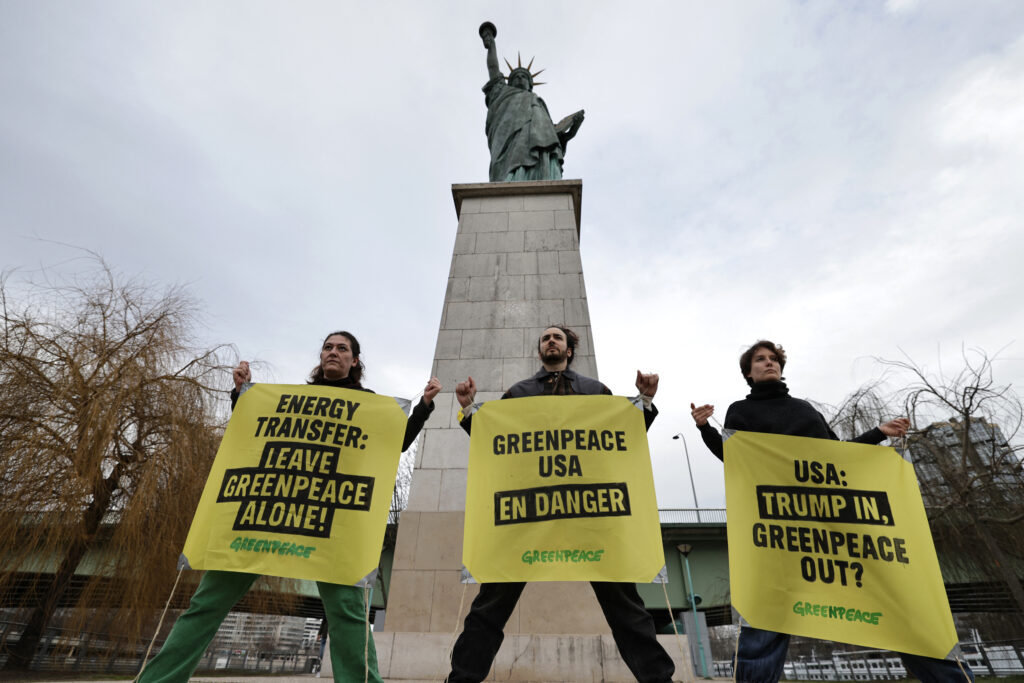
A lawsuit filed by Greenpeace International against the U.S.-based fossil fuel company Energy Transfer in the Netherlands is moving forward after a Dutch court recently ruled in favor of the environmental organization in rejecting the company’s bid to toss out the case.
The suit is connected to the ongoing litigation in the U.S. between Energy Transfer and Greenpeace entities over the 2016-2017 indigenous-led protests of the Dakota Access Pipeline, which resulted in a staggering jury verdict delivered against Greenpeace in North Dakota last year.
Now, as Greenpeace fights to contest the verdict while it simultaneously pursues claims against Energy Transfer in the Netherlands, the two parties remain locked in an unusual and bitter legal dispute that is proceeding on parallel tracks on both sides of the Atlantic.
A little over a year ago, on March 19, 2025, a North Dakota jury unanimously handed down a crushing damage award amounting to nearly $667 million against three Greenpeace entities—the U.S.-based Greenpeace Inc. and Greenpeace Fund, and the Netherlands-based Greenpeace International—over their alleged role in the Standing Rock protests against the controversial crude oil pipeline.
The 1,172-mile-long pipeline was rerouted around Bismarck to cross within a mile of the Standing Rock Sioux reservation and beneath Lake Oahe—the primary drinking water source for the tribe. Following a three-week trial in Morton County, North Dakota, where the uprising took place, the jury sided with pipeline developer Energy Transfer in finding Greenpeace liable for claims including defamation, tortious interference with business, conspiracy, aiding and abetting property damage and trespass.
While Energy Transfer alleged that Greenpeace had orchestrated the protest, Greenpeace argued that it played just a minor supporting role and only got involved at the request of the Standing Rock Sioux. The environmental group provided training and supplies including lock box devices that some demonstrators used to chain themselves to construction equipment. The protests involved some acts of civil disobedience, like trespassing and blocking traffic, as well as moments of heightened tension between protestors and law enforcement.
Greenpeace and its allies
slammed the verdict as an attack on free speech, and Greenpeace vowed to continue to fight back against the case that it characterized as “one of the largest Strategic Lawsuits Against Public Participation (SLAPP) cases ever filed.”
In February 2025, just ahead of the start of the North Dakota trial, Greenpeace International
sued Energy Transfer in the Netherlands, invoking a newly adopted European Union directive intended to protect EU citizens from abusive lawsuits or SLAPPs that aim to stifle democratic public participation. The case was filed in Amsterdam District Court claiming that Energy Transfer’s lawsuit against Greenpeace International in North Dakota was baseless and designed to silence and punish its opponents.
The case also points to an initial federal racketeering lawsuit that Energy Transfer tried to bring against Greenpeace but was dismissed, arguing that the pipeline company has engaged in harassment and defamation that amount to torts under Dutch law.
With the filing of the Dutch case along with the ongoing proceedings in North Dakota, two tracks of litigation involving the same parties are playing out in separate countries. This is already raising thorny questions around jurisdiction. And it remains to be seen how the disputes will ultimately get resolved and whether there will be conflicting rulings.
“There may be an outright conflict between the two courts in the two cases, or there may not. This is uncharted territory,” Patrick Parenteau, emeritus professor of law at Vermont Law and Graduate School, told Inside Climate News. “Each case is in a very different posture. Some of the issues that have yet to be settled in the U.S. are going to have a direct bearing on what happens in the Netherlands. And which court goes first, or which court gets to a final resolution first, that’s another question.”
Dueling Legal Battles
Although there has been a trial and a jury verdict in the North Dakota case, Greenpeace insists that the case is not over. In February, when the trial court entered its judgment in favor of Energy Transfer, it cut the initial damage award in half, down to $345 million. That amount, of which Greenpeace International would be liable for about $65 million, is closer to the roughly $300 million Energy Transfer had sought when the case
went to trial.
But Greenpeace has said that its U.S. entities would face bankruptcy if it is forced to pay such a sum. The Greenpeace defendants are thus
continuing to contest the verdict. In March they filed a motion for a new trial. If that is denied, they plan to appeal the verdict to the North Dakota Supreme Court.
Meanwhile, Energy Transfer is fighting back against the Dutch lawsuit, claiming it is baseless and that the court lacks jurisdiction over the company.
On June 3 the Amsterdam District Court
ruled against Energy Transfer’s preliminary request to dismiss the case, rejecting the company’s argument that it lacks jurisdiction. The court also refused to pause the case pending the final outcome of the proceedings in North Dakota, and it denied Energy Transfer’s request to appeal before the case is heard on the merits. The ruling means that the case will proceed on the merits, according to Greenpeace International.
The Amsterdam court did side with Energy Transfer on the applicability of the 2024 EU anti-SLAPP directive, finding that it does not apply because the Netherlands has not yet implemented the directive through national legislation. The Dutch government had argued there was no need to do so since there are similar anti-SLAPP remedies under existing Dutch law.
“The court disagreed with the Dutch government and said there is an implementing law needed,” Daniel Simons, senior legal counsel for strategic defense at Greenpeace International, explained. “It still allowed our case to move forward, but it does so under the existing Dutch law rather than that together with the EU directive.”
In a
statement commenting on the Amsterdam District Court’s ruling, Energy Transfer described it as an “important victory” and a “step in the right direction.”
This story is funded by readers like you.
Our nonprofit newsroom provides award-winning climate coverage free of charge and advertising. We rely on donations from readers like you to keep going. Please donate now to support our work.
Donate Now
“The court rejected Greenpeace’s central legal argument that the EU Anti-SLAPP Directive supports its claims to essentially undo Energy Transfer’s successful outcome in the North Dakota court last year,” the company said in its statement. “The court agreed with our position that the Directive does not apply. This is a significant legal determination that vindicates Energy Transfer’s consistent stance throughout this litigation.
“Energy Transfer maintains that no legitimate basis exists for a European court to assert jurisdiction over an American company with no employees, operations, or assets in the Netherlands, for conduct that occurred entirely on American soil. That jurisdictional reality has not changed, and Energy Transfer will continue to press that position. We remain committed to pursuing all available legal remedies to full resolution.”
The company has already tried to get the North Dakota courts to block the case in the Netherlands through requesting what is called an anti-suit injunction. As Parenteau explained in a
2025 working paper, such requests to stop a lawsuit in another country “are rare in the U.S.”
In September, the North Dakota district court denied Energy Transfer’s request, finding that the Dutch case raised different issues from the North Dakota case. Greenpeace International alleges defamation from out-of-court statements made by the company and from the company’s initial filing of a federal suit accusing Greenpeace of criminal racketeering and terrorism, for example.
Greenpeace International also alleges that Energy Transfer engaged in SLAPPs, and the trial in North Dakota did not address that because North Dakota, as one of a handful of U.S. states that lacks an anti-SLAPP law, does not recognize this type of action.
Energy Transfer, which had argued that the Dutch lawsuit is a “collateral attack” on the North Dakota jury verdict, then went to the North Dakota Supreme Court to try to stop Greenpeace International from proceeding with its suit in the Netherlands. Last month that court
decided largely in favor of Energy Transfer, concluding that the district court “abused its discretion” in denying the company’s request. The state Supreme Court said, contrary to the district court, that the issues between the Dutch and North Dakota cases are “substantially similar.”
“If successful, the Dutch action would contradict and offset the verdict, functionally nullifying it. This is not a legitimate parallel action. It is an attack on a fundamental policy of this state,” the majority opinion
stated. Chief Justice Lisa Fair McEvers dissented. The ruling orders the trial court to enter a “narrowly tailored anti-suit injunction” that would limit the scope of claims that Greenpeace International can pursue in the Netherlands, but would not quash the case entirely.
“The injunction would impose a certain restriction on the arguments we could make, but certainly not prevent the whole case from moving forward,” Simons told Inside Climate News. He said the trial court has not yet issued the injunction.
One contested issue that could impact the district court’s injunction order is jurisdiction. Just as Energy Transfer argues that the Dutch court lacks jurisdiction over it, Greenpeace International similarly contends that there is no basis for North Dakota courts to assert jurisdiction over the Amsterdam-based organization. Greenpeace International says it had no physical presence at the pipeline protests in North Dakota, and argues it is being unfairly targeted simply for signing onto a
letter, which was also signed by more than 500 other organizations, urging banks to restrict financing for the pipeline.
“What we said in our initial complaint was all that Greenpeace International did was sign an open letter, and yet we’re faced with a liability for $65 million,” Simons said. “It needs to be evaluated post-trial whether [Energy Transfer] has met the burden of proof by the preponderance of the evidence to establish personal jurisdiction. And our position is very clear that they did not meet that burden of proof.”
In her dissent, the state Supreme Court chief justice said that the trial court should resolve the jurisdiction issue before issuing any injunction.
“If the district court is required, under the direction of the majority opinion, to issue an injunction, it should first determine whether the facts presented at trial support a finding of personal jurisdiction over [Greenpeace International]. Without such a finding, the court has no authority to issue the injunction,” McEvers wrote.
Simons said he is pleased that the Dutch case against Energy Transfer is moving forward. “For a third time, Energy Transfer has failed to halt our case. After unsuccessfully petitioning two levels of North Dakota courts and the Amsterdam District Court, Energy Transfer will have to face accountability for its conduct, including repeated abusive lawsuits and defamatory statements,” he said.
The Amsterdam District Court gave Energy Transfer six weeks to file its defense on the merits.
Simons told Inside Climate News that the Dutch case is the “first case of its kind where the SLAPP victim sues the perpetrator for damages.” If Greenpeace International prevails, he said it could help deter powerful corporate interests from bringing SLAPP suits against activists in the future.
“If it ends up that Energy Transfer is branded by a court of being a bully essentially and is ordered to pay damages, that might change the calculus a little bit for wealthy corporations or individuals considering bringing these types of suits,” he said.
The case in North Dakota, meanwhile, continues to grind on as Greenpeace seeks to get the jury verdict overturned.
Greenpeace ally EarthRights International argues in a new
report that there is a strong case to be made for overturning it, saying that the suit brought against Greenpeace was a SLAPP and that the trial and resulting verdict were manifestly unfair.
“Courts are careful to respect the role of juries in finding facts and only step in when a jury acts in an extremely unreasonable way, such as when the verdict is ‘manifestly against the weight of the evidence.’ This case surpasses that threshold several times over,” the report asserts.
“Based on our reading of the case, [the verdict is] not consistent with basic law,” Kirk Herbertson, EarthRights International’s U.S. director of advocacy and campaigns, told Inside Climate News. He said the case against Greenpeace “has created a chilling effect, especially in this current political environment.”
Parenteau noted that Greenpeace likely faces an uphill battle in trying to get the jury verdict nullified in North Dakota or even with the U.S. Supreme Court. “It looks awfully difficult to set the verdict aside completely,” he said.
If the verdict does stick, that may be the end of the road for Greenpeace in the U.S.
“If there is no new trial and the appeal is unsuccessful, that would then [mean] bankruptcies looming for Greenpeace U.S. entities,” Simons said. “But of course we’re not there yet.”
About This Story
Perhaps you noticed: This story, like all the news we publish, is free to read. That’s because Inside Climate News is a 501c3 nonprofit organization. We do not charge a subscription fee, lock our news behind a paywall, or clutter our website with ads. We make our news on climate and the environment freely available to you and anyone who wants it.
That’s not all. We also share our news for free with scores of other media organizations around the country. Many of them can’t afford to do environmental journalism of their own. We’ve built bureaus from coast to coast to report local stories, collaborate with local newsrooms and co-publish articles so that this vital work is shared as widely as possible.
Two of us launched ICN in 2007. Six years later we earned a Pulitzer Prize for National Reporting, and now we run the oldest and largest dedicated climate newsroom in the nation. We tell the story in all its complexity. We hold polluters accountable. We expose environmental injustice. We debunk misinformation. We scrutinize solutions and inspire action.
Donations from readers like you fund every aspect of what we do. If you don’t already, will you support our ongoing work, our reporting on the biggest crisis facing our planet, and help us reach even more readers in more places?
Please take a moment to make a tax-deductible donation. Every one of them makes a difference.
Thank you,
<small>Source: Inside Climate News</small>