- Published
The Strawberry Moon is set to rise in UK skies this week, marking the first full Moon of the summer season.
It will reach its peak in the early hours of Tuesday, 30 June, according to the Royal Observatory Greenwich.
But for skygazers hoping to catch a glimpse at a more reasonable hour, it will appear full in the nighttime sky on Monday, 29 June and the following evening.
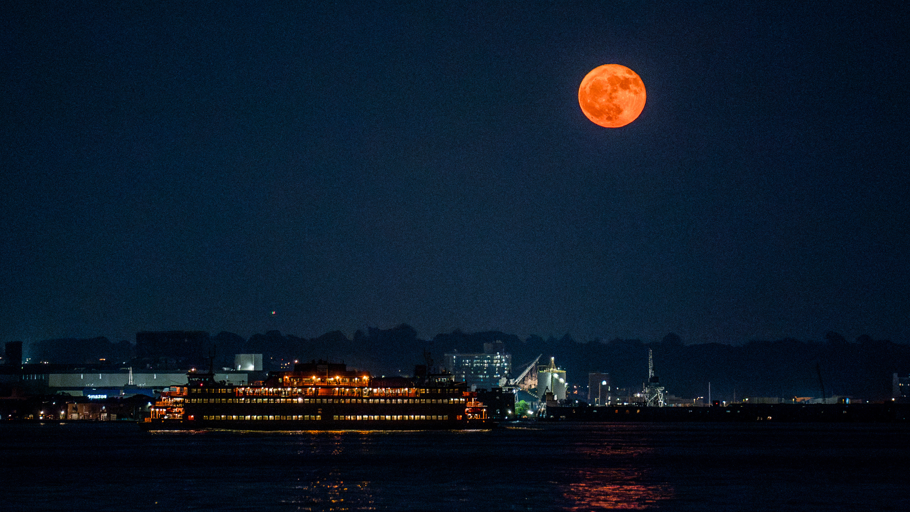
In the northern hemisphere, June's full Moon is different from others in the calendar year as it is the lowest-hanging in the sky.
This means it sits closer to the horizon causing something known as the Moon illusion, a phenomenon where the Moon appears larger than when it's positioned high in the sky at other times of the year.
Why is it called a Strawberry Moon and is it pink?
The Strawberry Moon is the name given to the full Moon in June - but skygazers may be disappointed to learn it does not actually appear pink or red.
Its name is connected to the time of year that it rises, rather than its actual colour.
Named after the harvest season observed by indigenous Americans, it signalled the time of year that wild strawberries were harvested, according to the Old Farmer's Almanac.
Historically, full Moons were given nicknames to help keep track of time and monitor the changing seasons.
Will the weather cooperate for skygazers?
Following a record-breaking heatwave in the UK this week, the door is being opened to cooler and fresher air coming in from the Atlantic.
As well as a change in temperature, there is more unsettled weather in the forecast for the early part of the week.
While many places will be dry on Monday during the day with sunny spells, an area of low pressure will be approaching during the evening and overnight.
That means thicker cloud and outbreaks of rain will be pushing across from the west on Monday night.
Most of this cloudy, wet weather will affect Scotland, Northern Ireland and northern England. The best chances for clear skies will be across the Midlands, Wales and southern England.
You can check
the forecast where you live here.
If weather hinders your chances of seeing this full Moon, there are two more opportunities throughout meteorological summer.
The Buck Moon - named after the time male deer sprout new antlers - will rise on 29 July. This will be followed by the Sturgeon Moon - named after the freshwater fish caught by Native Americans in the Great Lakes - on 28 August.
<small>Source: BBC Science</small>