Fifty years after Gen
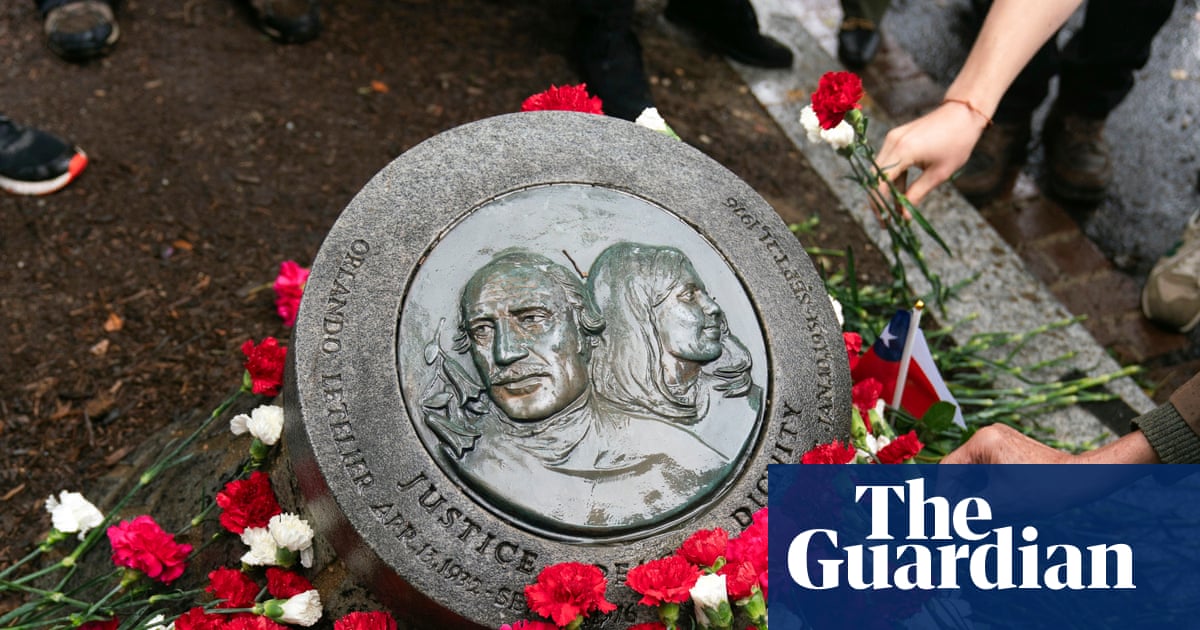
Augusto Pinochet’s secret police detonated a car bomb in the heart of Washington DC, killing Orlando Letelier, a former Chilean minister and ambassador to the US, and his American colleague Ronni Karpen Moffitt, a Santiago court has convicted three former agents of Moffitt’s murder.
Judge Paola Plaza, a special minister for human rights in
Chile, sentenced Pedro Espinoza, José Zara, and Raúl Iturriaga to 15 years in prison for their roles in the killing of Moffitt, 25.
All three men were agents of the Dirección Nacional de Inteligencia (Dina), Pinochet’s feared secret police which hunted down opponents at home and abroad.
Espinoza and Iturriaga – who is serving more than 500 years’ prison time for a litany of human rights atrocities – were being
held at an exclusive facility outside Santiago, but Zara had been released in August last year having completed a 15-year jail term. He has now been arrested once more.
Juan Gabriel Valdés, who served as Chile’s ambassador in
Washington DC until March this year and knew Letelier and Moffitt during his own exile in the US capital, posted on social media: “Justice took 49 years and 97 days to arrive,” remembering Moffitt’s cheerful greeting each morning at the Institute of Policy Studies where she worked with Letelier.
On 21 September 1976, the pair were driving to work when the bomb exploded as they rounded a bend on Massachusetts Avenue Northwest.
According to the court ruling, the agents, led by notorious Dina chief Manuel Contreras, concocted a plan to carry out extrajudicial murders on foreign soil and carried out surveillance on Letelier, whose murder was initially investigated separately.
Several high-ranking Chilean military officials were sentenced in connection to the case during the 1990s, as well as US citizen Michael Townley, a Dina collaborator
who confessed to his role in the murders in 1978, but in 2012 a Santiago appeals court ruled that Moffitt’s case must be reopened as the perpetrators were Chilean nationals.
Rebecca Karpen, Moffitt’s niece, said in a statement: “These sentences are not just a victory for our family, but are a reminder that the countless lives ruined by the Pinochet regime are still being fought for, that the pain of the Chilean people will not be forgotten.”
Juan Pablo Letelier, the former ambassador’s son, called on the US to pursue justice against the killers.
Orlando Letelier had become a prominent critic of the dictatorship while living in exile in the US, where he arrived in January 1975 after a year’s imprisonment in a concentration camp on a frozen Patagonian island before being transferred to another on Chile’s central coastline.
On 10 September 1976, Pinochet revoked his Chilean citizenship. That night, Letelier addressed a crowd of 75,000 at an anti-Pinochet rally at Madison Square Garden in New York, telling them: “I was born a Chilean, I am a Chilean, and I will die a Chilean. They were born traitors, they live as traitors, and they will be known forever as fascist traitors.”
He was murdered 11 days later, aged 44.
The brazen killings in Washington frayed relations between Chile and the US, which had enthusiastically thrown its financial backing behind Pinochet’s coup d’état on 11 September 1973, and the US Congress ordered an investigation into the killings as well as imposing an arms embargo on Chile.
Pinochet’s junta disbanded the Dina in response, although quietly replaced it with the Central Nacional de Informaciones (CNI) a few months later.
<small>Source: The Guardian</small>