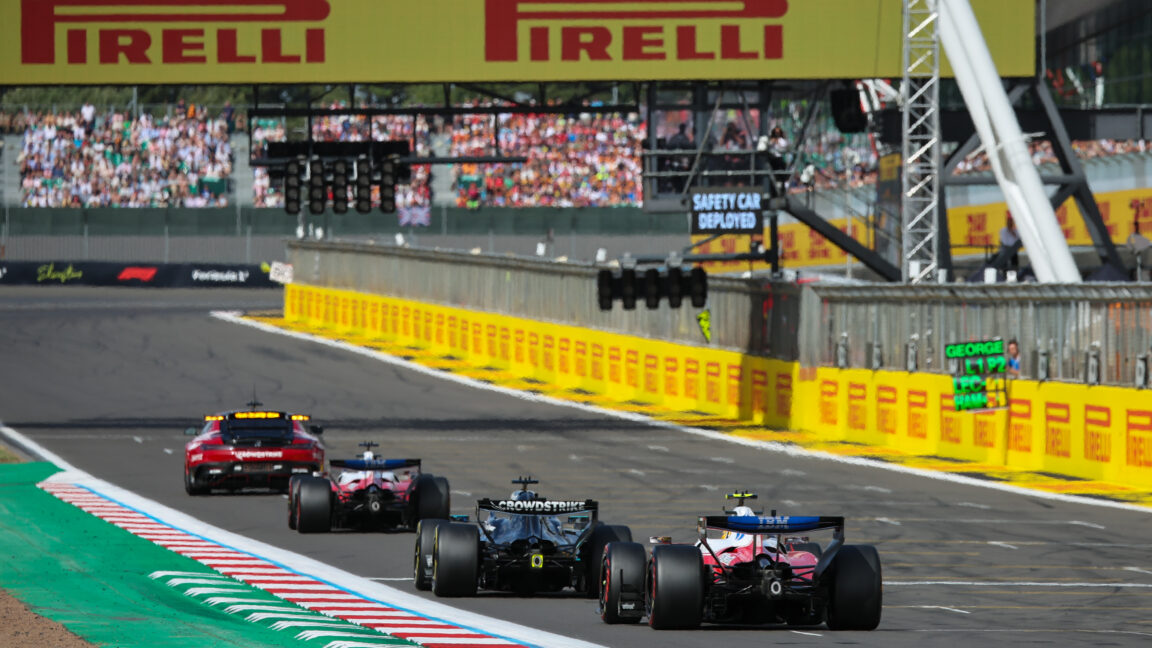
Formula 1 returned to what is a home race for most of the teams on the grid this past weekend with the British Grand Prix. Yet again this season, we saw the fastest car not win the race, as reliability has been a problem. But racing giveth and racing taketh away, and the beneficiary of one driver’s bad luck was another driver who really needed that win. Perhaps the bigger story, though, was the unfulfilled expectation that we’d see a late-race restart after the safety car came out on lap 48 of 52. An on-screen message told commentators and viewers this would be the case, but it was displayed in error, and what had been an entertaining race ended as something of a damp squib.
Silverstone, like many of Britain’s race circuits, was a World War II airbase before being demobbed, which means it’s quite flat and can be rather windy. It’s also pretty fast even in its current layout (which was changed in 2010), with corners that are among the best places in the world to watch an F1 car change direction. There were worries that the new cars would find their hybrid power units starved of energy part-way round the track, and in qualifying, the cars were limited to recovering and deploying just 6.5 MJ across a lap, compared to the 8 MJ per lap allowed in the sprint and main race.
That energy limit in qualifying was about right—unlike at Suzuka in Japan, where we had the rather pathetic sight of cars slowing down before the fast 130R corner, drivers in qualifying looked to be at the limit through corners like Copse, Maggotts, and Becketts.
On Friday, one driver in particular stood out: Ferrari’s Lewis Hamilton. The most successful driver at Silverstone since its inception, the place named a straight after him as part of that 2010 update. It must be weird going to a track knowing they named part of it after you because you’re just that good; that honor usually comes in retirement. But Hamilton was on form, buoyed up by a massive crowd, most of whom were there to see him.
<small>Source: Ars Technica</small>