Could the Army’s light squad vehicle power battlefield drones?
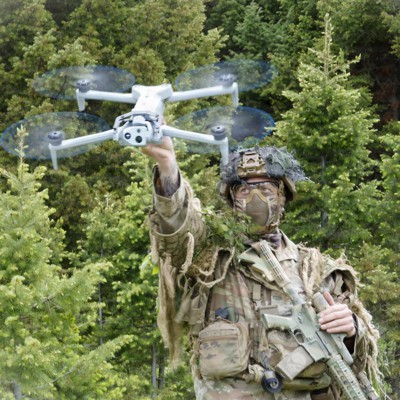
A mobile brigade in the 101st Airborne Division put drones to the test in a recent training rotation—and used the Infantry Squad Vehicle to keep unmanned systems running.
The Army’s proliferating drone use is exacerbating the modern problem of keeping everything charged. One combat team is testing ways to use its light
Infantry Squad Vehicles as mobile charging stations.
“As we field technology, power generation becomes increasingly problematic. The [
Integrated Tactical Network], all the soldier-borne equipment, all require batteries that have to be recharged. [ Enhanced Night Vision Goggles] require batteries, particularly to use thermals,” said Col. Ryan Bell, commander of the 3rd Mobile Brigade Combat Team in the 101st Airborne Division, of lessons from an April training rotation at the Joint Readiness Training Center at Fort Polk, Louisiana.
“Every squad functionally had their own generator without having to tow a trailer, or a generator, behind it,” Bell said.
But more power is needed, he said, like hybrid generators that could deliver up to 10 kilowatts, depending on a unit’s needs.
Bell suggested sizing the generators so they can be mounted on the
five-seater ISV-Utility variant the Army plans to field. They could also be towed, but that’s not a great solution for rough terrain.
“As future ISVs are fielded, we need to ensure they are utilized as power generation platforms, particularly for our squads. Our use of the vehicle as a sustainment platform by adding commercial off-the-shelf racks on the back was very helpful,” Bell said.
“We are also excited to get the ISV-U, which will give us more utility lift capacity. Having a single, common platform across the formation will simplify our logistics chain. The utility variant will be extremely helpful for mission command and power generation for our command posts.”
Bell also said troops also need batteries that carry more charge and last longer, which would “reduce the number of batteries you have to charge and have to carry, because solder load is a real thing.”
<small>Source: Defense One</small>