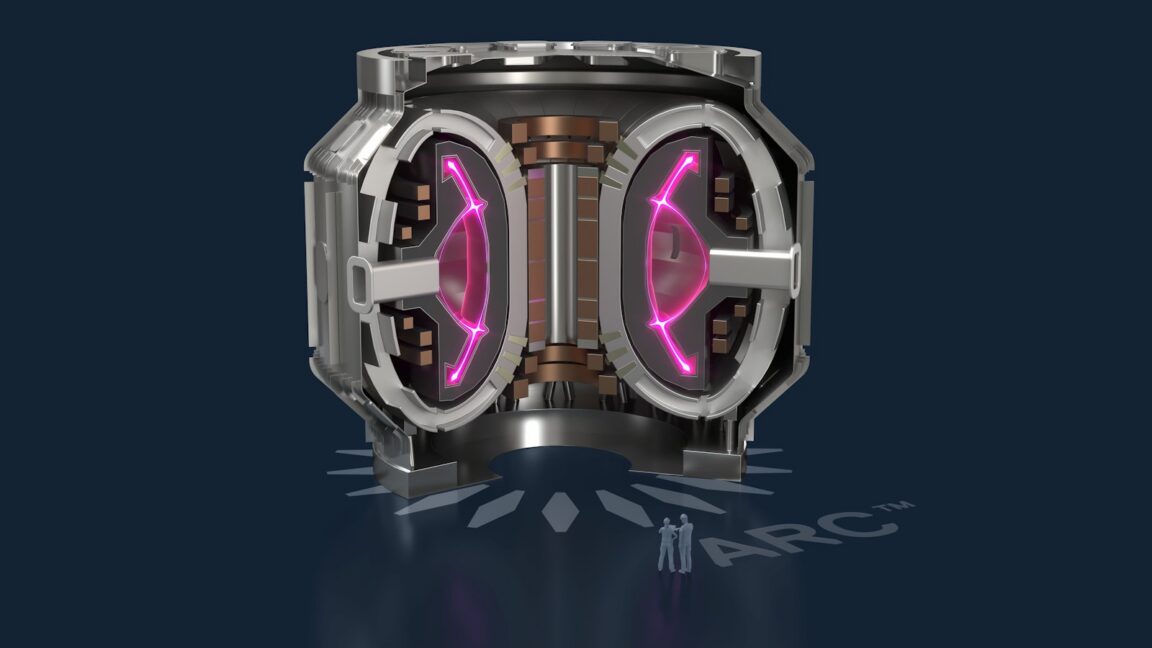
The scientific community has a plan for achieving fusion power. It involves getting a better understanding of how to control fusion in a tokamak-style reactor using the currently under construction
ITER reactor, and then using that knowledge to build DEMO-style plants. But ITER isn’t even expected to see hot plasmas until the middle of the 2030s, by which point solar panels will be so cheap that we’ll probably all be getting them free in our cereal boxes.
Commonwealth Fusion is a startup that’s basically asking “what if we did that, but now?” Its ITER equivalent, a tokamak called SPARC, is over 70 percent complete and is planned to be operating as soon as next year. The company already has a site and customers for the power-generating follow-on, called ARC. Both of those projects are predicated on using high-temperature superconductors to generate an extremely powerful magnetic field that will allow the company to build a smaller reactor, and thus get things done faster.
Years of running plasmas through tokamaks has given us confidence that the basics of these plans are sound. But there are lots of potential devils in the details (otherwise there’d be little need for experimental reactors). So Commonwealth’s scientists, in collaboration with the academic community, have recently released five peer-reviewed papers that detail its plans for ARC: what our best models tell us now, and what we’ll still need to learn from SPARC to finalize the design of a production fusion plant.
The basics of ARC
The articles are all
published in the Journal of Plasma Physics—they’re open access, so you can view them yourself, but they are long (roughly 30–40 page PDFs) and highly technical. What follows is an overview of some of what’s there and a few things that stood out to me as I went through them.
<small>Source: Ars Technica</small>