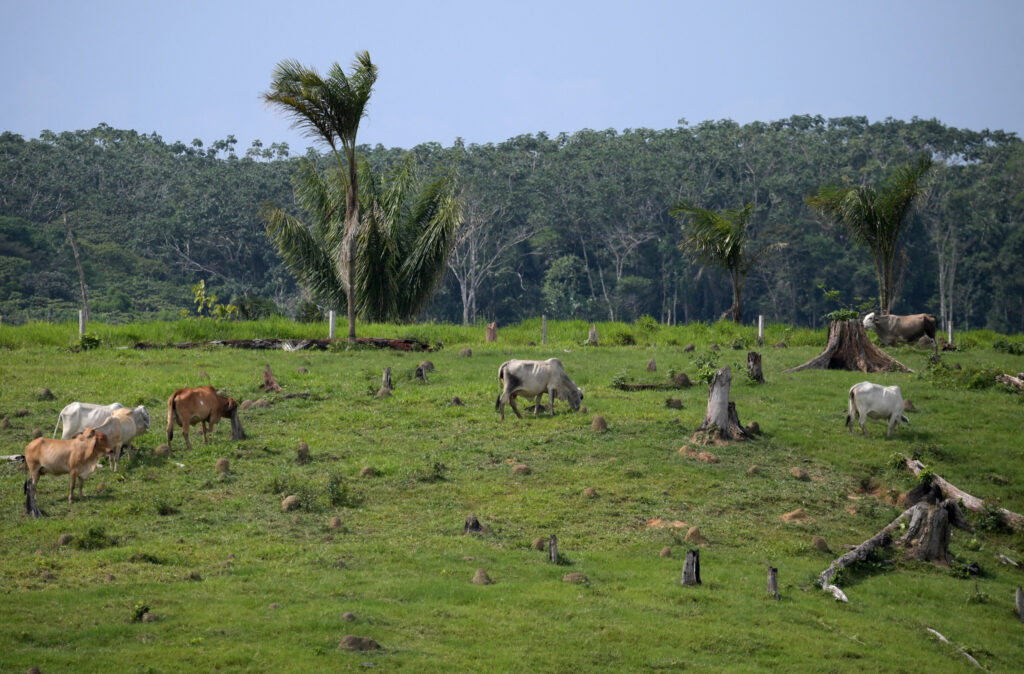
Colombia this month enacted a landmark law designed to stop deforestation connected to cattle ranching, a move that environmental groups say could provide a model for the wider Amazon region, where livestock production is a leading driver of tree loss in the world’s largest and most climate-critical rainforest.
The law will require that cattle are rigorously tracked from their origins all the way to the supermarket. It gained traction after advocacy groups and investigators found Colombian grocery stores were unwittingly selling beef from cattle that had been raised on illegally deforested land in the country’s national parks. The measure comes as commodity-exporting countries face increasing scrutiny of products tied to deforestation, including from the European Union, which passed a law in 2022 requiring beef and other commodity exporters to demonstrate their products are deforestation-free.
The Amazon rainforest is a huge repository of carbon and critical for maintaining Earth’s atmospheric stability.
“For decades, cattle expansion has been a major driver of deforestation in the Colombian Amazon,” said Boris Patentreger, a senior director with Mighty Earth, an advocacy organization that has extensively tracked deforestation in the Amazon but was not directly involved in pushing for the new law. “By requiring traceability from farm to slaughterhouse and linking cattle movement data with deforestation monitoring, Colombia is taking a critical step toward ensuring that beef and leather are no longer associated with forest destruction.”
In many Amazon countries, beef production is a major driver of tree loss as ranchers clear or burn forest to create grazing land. But in Colombia, the situation is especially complex: Ranchers often graze cattle in an effort to eventually gain title to the land. Armed groups, linked to drug trafficking, also routinely extort ranchers for a per-cow “protection” fee, according to an
2021 investigation by the Washington, D.C.-based Environmental Investigation Agency.
These payments are major sources of income for armed groups, adding up to hundreds of thousands of dollars per year, EIA found in its analysis. The agency said armed groups frequently issue illegal permits to clear forests for grazing.
“In Colombia the situation is very complicated. There is armed conflict,” said one investigator who asked not to be named for fear it would compromise their work and potentially put them in danger. “They don’t want cows being traced back to their origin because it leads to them.”
The 2021 EIA investigation said the Colombian government had no system in place to track cattle back to their birthplace, pointing out that cattle were moved through a series of owners and ranches to obscure their origins. A
subsequent analysis by EIA showed that more than 200,000 cattle were sourced from protected areas, where ranching is illegal, between 2020 and 2024. Colombia had about 30 million head of cattle in 2025.
Voluntary efforts to track deforestation in livestock supply chains have largely failed or collapsed in recent years. An industry pact known as the Soy Moratorium, in which soy producers and traders pledged to avoid buying soybeans from deforested land, was widely credited with slowing deforestation across the Brazilian Amazon. But earlier this year, the association that represents the biggest soy traders pulled out of the pact. (In the Amazon, soybean plantations often occupy land that had been previously cleared for livestock, in a kind of continuum that connects the livestock and soybean industries. Soy is also a major feed for livestock.)
“As long as there is no legal obligation to follow a product back to its origin—in the case of cattle, the place of birth—actors along the supply chain will continue to avoid responsibility for due diligence, while armed groups and land speculators continue to profit from environmental crimes with impunity,” the EIA report noted.
The Brazilian state of Pará, a major cattle region, managed to pass a law similar to the Colombian measure, but that, too, has fizzled.
“At a time when Colombia is moving in the right direction, other countries in the region should take note,” Patentreger said. “Bolivia continues to face increasing pressure on its forests and is moving in the opposite direction on forest protection. In Brazil, the Pará cattle traceability initiative has stalled and should draw inspiration from Colombia’s example.”
The Colombian law will be rolled out over the next two years and will require regulations defining what constitutes a “deforestation-free producer,” surveillance measures in deforestation hotspots and the institution of specific policies for actors along the cattle supply chain, from cattle auctions to slaughterhouses.
“Traceability systems only work if they are transparent, enforced and accompanied by meaningful consequences for actors linked to deforestation,” Patentreger added.
About This Story
Perhaps you noticed: This story, like all the news we publish, is free to read. That’s because Inside Climate News is a 501c3 nonprofit organization. We do not charge a subscription fee, lock our news behind a paywall, or clutter our website with ads. We make our news on climate and the environment freely available to you and anyone who wants it.
That’s not all. We also share our news for free with scores of other media organizations around the country. Many of them can’t afford to do environmental journalism of their own. We’ve built bureaus from coast to coast to report local stories, collaborate with local newsrooms and co-publish articles so that this vital work is shared as widely as possible.
Two of us launched ICN in 2007. Six years later we earned a Pulitzer Prize for National Reporting, and now we run the oldest and largest dedicated climate newsroom in the nation. We tell the story in all its complexity. We hold polluters accountable. We expose environmental injustice. We debunk misinformation. We scrutinize solutions and inspire action.
Donations from readers like you fund every aspect of what we do. If you don’t already, will you support our ongoing work, our reporting on the biggest crisis facing our planet, and help us reach even more readers in more places?
Please take a moment to make a tax-deductible donation. Every one of them makes a difference.
Thank you,
<small>Source: Inside Climate News</small>