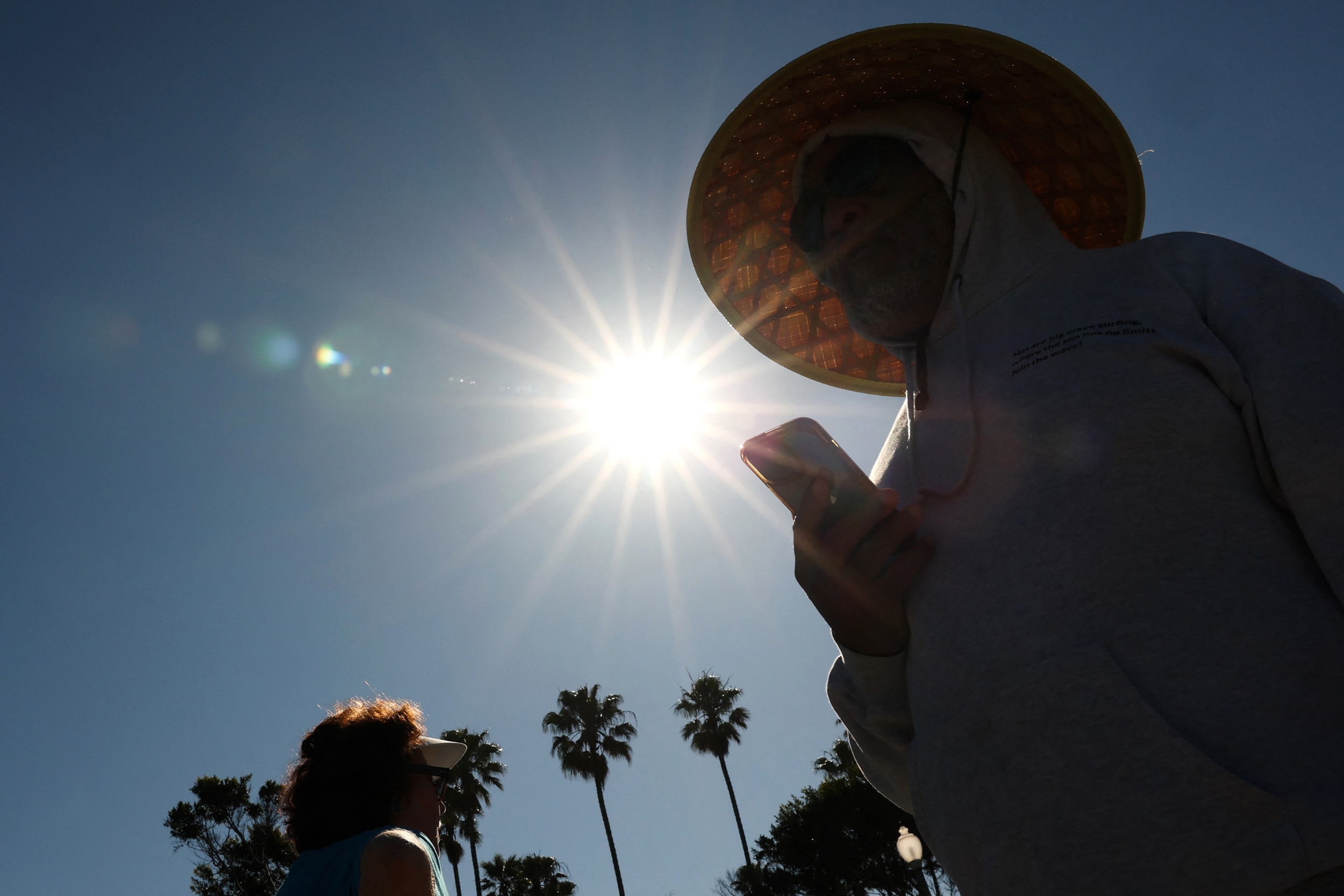
Former federal climate experts warn that atmospheric carbon dioxide concentrations hit a record high in May and that the monthly average global temperature this summer could rise as much as 3.5 degrees Fahrenheit (1.9 degrees Celsius) above the pre-industrial benchmark used to measure the heating from greenhouse gases.
Research shows human-caused warming will contribute significantly to deadly heat waves, intensified storms and wildfires, atmospheric scientist Zack Labe said as he opened a Tuesday briefing by a team of experts with
Climate Central, a nonprofit research and communications organization based in Washington, D.C.
Labe and several other members of the Climate Central team are former National Oceanic and Atmospheric Administration scientists. They decided to provide public monthly climate updates after NOAA, citing Trump administration budget cuts, canceled its briefings last year. Climate Central’s monthly briefings are part of
a larger effort to ensure useful climate information remains available to the public as the current administration tries to erase the topic from government records.
Several other research groups, including
Berkeley Earth and Copernicus, the European Union’s climate change service, also provide monthly public climate updates with data collected from global climate monitoring networks.
“We heard from a lot of folks that they missed the NOAA briefings and being able to talk with experts,” said Climate Central’s Tom Di Liberto. “We were happy to tap into Climate Central’s expertise and combine it with our NOAA experience to bring this to fruition.” He added that Labe leads the monthly briefing and aims to establish the links between human-caused warming and climate extremes.
“As someone who used to be the climate scientist and meteorologist for climate.gov, and an expert guest on the old NOAA monthly climate briefings,” Di Liberto said, “there certainly is more flexibility and freedom to make those connections front and center.”
During the briefing, Labe explained that atmospheric CO2 levels reach a seasonal peak each May, just before forests across the vast Northern Hemisphere landmasses go into full growth mode when they suck CO2 out of the air for several months.
But human emissions are overwhelming forests, as well as the oceans, the other major natural carbon sponge, leading to continued buildup in the atmosphere and more heating. About two-thirds of the excess CO2 has accumulated just in the past 50 years.
Separately from the Climate Central briefing, former NASA climate scientist
James Hansen also reinforced his warning about a short-term temperature spike. In an update on his website on Friday, Hansen wrote that many scientists are still underestimating how sensitive Earth’s climate system is to greenhouse gases, and that 2026 is likely to be the planet’s warmest year on record, despite starting out cooler than 2024, the previous record-warm year.
Hansen wrote that he is concerned that the public does not understand the current dangerous acceleration of warming because “the media are gobbling up and regurgitating an interpretation of global climate change that we believe is fundamentally flawed,” referring to what he says is the still-widely misunderstood overall sensitivity of the climate system, based on the estimates by the Intergovernmental Panel on Climate Change.
On June 11, Copernicus also issued a dire warning about warming, with data showing that Earth’s climate system is accumulating heat faster than at any time in the known record. The finding came in a major
report written by 70 scientists from 56 institutions across 17 countries.
The study shows “nearly all of the warming over the last decade is driven by human activities,” said
Samantha Burgess, the Copernicus strategic lead for climate.
That “energy imbalance” is a key indicator of the climate system, said climate scientist and lead author
Piers Forster, director of the Priestley Centre for Climate Futures at the University of Leeds in the United Kingdom.
“It provides a crucial measure of the pace of climate change,” he said. “Without human influence, it should be close to zero … but it has doubled in recent decades.”
About This Story
Perhaps you noticed: This story, like all the news we publish, is free to read. That’s because Inside Climate News is a 501c3 nonprofit organization. We do not charge a subscription fee, lock our news behind a paywall, or clutter our website with ads. We make our news on climate and the environment freely available to you and anyone who wants it.
That’s not all. We also share our news for free with scores of other media organizations around the country. Many of them can’t afford to do environmental journalism of their own. We’ve built bureaus from coast to coast to report local stories, collaborate with local newsrooms and co-publish articles so that this vital work is shared as widely as possible.
Two of us launched ICN in 2007. Six years later we earned a Pulitzer Prize for National Reporting, and now we run the oldest and largest dedicated climate newsroom in the nation. We tell the story in all its complexity. We hold polluters accountable. We expose environmental injustice. We debunk misinformation. We scrutinize solutions and inspire action.
Donations from readers like you fund every aspect of what we do. If you don’t already, will you support our ongoing work, our reporting on the biggest crisis facing our planet, and help us reach even more readers in more places?
Please take a moment to make a tax-deductible donation. Every one of them makes a difference.
Thank you,
<small>Source: Inside Climate News</small>