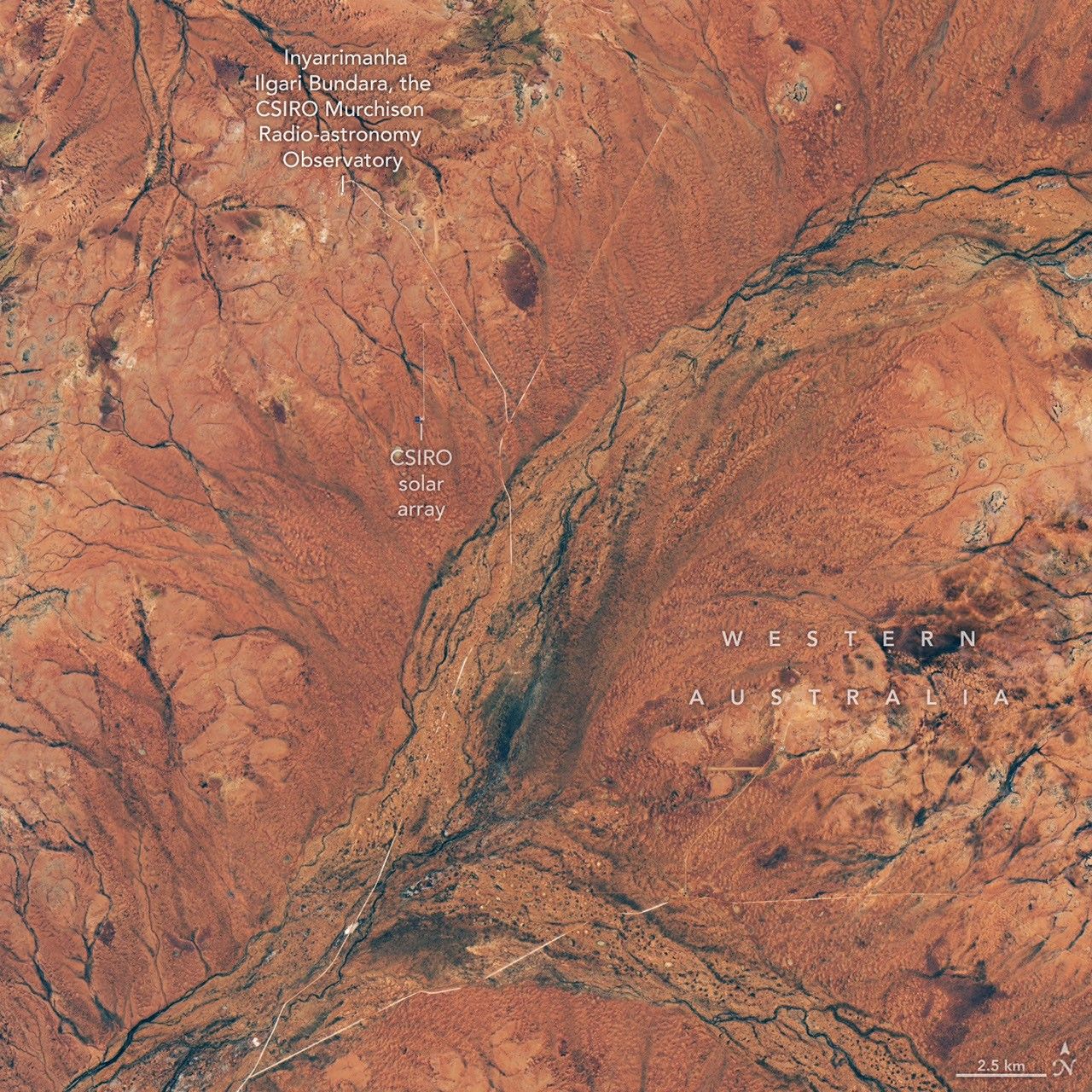
In late austral winter 2026, the Murchison region of Western Australia burst into colour as a profusion of wildflowers carpeted the rusty ochre landscape. NASA’s Earth Observatory, using images from the Landsat 8 satellite’s Operational Land Imager, recorded a dramatic shift from the drier, orange terrain of August 2025 to a verdant scene in August 2026.
The surge of green is attributed to wetter-than‑normal conditions earlier in the year. Australia’s Bureau of Meteorology reported above‑average rainfall in June and very high totals in August, driven by several cold fronts that moved through the area. The extra moisture awakened dormant seeds in the soil, producing a diverse mix of grasses, saltbush, and the slow‑growing evergreen mulga tree.
Among the blossoms were several threatened species that CSIRO has been monitoring on its former pastoral land. The organisation’s Murchison Radio‑Astronomy Observatory, situated about 600 kilometres north of Perth, is located in a “radio quiet” zone where terrestrial communications are tightly controlled to protect its deep‑space instruments.
Although the outback’s floral display stole the spotlight, the CSIRO site remains focused on observing the heavens. Its antenna arrays catalogue objects in the southern sky, and the facility is part of a network of Australian telescopes that have supported NASA missions for decades.
CSIRO’s Murriyang radio telescope in Parkes, New South Wales, tracked the Mariner 2 planetary science mission in 1962 and served as a key receiving station for Apollo 11 in 1969. The Canberra Deep Space Communication Complex, also operated by CSIRO, is one of three sites in NASA’s global Deep Space Network and helped support the Artemis II lunar mission in April 2026.
Experts say the 2026 wildflower bloom may be the most spectacular the region has seen in nearly twenty years, a vivid reminder of how climate, science and natural beauty can intersect in Australia’s remote outback.
<small>Source: NASA — read the original story there.</small>