It was designed to survive the apocalypse, as humanity’s last testament to its failure. But for a while it seemed the “Earth’s Black Box” hadn’t even survived its own planning process.
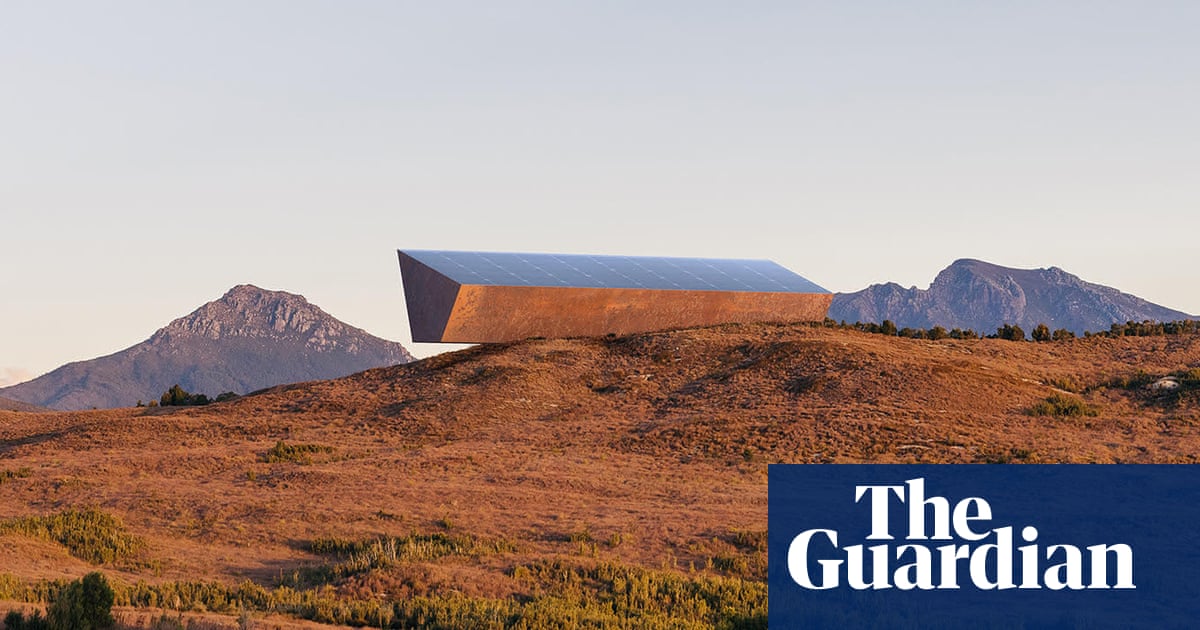
Now, five years after it was announced to much fanfare, followed by years of ominous silence, the box is back. Its creators say parts assembly is under way and, in December, the full monolith will be installed near Queenstown on the edge of a remote western Tasmanian airfield.
When it was first announced that an indestructible doomsday device would be built in a remote part of Tasmania to bear witness to the climate crisis, the news went viral around the world.
“Earth is getting a black box to record events that lead to downfall of civilization,” CNET declared, a headline that would later be quoted on The Late Show with Stephen Colbert. “We’re doomed,” he whispered to the camera.
Sign up for the Breaking News Australia email
According to the project’s website, the 16-metre long, four-metre high steel structure – to be topped with solar panels encased behind glass – will record “every step” humanity takes towards climate catastrophe.
“Hundreds of data sets, measurements and interactions relating to the health of our planet will be continuously collected and safely stored for future generations,” it says.
“How the story ends is completely up to us. Only one thing is certain, your actions, inactions, and interactions are now being recorded.”
The project’s inspiration is an aeroplane’s flight recorder, also known as a “black box” (despite usually being orange), which stores data within crash-proof casing to help investigators piece together the causes of accidents. That was also an Australian invention: the prototype was put together at a
government research lab in Melbourne in 1954.
The Earth’s Black Box was announced to coincide with the UN’s 2021 Cop26 climate talks in Glasgow.
Digital hard drives were turned on to begin recording data from the talks, to be transferred later to the physical box.
Map
But then all mysteriously fell quiet. The last – and only – posts on its Instagram page are black tiles which form a 3x3 box from October 2021.
Some wondered if it was all just performance art or a PR stunt, owing to the fact the project was dreamed up by Rouser Lab, an Australian not-for-profit “experimental environmental communications agency”, rather than scientists.
Its artistic director, Jonathan Kneebone, says the project is now being coordinated by the Earth’s Black Box Foundation, a registered charity dedicated to the idea.
“It will be approximately five years to the day that we are finally able to install the work,” he told Guardian Australia.
“In those five years, we have been evolving the design, data storage systems, source materials, web platform – as well as developing funding models to sustain the project into the future.”
Rouser Lab claims its climate interventions have had 4bn media impressions worldwide, including for another “techno-obelisk”, also yet to be built, that will constantly transmit a Climate S.O.S. into space.
Collaborators on the black box include art and directing collecting The Glue Society, and production company Revolver, but the University of Tasmania, which was initially affiliated, has dropped out in the intervening years and will request to be removed from Rouser Lab’s website.
The mayor of West Coast council in Tasmania, Shane Pitt, says the project has been a “long time coming”.
“It certainly is something we can see as a tourist attraction,” he said, adding the rugged, remote outcrops of Tasmania’s west coast were picked for their geological, and political, stability – much of the landscape was carved by glaciers.
“The west coast is certainly not a place that has got high value for anyone to cause major catastrophes.”
This year, the Doomsday Clock was set at
85 seconds to midnight, the closest it has been to apocalypse and narrowed from 100 seconds in 2021.
If the Earth’s Black Box is ever complete, will future beings trawl through its records to determine where it all went so wrong? Or will we land the plane safely, rendering the strange object built into Tasmania’s granite landscape as a reminder of an apocalypse that never came?
Perhaps that’s the thing about a black box: it is the canonical object whose inner workings are a mystery.
<small>Source: The Guardian</small>