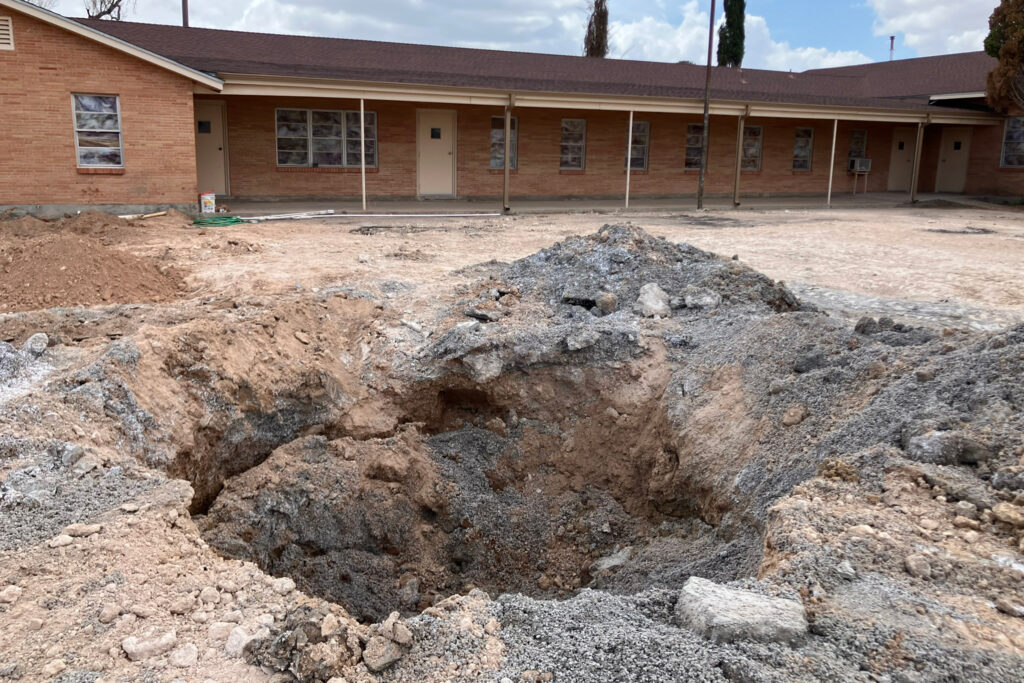
GRANDFALLS, Texas—An old oil well sprang back to life under the parking lot of the First Baptist Church of Grandfalls in April.
Over the next eight days, more than 1.5 million gallons of toxic wastewater flowed out of the earth, according to state records. The state regulator, the Railroad Commission, spent $1.49 million plugging the leak and another $1.16 million disposing of the wastewater back underground. By early June, crews had stopped the flow and plugged the wellbore.
Wastewater, fortunately, did not enter the church. The imminent threat passed. But questions linger for the church’s pastor and Permian Basin residents. Why do old wells in the area keep blowing out? What will happen if the next leak isn’t under a parking lot, but a house or school?
The Permian Basin’s oil and gas wells generate prodigious quantities of wastewater, known as produced water. This salty, toxic liquid is pumped underground into injection wells, increasing underground pressure. This pressure is finding its way to the surface through old wells that burst and spew wastewater aboveground.
The Railroad Commission requested injection wells within a five-mile radius of Grandfalls to stop pumping waste underground while the leak was being plugged. Agency spokesperson Bryce Dubee said that the old well underneath the parking lot is still under investigation.
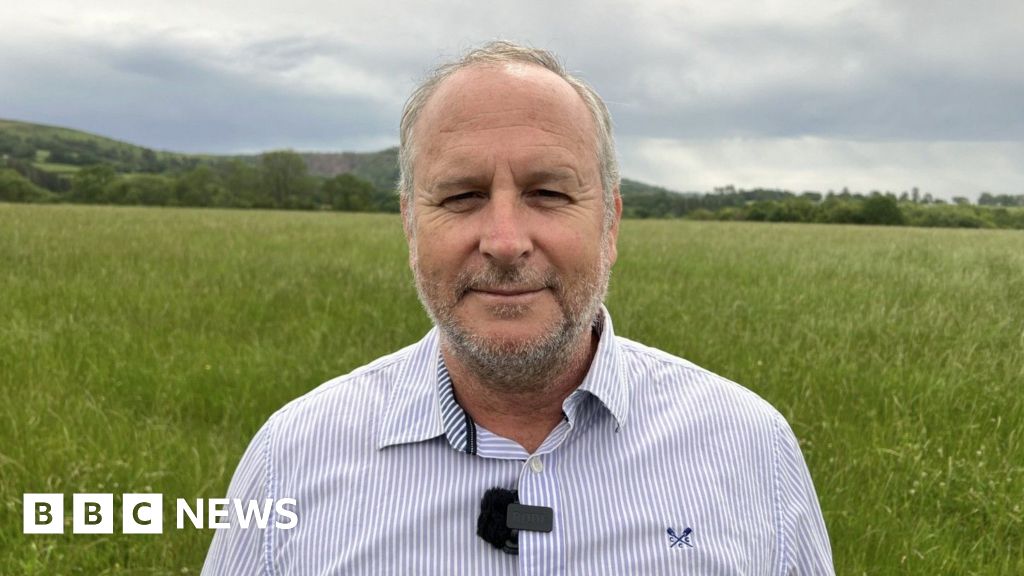
When David Tucker stepped in as the interim pastor at First Baptist last summer, his biggest concern was replacing an aging air conditioning unit. But once the leak sprang, Tucker, an oil and gas industry veteran, was uniquely qualified to help. He hopes the incident can lead to change.
“This was kind of a good thing because it brought attention to what’s happening,” he said, referring to the spate of oilfield leaks and geysers in the Permian Basin.
Tucker praised the Railroad Commission’s quick response but said the agency needs more resources to address the problem.
“They’re trying to do a good job. But they don’t have the money to do it. They’re overwhelmed,” he said. “The state needs to turn loose some more money to start funding this.”
Dubee, the RRC spokesperson, said the agency’s State Managed Plugging program “remains focused on addressing the well in Grandfalls.”
“We’re Doing Something Subsurface”
Injection wells are designed to seal wastewater permanently underground. But a few years ago, wastewater started blasting out at the surface, causing geysers, leaks and sinkholes.
Tucker, the pastor, is no stranger to the problem. On his own property outside Grandfalls, he has called the Railroad Commission for help when old wells started leaking. Ranches near Grandfalls in Crane, Pecos and Ward Counties have been hotspots for surface leaks, including a
towering geyser in 2022 and a blowout in 2023.
“We’re doing something subsurface, and I think everybody knows it,” Tucker said. “We’ve turned a lot of the shale play into just one big crack. Everything’s communicating.”
Unlike previous incidents, the leak that sprang on April 21 was smack-dab in the middle of town. The First Baptist Church, built in 1955, is on Grandfall’s main thoroughfare, Avenue D. It’s down the block from the town’s sole gas station and across the street from a K-12 school. The gusher in Grandfalls is the most significant oilfield wastewater incident to date within a populated area in Texas.
According to census data, 375 people live in Grandfalls. More than 20 percent of residents live below the poverty line and nearly half the population is Hispanic.
Inside Climate News obtained records from the Railroad Commission that document the agency’s response. Water testing results from a Midland lab showed the wastewater was loaded with chloride, sulfate and had Total Dissolved Solids of 138,771 parts per million, or four times saltier than seawater. These results are consistent with produced water.
Railroad Commission daily reports detailed how vacuum trucks slurped up the wastewater pouring out of the ground. From the night of April 21 into the next morning, 2,280 barrels, or 95,760 gallons, of wastewater were hauled away. In a 24-hour period between April 22 and 23, 6,600 barrels, or 277,200 gallons, were trucked offsite.
In a 24-hour period between April 25 and 26, over 10,000 barrels of wastewater, or 42,000 gallons, were taken offsite.
“We are seeing a 7 [barrel] per minute release from the leak site,” a Railroad Commission employee noted in the daily report. By then, 21 vacuum trucks were rotating through the site to keep up with the deluge.
Oil was also leaking from the ground, according to the documents.
Contractors rushed to find the source of the leak. By April 29, crews were finally able to find a wellbore and fill it with concrete to stop the flow.
The well’s location is marked on Railroad Commission maps, but the agency has not been able to identify when it was drilled. Numerous oil wells were drilled in Grandfalls in the 1930s.
“The RRC has located historic well records for wells in the area and while we have not yet been able to positively identify the well in question, we continue to investigate potential sources,” the agency spokesperson said.
This story is funded by readers like you.
Our nonprofit newsroom provides award-winning climate coverage free of charge and advertising. We rely on donations from readers like you to keep going. Please donate now to support our work.
Donate Now
Hawk Dunlap, a well control specialist who has previously run for a seat on the Railroad Commission, was encouraged to hear the agency suspended injection in the area. He said that Permian Basin residents like him often have to “read between the lines” to understand how the agency responds to emergencies.
But he noted the irony of the wastewater being trucked to injection wells and pumped back underground.
“You’re taking it out of one and putting it in another,” he said.
“They Should at Least Know That These Wells Exist”
State Rep. Brooks Landgraf, a Republican from Odessa, visited the First Baptist Church on April 24.
“This particular situation is under control, with no apparent threats to public safety,” he
wrote on Facebook. “Obviously, a well that was plugged in the 1930s causing a leak in town is a reason to be concerned, and I’m in discussion with folks who have the scientific background to help better address situations like this.”
Landgraf has advocated for Texas to issue permits to use treated produced water outside the oilfield to reduce the volumes injected underground. On April 29,
he posted about meeting with Texas Commission on Environmental Quality (TCEQ) officials to discuss the agency’s permitting process for spreading treated produced water on land.
“Every gallon of produced water that they permit for safe land application is one fewer gallon that is injected into the ground in and around the Permian Basin,” he wrote. “TCEQ was very receptive, and I’m confident they are moving forward as quickly as they can.”
Landgraf did not respond to questions from Inside Climate News.
Commission Shift, a non-profit focused on improving oil and gas oversight in Texas, has urged regulators to proceed with caution when permitting uses of produced water outside the oil industry. The organization said incidents like the leak in Grandfalls show that injection should be restricted.
“It’s time to stop injecting in areas that are overpressurized, where we keep seeing these problems,” said Julie Range, Commission Shift policy manager. “The combination of overpressurized fluids and unplugged conduits is creating these very expensive messes.”
The organization is circulating a petition urging TCEQ to strengthen the proposed rule on
spreading produced water on land, which is currently under review, because of concerns about potential groundwater contamination and toxic exposure.
The Grandfalls gusher confirmed surveyor Jackie Portsmouth’s fears that old wells could be compromised and cause property damage.
Portsmouth, who works with the firm G-Forensic, said that Railroad Commission records are often incomplete, especially for wells that were drilled before the modern record-keeping era or the advent of detailed topographic maps. He hopes to raise awareness of the risks posed by old oil wells beneath houses and other structures. He spent months researching the legacy of oil wells under Midland city neighborhoods. He found that plugged oil wells sit under the foundation of houses, unbeknownst to the homeowners.
“I’m not trying to scare anybody,” he said. “But they should at least know that these wells exist.”
In Oklahoma, ProPublica
reported on a leak under a family’s home that apparently came from an old well. The displaced family is still seeking answers.
Tucker, the pastor, said he has fielded calls from Permian Basin residents who, for the first time, are looking up the locations of old wells around their homes. He is grateful that no one was injured in the leak and optimistic that it will raise awareness.
The extremely salty water from the leak killed several trees on the church property. In the rush to contain the flow, crews also inadvertently cut the church’s sewer line. Tucker said that insurance for an old, rural church like First Baptist is “practically nonexistent” and that he does not expect insurance to cover the damages.
For now, First Baptist is meeting in the Union Church across the street. Tucker hopes the congregation is back in their own sanctuary by the end of the summer. He is counting on the Railroad Commission to repair the parking lot and help with reconnecting the church sewer line.
“I’m hoping the commission uses that to show the people, ‘Yep, this is a little, bitty congregation in a little, bitty town, but we helped out,’” he said.
About This Story
Perhaps you noticed: This story, like all the news we publish, is free to read. That’s because Inside Climate News is a 501c3 nonprofit organization. We do not charge a subscription fee, lock our news behind a paywall, or clutter our website with ads. We make our news on climate and the environment freely available to you and anyone who wants it.
That’s not all. We also share our news for free with scores of other media organizations around the country. Many of them can’t afford to do environmental journalism of their own. We’ve built bureaus from coast to coast to report local stories, collaborate with local newsrooms and co-publish articles so that this vital work is shared as widely as possible.
Two of us launched ICN in 2007. Six years later we earned a Pulitzer Prize for National Reporting, and now we run the oldest and largest dedicated climate newsroom in the nation. We tell the story in all its complexity. We hold polluters accountable. We expose environmental injustice. We debunk misinformation. We scrutinize solutions and inspire action.
Donations from readers like you fund every aspect of what we do. If you don’t already, will you support our ongoing work, our reporting on the biggest crisis facing our planet, and help us reach even more readers in more places?
Please take a moment to make a tax-deductible donation. Every one of them makes a difference.
Thank you,
<small>Source: Inside Climate News</small>